In this article06 +
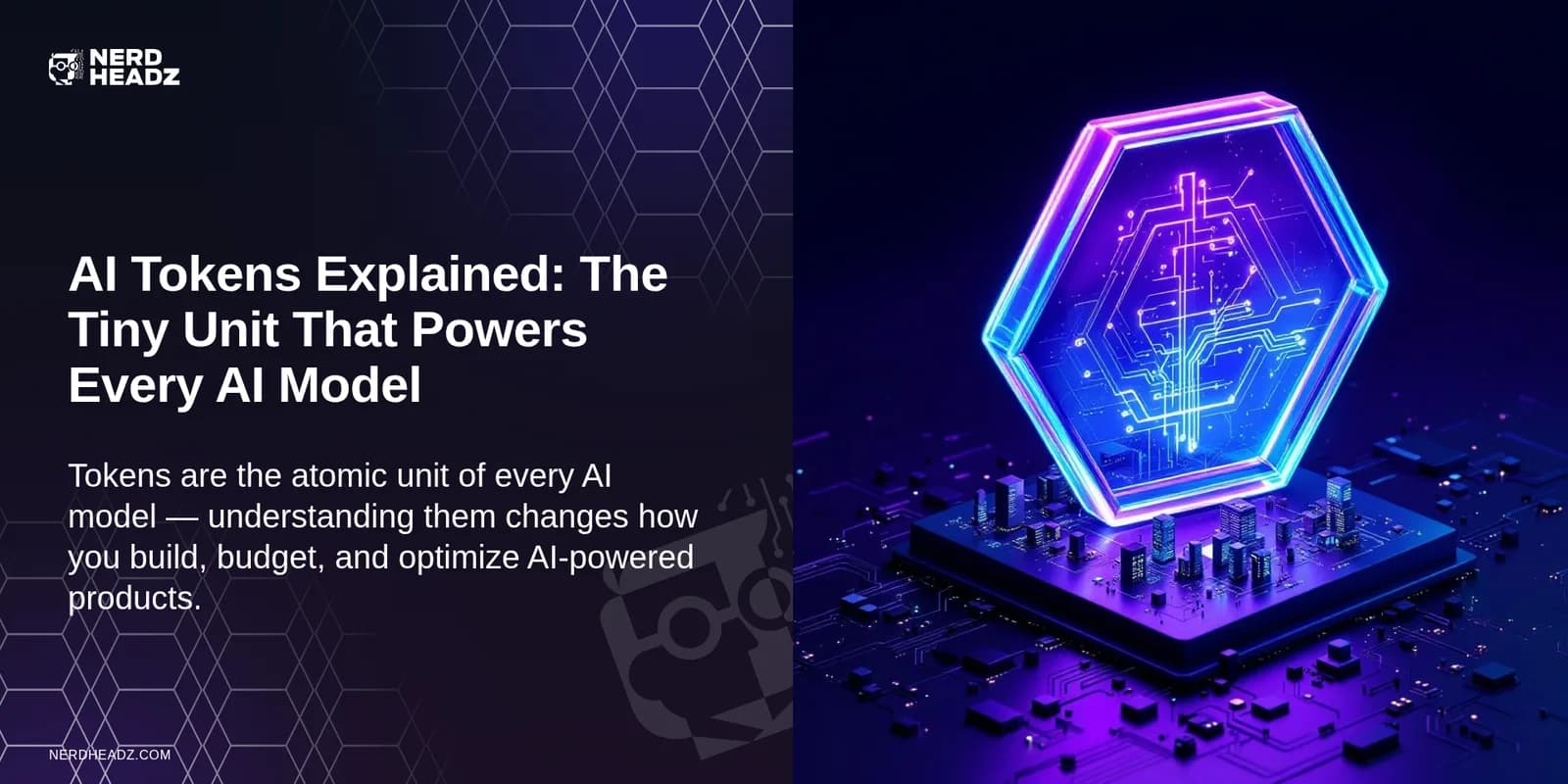
AI Tokens Explained: Why This Tiny Unit Runs Everything

If you've ever wondered why your OpenAI API bill fluctuates, why some prompts feel slow, or why a model seems to "forget" earlier parts of a long conversation, the answer almost always traces back to one concept: the AI token. Understanding tokens is not an academic exercise — it is the foundation of building AI products that actually perform in production.
The team at Turing Post recently published a solid primer on tokens, and it reinforced something we tell every client at NerdHeadz: you cannot make good architectural decisions on an AI project without understanding the unit the model actually operates on. So here is our practitioner's take on what tokens are, how they are formed, and why they matter the moment you start building.
---
What Is an AI Token?

An AI token is the smallest unit of text that a language model processes. It is not a word, a syllable, or a character — though it can overlap with any of those. A token is whatever chunk of text the model's tokenizer has learned to treat as a single processable unit.
Before any generation happens, your input text is broken into tokens, each assigned a numeric ID, and then converted into high-dimensional vectors. That is what the model actually "sees." There is no reading of meaning in a human sense — the model is doing mathematics on numerical representations of these chunks.
In practical terms for English: one token is roughly four characters, or about three-quarters of an average word. A sentence of 15-20 words typically produces around 20-30 tokens. But these are rough guides. The real count depends on the tokenizer, and it varies significantly across languages.
---
How Tokenization Works (And Why the Method Matters)

Tokenization is the process of converting raw text into those processable units. Modern AI systems almost universally use subword tokenization — a middle ground between splitting text word-by-word and character-by-character. This approach keeps vocabulary sizes manageable while still handling rare or invented words gracefully.
The three dominant methods in production systems are:
- Byte Pair Encoding (BPE) — used by GPT models. It iteratively merges the most frequent character pairs until it reaches a target vocabulary size.
- WordPiece — used by BERT. Similar to BPE but optimizes for the likelihood of the training data rather than raw frequency.
- SentencePiece — language-agnostic and treats the input as a raw byte stream, which makes it especially effective for non-Latin scripts.
The choice of tokenizer has downstream consequences. A rarer word like "tokenization" might be a single token in one model's vocabulary and split into token + ization in another. This changes how the model represents the concept internally — and can subtly affect output quality, especially for technical or domain-specific language.
Working on an AI integration and unsure which model architecture fits your use case? Talk to our team about your project.
---
Why Token Count Affects Everything You Care About

Tokens are not just a parsing detail — they are the operational unit that governs four things that matter enormously in production:
Context window. Every model has a maximum token limit for a single interaction — the context window. Exceed it and the model either truncates your input or throws an error. For complex document processing or long conversational flows, this becomes a real engineering constraint.
Speed. Models generate output one token at a time. More tokens in, more tokens out — slower responses. When we optimize inference latency for clients, token efficiency is always on the checklist.
Memory. Attention mechanisms scale with token count. Longer contexts require exponentially more compute to process. This is a core reason why large context windows are expensive to run.
Cost. Every major AI API bills by tokens — both input and output. A poorly designed prompt that includes redundant context can quietly double your API spend. We go deep on this in our guide to AI token taxonomy and API billing, which is worth reading before you finalize any production architecture.
---
The Language Gap Problem

Here is something that catches teams off guard: token counts are not equal across languages. English benefits from clear word boundaries (spaces) and a vocabulary built around common Latin-script subwords. The same sentence in Japanese, Arabic, or Chinese can require significantly more tokens to express.
This has real cost implications for any product serving multilingual users. It also affects quality — a model trained primarily on English text may have a less rich subword vocabulary for other languages, which can degrade reasoning performance.
When we scope AI development work that involves multilingual content, we always factor in a token overhead estimate per language group. It changes the architecture conversation early, which is far cheaper than discovering it after deployment.
---
Tokens as the Currency of AI

The phrase "token economy" is not metaphorical — it is literally how AI infrastructure is priced and allocated. Every major provider (OpenAI, Anthropic, Google, Cohere) publishes per-token pricing. Open-source models hosted on your own infrastructure shift the cost from per-token API fees to compute and memory, but token count still determines resource utilization.
Understanding token economics is also what separates teams that build AI features sustainably from those that hit unexpected cost cliffs at scale. Our AI development services always include a token budget analysis as part of the production readiness review — because an AI feature that works in demo but costs 10x what was projected is not a shipping feature.
---
Ready to build? NerdHeadz ships production AI in weeks, not months. Get a free estimate.
“Tokens are not just what an AI reads — they are the unit that determines cost, speed, memory, and context.”
Tokens are the atomic unit of every large language model — the lever that controls cost, speed, context, and quality all at once. Building AI products without understanding token mechanics is like optimizing a database without understanding indexes. Once you internalize how tokenization shapes model behavior, every architectural decision gets clearer.
FAQ
Frequently asked questions
What is an AI token in simple terms?
An AI token is a small chunk of text — typically a word fragment, whole word, or punctuation mark — that a language model uses as its basic unit of processing. Text is split into tokens before the model reads it, and models generate output one token at a time.
How many tokens is a typical word in English?
In English, one word is approximately one to one-and-a-half tokens on average. Common short words are usually one token, while longer or rarer words may be split into two or more subword tokens. A rough rule of thumb is 100 tokens per 75 words.
Why do AI API costs depend on token count?
AI APIs bill by the number of tokens processed — both the tokens in your prompt (input tokens) and the tokens in the model's response (output tokens). Longer prompts, verbose responses, and inefficient context management all increase token consumption and therefore cost.