Custom AI solutions and AI integration that ship to production
We design, build, and integrate custom AI into the software you already run: agents, RAG, and workflow automation that reach real users, not slide decks. 30+ in-house engineers. 60+ products shipped since 2022. Fixed-price scopes after a free discovery call.
We’re an engineering team that does AI work — not a consultancy that talks about it.
Every project ends with code in production, monitoring in place, and a runbook your team can read.
What are custom AI solutions?
Custom AI solutions are AI systems built around your data, your workflows, and the software your team already uses, instead of an off-the-shelf tool you bend your process to fit. A custom solution might be an assistant that answers from your own documentation, an agent that triages inbound requests and updates your CRM, or a pipeline that pulls structured data out of thousands of contracts. The model is only one piece. The rest is engineering: data access, retrieval, prompts, evaluation, permissions, monitoring, and the integration work that puts the output where people actually work.
Off-the-shelf AI is the right call when a SaaS product already does the job. Custom AI development makes sense when the value sits in your own data or process, when the AI has to act inside your systems rather than beside them, or when you need control over cost, privacy, and model choice. Part of discovery is telling you which side of that line you’re on.
What AI integration services include
AI integration services connect models like Claude, OpenAI GPT, and open-source LLMs to the applications, databases, and tools your business depends on, without rebuilding what already works. Most of our AI work is integration: adding an AI feature to a live SaaS product, putting an assistant inside an internal tool, or wrapping an automation layer around an existing workflow.
Product integration — AI search, drafting, summarization, and recommendations embedded in your web or mobile app, behind your existing login and permissions.
Systems integration — AI connected to your CRM, helpdesk, ERP, databases, email, and Slack through their APIs, so outputs land as records and actions instead of copy-paste.
Data integration — pipelines that index your documents, tickets, and transcripts for retrieval, with access controls that match who is allowed to see what.
Model integration — a provider-agnostic layer, so you can move between Claude, OpenAI, and open-source models as prices and quality change without rewriting the app.
AI implementation services: from pilot to production
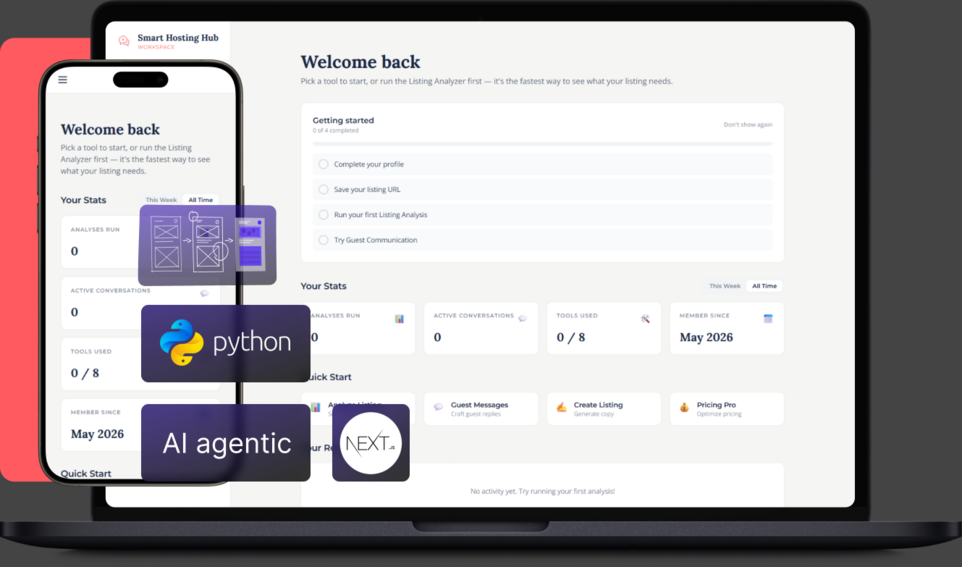
Plenty of teams already have an AI pilot: a notebook, a custom GPT, a demo that impressed the leadership meeting. AI implementation is the work that turns it into a system people rely on every day. That means evaluation against real inputs, human-in-the-loop checkpoints where judgment matters, cost and latency budgets, logging, failure handling, and a runbook for when the model gets it wrong. SmartHostingHub is a good example: eight ChatGPT custom GPTs rebuilt as a production AI SaaS with Stripe billing, live in about six weeks.
How we’re different:
vs. a freelancer — you get an engineering team, internal tooling, and a process refined across 60+ shipped products, not one person’s calendar.
vs. an in-house hire — you pay for the project scope, not a six-month salaried runway with no guarantee of delivery.
vs. enterprise “AI transformation” consultancies — we ship code. Our stack is Claude Code, TypeScript, Python, React, Next.js, and the AI APIs that best fit your problem.
Our AI implementation process
Every custom AI project follows the same four phases. The weight of each depends on how well-defined the problem is when you arrive.
1
Discovery
1–2 weeks
We learn the business problem, review your data and the systems the AI has to plug into, and identify the decision or task it needs to inform or automate. AI projects fail most often here, when the wrong problem gets scoped. You get: a scope document, an integration map, and a fixed-price quote.
2
Prototyping
1–2 weeks
We build a coded proof-of-concept against your real data, not a demo on synthetic inputs. If the output isn’t good enough, we tell you before the production build starts. You get: a working prototype and an honest go/no-go.
3
Build
3–8 weeks
Production integration with your software, human-in-the-loop safeguards, evaluation suites, and monitoring for drift and failure cases, deployed to your infrastructure or ours. You get: a production system, monitored and documented.
4
Handoff
1 week
Production deployment, monitoring dashboards, runbooks for common failure modes, and documentation engineers who weren’t on the build can read. You get: the keys, the docs, and a maintenance option.
End-to-end6–12 weeks
Not every project needs all twelve weeks. A single AI feature integrated into an existing app can ship in 3–4 weeks. Agent projects run on their own timeline: a single-purpose AI agent MVP takes 4–8 weeks and a multi-agent system 8–16 weeks, as covered on our AI agent development page.
Custom AI solutions we build
AI integrations into existing software
Claude, OpenAI, or open-source models embedded in the product or internal tool you already run (search, drafting, summarization, recommendations) without a rebuild.
Works well for: SaaS products adding AI features, legacy systems getting an AI assistant.
Pulling structured data out of PDFs, emails, contracts, invoices, and forms, then writing it into the system of record.
Works well for: finance ops, legal review, claims processing, KYC.
When custom AI actually delivers ROI
AI works well for a narrow set of problem shapes — and fails predictably on others. Here’s the honest breakdown.
✅ Works well
❌ Usually doesn’t work
Task shape
High-volume repetitive tasks where judgment is light — classification, extraction, triage, tier-1 support, content with review. Throughput up 5–10×.
Replacing expert judgment entirely. AI is an assistant, not a replacement — pretending otherwise is how AI projects get abandoned.
Data
Surfacing insights from unstructured data your team can’t read fast enough — ticket trends, call summaries, monitoring, research synthesis.
High-stakes decisions without review — medical, legal, hiring; anywhere errors are expensive and accountability matters.
Goal
Decision support where a draft with reasoning beats a blank page — drafting, summarizing, explaining, translating.
“AI transformation” as the goal. Transformation is marketing language, not a problem. We build AI into specific workflows.
Before we commit, we tell you which category your use case falls into. If it’s in the “doesn’t work” bucket, we say so. We’d rather lose the contract than ship you an AI system that fails in production.
The AI integration stack we build on
We pick the right tool per project. These are the ones we reach for most.
Why these? We integrate Claude through the Anthropic API and GPT models through the OpenAI API, and keep the model layer swappable. Supabase with pgvector keeps RAG simple: embeddings sit in the same Postgres tables as your relational data, and larger corpora move to a dedicated vector database. FastAPI is the Python sidecar pattern we use when AI work needs the Python ML ecosystem from a Node app. When an assistant needs to reach into your internal tools, we expose them through MCP, the Model Context Protocol.
Engagement models and pricing
Every custom AI engagement starts with a free scoping call, and discovery ends with a fixed-price quote. No T&M surprises during the build.
Fixed-price project
The default. Most custom AI projects fall between $15,000 and $150,000+, depending on scope, data complexity, and integration depth. The quote comes after discovery, when we know enough to stand behind it.
Focused service lines
If your project fits a narrower shape, the numbers on those pages apply: custom AI chatbots run $10,000–$80,000+ and AI-powered automations $5,000–$50,000.
Maintenance after launch
Optional, at a lower T&M rate than the build. Or hand off entirely, with runbooks and documentation your engineers can read.
You own everything
All code, prompts, evaluation suites, and infrastructure-as-code are yours. Where we use third-party APIs, you own the account and the billing relationship.
Need a small internal tool rather than an AI integration project? SelfWare is a separate, productized offering for dashboards, internal tools, and client portals, with its own scope and pricing.
Custom AI solutions by industry
The integration pattern changes by industry: HIPAA-aware data handling in healthcare, audit trails in fintech, grounding and human review in legal. These are the sectors we ship AI into most.
This system has been a dream of mine for almost a year. I have tried to build it myself and finally came to the conclusion I needed help. The NerdHeadz team has built me exactly what I was dreaming about and more! Working with them has been an absolute pleasure. I can't thank them enough.
Every person on your project writes code: 30+ in-house specialists across 16 countries, run from Sheridan, Wyoming since 2022. No account-manager layer between you and the people building.
02
Honest about fit.
We tell you when AI is the wrong answer. ~20% of scoping calls end with us recommending a non-AI solution or a different agency.
03
Fixed-price scopes.
After discovery, you get a fixed price. No T&M surprises during the build.
04
No lock-in.
A provider-agnostic model layer, code you own, and a system your team can extend with AI tools like Claude Code and Cursor.
Related AI services
Custom AI solutions is the umbrella. If your project has a narrower shape, one of these pages goes deeper:
AI agent development — the AI takes actions on its own: tool use, multi-step, agentic.
AI systems built around your own data, workflows, and software rather than an off-the-shelf tool. Typical examples are an assistant that answers from your internal documentation, an agent that triages requests and updates your CRM, or a pipeline that extracts structured data from contracts. The model is one part; the engineering around it (retrieval, evaluation, permissions, monitoring, integration) is what makes it work in production.
Most custom AI projects fall between $15,000 and $150,000+, depending on scope, data complexity, and integration depth. After discovery you get a fixed-price quote, so there are no T&M surprises during the build.
It depends on the shape of the integration. A single AI feature added to an existing app sits at the lower end of our $15,000–$150,000+ range. Custom AI chatbots run $10,000–$80,000+ and AI-powered automations $5,000–$50,000. Multi-system integrations with evaluation suites and human review sit higher. Discovery ends with a fixed price.
An AI assistant inside a SaaS product, AI-powered search over a company's documentation, automatic ticket triage in a helpdesk, invoice and contract data extraction written straight into an ERP, and agents that research leads and log the results in a CRM. In each case the AI works inside an existing system instead of in a separate chat window.
Most projects take 6–12 weeks end-to-end: 1–2 weeks discovery, 1–2 weeks prototyping, 3–8 weeks build, and 1 week handoff. A single AI feature integrated into an existing app can ship in 3–4 weeks. A single-purpose AI agent MVP takes 4–8 weeks; multi-agent systems take 8–16 weeks.
Yes, that is most of what we do. We add AI features to existing platforms (search, content generation, recommendations, automation) without breaking what already works. Common starting points are an AI assistant inside your SaaS app, AI-powered search over your content, or an automation layer around an existing workflow.
Often, yes. If your team already ships production software and the use case is narrow, a prompt plus an API call can go a long way, and we will say so on the scoping call. Teams usually bring us in when the hard parts show up: retrieval quality, evaluation, permissions, integration with systems of record, and keeping cost and failure rates under control once real users arrive.
Yes. All code is yours. All prompts, evaluation suites, and infrastructure-as-code are yours. Where we use third-party APIs such as Claude or OpenAI, you own the account and the billing relationship.
Let’s ship
Ready to scope your custom AI solution?
Tell us about the workflow, decision, or product you want AI to power. We’ll come back with a feasibility take, a recommended integration approach, and a fixed-price quote.