
Venture intelligence · B2B SaaS
PovNexus
The intelligence layer for venture investing — a B2B SaaS platform that turns fragmented company, market, and relationship data into grounded, decision-ready answers. Built for a venture-capital intelligence client.





- 4
- user roles
- 9
- development phases
- 500+
- E2E test cases
- 11
- core services
- 85%+
- launch pass rate
Technology stack
A modern, six-layer stack — enterprise SaaS capability on a no-code-anchored foundation:
The challenge
Venture investors drown in scattered, stale, and unstructured data. PovNexus set out to build enterprise-grade SaaS — on a no-code foundation — that could ingest the messy reality of the market and return grounded intelligence. Five roadblocks defined the build:
- 01Deliver enterprise-grade SaaS on a no-code foundation — without hitting the usual scaling and performance ceilings.
- 02Pull reliable, fresh data from many fragmented sources (Crunchbase, LinkedIn, VC sites, news) and keep it enriched and current.
- 03Make AI outputs trustworthy enough to inform investment decisions — grounded in real data, not hallucinated.
- 04Serve four very different audiences (investors, startups, corporate VCs, public) from one platform with the right access for each.
- 05Hold a high quality bar across 11 core services and a large surface area, verified before launch.
The solution — a 9-phase build
We delivered PovNexus across nine development phases, including a mid-build re-architecture from a single-tenant to a multi-tenant model so one platform could serve four distinct audiences cleanly.
- Phase 0Discovery & scopeFrame the venture-intelligence problem, the four roles, and the data model.
- Phase 1Data architectureDesign ingestion and the Supabase (PostgreSQL + pgvector) store for structured + vector data.
- Phase 2Core platformBuild the Bubble + Vercel application shell, auth, and the index/search foundation.
- Phase 3Enrichment pipelineWire Apify, SERP APIs and Tavily through Inngest + n8n to keep records current.
- Phase 4AI agent reasoningBuild the multi-hypothesis agent with vector / SQL / web tools and an iteration budget.
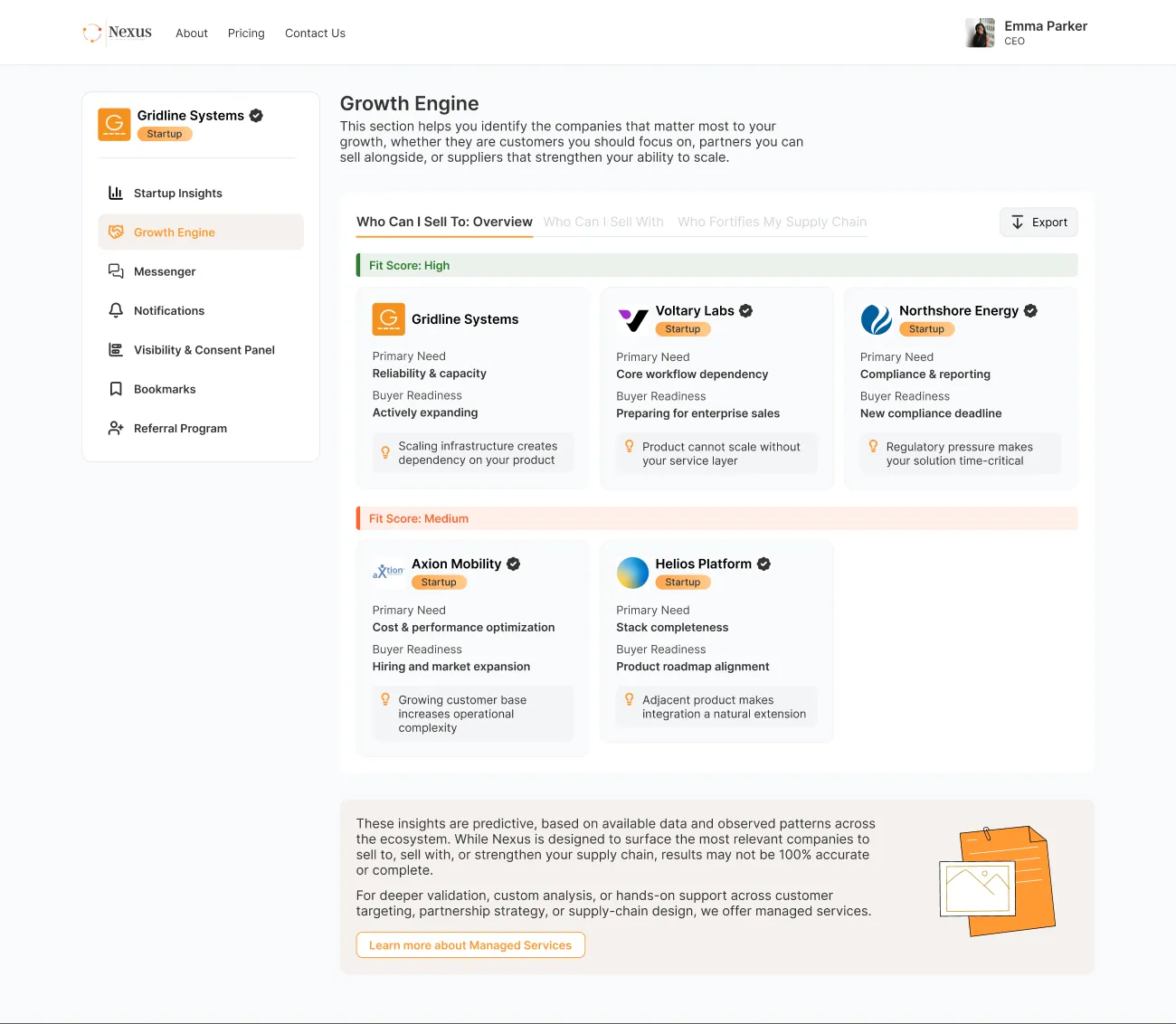
- Phase 5Growth EngineAdd the three weighted commercial lenses and ranked company output.
- Phase 6Single → multi-tenant pivotarchitecture pivotMid-build, re-architect from single-tenant to multi-tenant to serve all four roles cleanly.
- Phase 7Integrations & adminStripe, Mailgun, OAuth (Google + LinkedIn), notifications, and the admin surface.
- Phase 8QA — 500+ E2ERun 500+ end-to-end test cases across the 11 core services to the launch bar.
- Phase 9Launch & expansionShip live, then continue post-launch expansion.
Key features
Discovery & intelligence
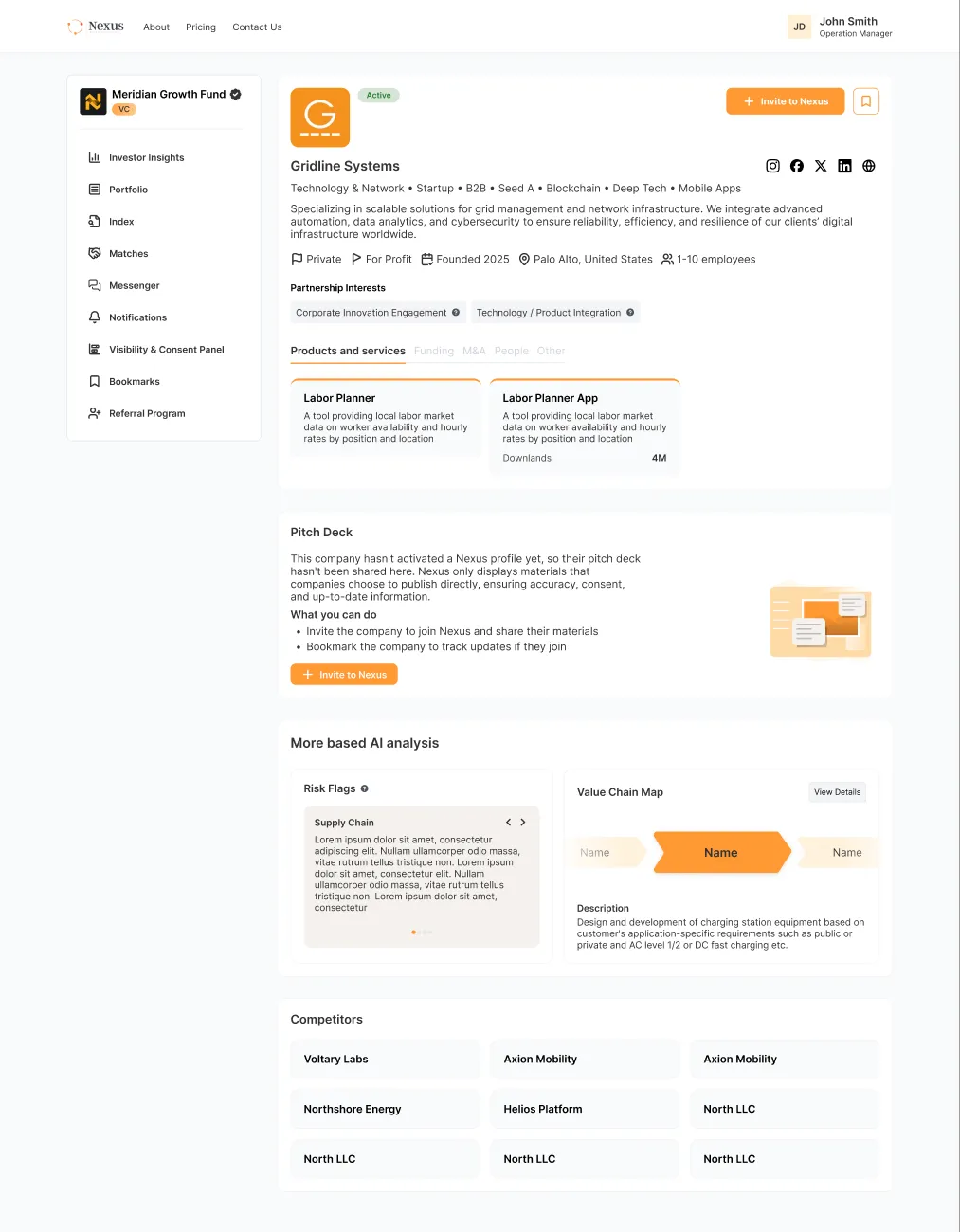
- Company index with AI-grounded profiles
- Value-chain mapping & risk flags
- Structured + vector search across sources
AI-driven features
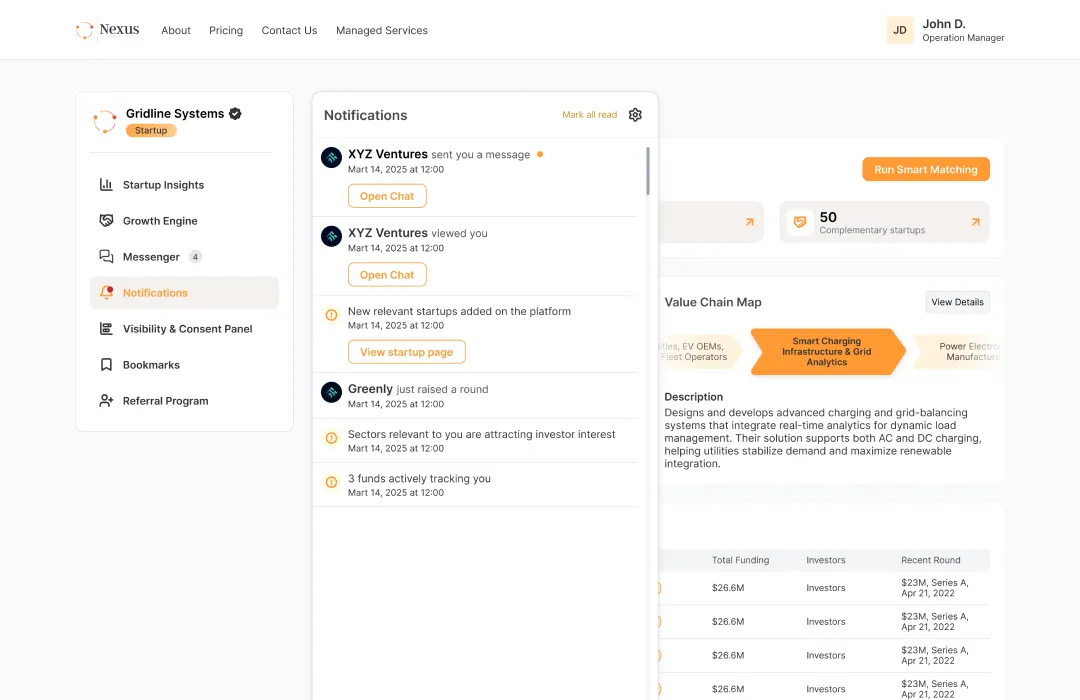
- Multi-hypothesis agent reasoning
- Smart matching & notifications
- Grounded, source-backed answers
Portfolio & collaboration
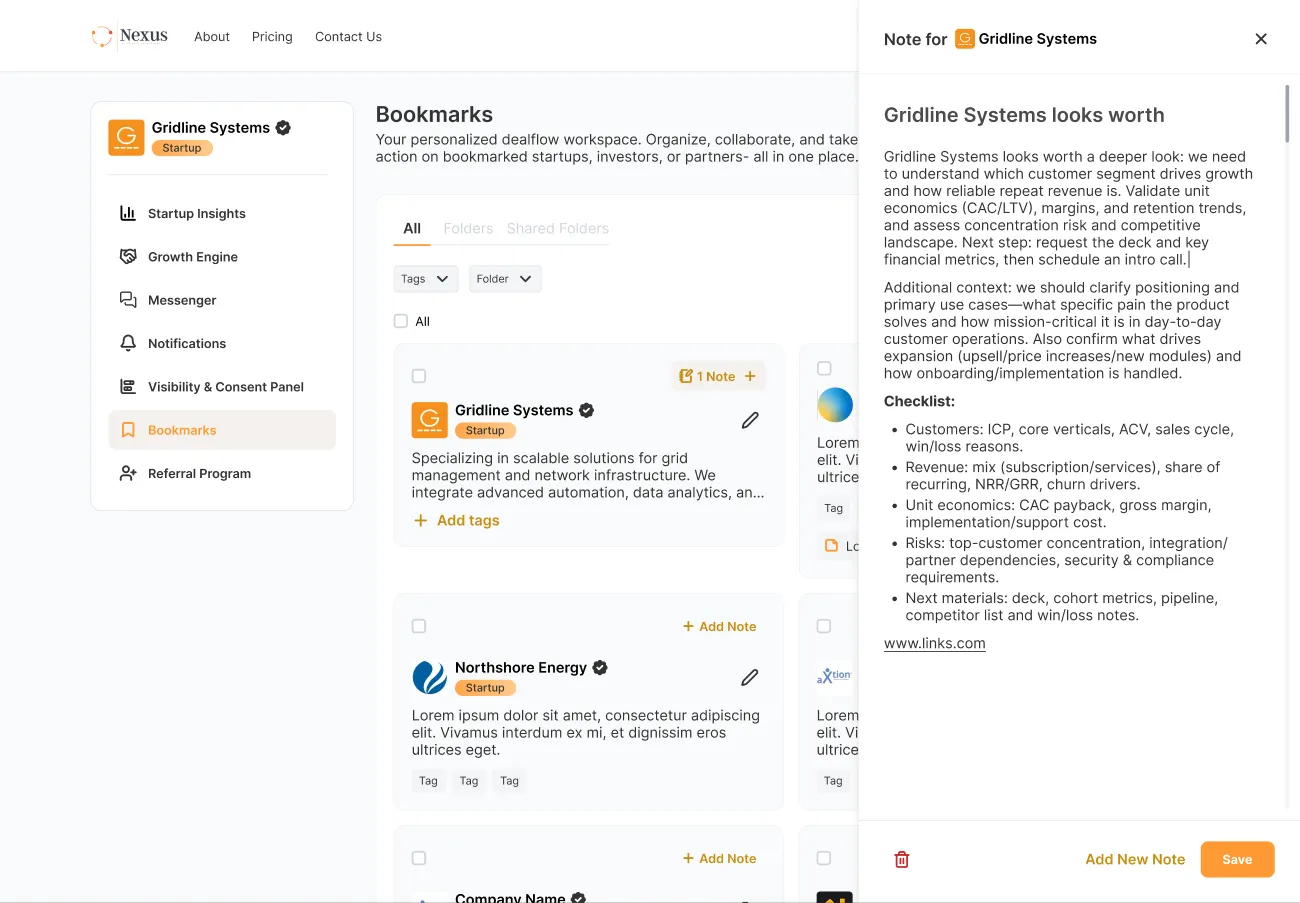
- Investor & startup profiles
- Bookmarks, views and shared notes
- Consent-aware visibility controls
Platform & admin
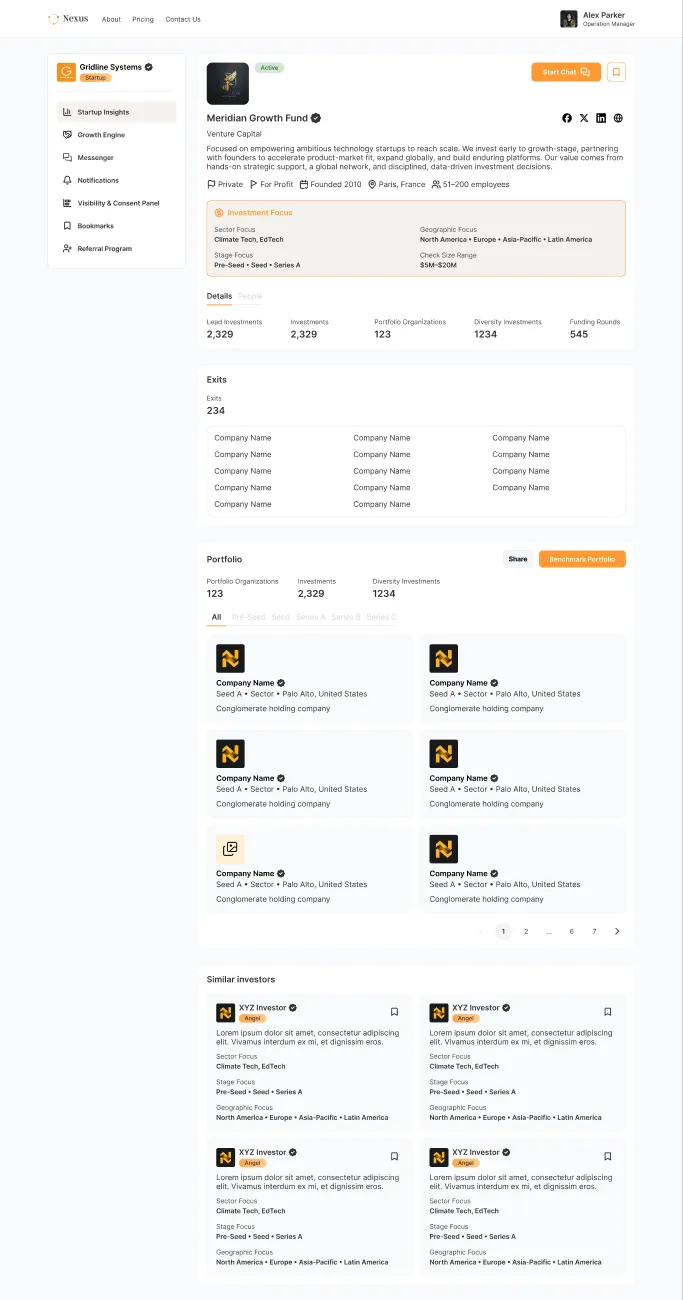
- Four role-based experiences
- Visibility & consent panel
- Stripe billing & OAuth sign-in
AI agent architecture
At the core is a multi-hypothesis reasoning agent. It detects question complexity, plans transparently, and works an iteration budget of up to 15 loops — pulling from three tool types until it’s confident: vector search over embeddings, structured SQL over the database, and live web search. Simpler questions resolve in one or two iterations; deep ones run the full budget.
- Transparent plan
- Complexity detection
- Iteration budget (1–15)
The Growth Engine
The Growth Engine ranks companies through three commercial lenses — who to sell to, who to sell with, and supply-chain relevance — each scored on weighted criteria, then synthesised into a ranked, explainable output.
- Value-chain dependency30
- ICP match25
- Buyer readiness25
- Proof from peers20
- Co-sell partners
- Channel & resellers
- Bundling
- Integration-ready
- Criticality35
- Stage relevance25
- Reliability20
- Risk reduction10
Data architecture
Raw sources are ingested, enriched, and stored once, then reused everywhere — from agent reasoning to the computed outputs each role sees.
Quality assurance
Quality was a first-class deliverable: 500+ end-to-end test cases spanning the 11 core services, run to an 85%+ launch pass rate before go-live — the bar that let enterprise-grade software ship on a no-code-anchored foundation with confidence.
Results delivered
- A live venture-intelligence platform serving four user roles from one codebase.
- An AI agent that returns grounded, source-backed answers — not hallucinations.
- A Growth Engine that turns raw company data into ranked, explainable go-to-market targets.
- A multi-tenant architecture proven across 11 core services and 500+ E2E test cases.
What made it distinctive
Enterprise SaaS delivered on a no-code-anchored stack, with a grounded multi-hypothesis AI agent and a weighted Growth Engine at its core.
Challenges overcome
Reliable multi-source enrichment, a mid-build single→multi-tenant pivot, and AI accuracy good enough to inform investment decisions.
Lessons learned
Decide the tenancy model early; ground every AI answer in real data; and treat a large E2E test suite as the price of shipping enterprise SaaS fast.
Who built it
Project management
Tijana Evstratiev
Development
Alesya Marova · Anastasia Volkova · Nikita Shurov · Igor Tomas
QA
Andrian Syahputra
Design
Maria Kulkina
Frequently asked questions
What is PovNexus?
PovNexus is the intelligence layer for venture investing — a B2B SaaS platform NerdHeadz built that turns fragmented company, market, and relationship data into grounded, decision-ready answers, served to four user roles from one platform.
What is PovNexus built with?
A modern six-layer stack: Bubble.io, Vercel and TypeScript on the frontend; Python with Supabase (PostgreSQL + pgvector) on the backend; OpenAI, Anthropic and Google Gemini via the Vercel AI SDK; Inngest and n8n for workflows; Apify, SERP APIs and Tavily for data enrichment; Stripe and Mailgun for payments and email.
How does the AI agent stay accurate?
A multi-hypothesis reasoning agent grounds every answer in three tool types — vector search, structured SQL, and live web search — working an iteration budget of up to 15 loops until it is confident. Answers are evidence-backed rather than hallucinated.
What is the Growth Engine?
The Growth Engine ranks companies through three weighted commercial lenses — who to sell to, who to sell with, and supply-chain relevance — and synthesises them into a ranked, explainable output.
Who is PovNexus for?
Four roles are served from one multi-tenant platform: investors, startups, corporate VCs, and the public — each with its own role-based experience.
Is PovNexus live?
Yes — it is live with ongoing post-launch expansion. The engagement started September 2025 and was delivered across nine development phases, with 500+ end-to-end test cases run to an 85%+ launch pass rate.
Let’s build something
See PovNexus live
Explore the live product, or talk to us about building something like it.