How traditional ERP projects end
Roughly two in three traditional ERP projects miss their objectives. Around half fail on the first attempt entirely.
Source: Gartner via Rand Group; RubinBrown ERP Advisory.
55–75% of traditional ERP projects miss their objectives, and many run 300–400% over budget. We build your operational backbone the opposite way — module by module, each one delivering value before the next phase begins. No $2M big-bang go-live. No betting the company on one launch date.
ERP projects don’t usually fail because of bad code. They fail because they try to replace an entire company’s operations in one terrifying go-live — betting the business on a single launch date.
The numbers are sobering. Gartner puts the ERP failure rate at 55–75%. The landmark McKinsey–Oxford study of 5,400 large IT projects found they deliver, on average, 56% less value than predicted — and 17% go so badly they threaten the company’s existence. More than half of companies experience operational disruption when a new ERP goes live: payroll breaks, orders don’t fulfill, the business limps for months.
The root cause is almost never technical. It’s the big-bang model — design everything, build everything, migrate everything, then flip one switch. By the time the failure shows up, you’ve spent two years and several million dollars, and rolling back isn’t an option.
We build the opposite way. One module at a time, each delivering value before the next begins. Start with the operational pain that’s costing you most — inventory, dispatch, procurement, financial reporting — ship it, prove it works, then add the next module. No single go-live can sink the project, because there is no single go-live. The system grows into your operations instead of being dropped on top of them.
Three published data points on why traditional ERP is the riskiest software project a business undertakes — and why the modular alternative changes the math.
Roughly two in three traditional ERP projects miss their objectives. Around half fail on the first attempt entirely.
Source: Gartner via Rand Group; RubinBrown ERP Advisory.
Traditional ERP projects routinely cost 3–4× the original budget, run ~30% longer, and deliver barely 44% of the value promised. The gap between the pitch and the outcome is the category’s defining problem.
Source: NetSuite/Panorama (budget); McKinsey–Oxford (44% value); RubinBrown (timeline).
The custom modular approach delivers the first working module in 6–12 weeks — value arrives before a traditional ERP project has finished its discovery phase.
Source: ERP Research Implementation Cost Breakdown 2026; NerdHeadz internal data.
We never ask you to replace your whole operation in one launch. Each module ships, proves its value, and earns the next. Here’s how a custom ERP grows.
We don’t begin with "finance" because the textbook says so. We begin with whatever is costing you the most right now — the inventory chaos, the dispatch bottleneck, the procurement approval mess. The first module pays for itself fastest.
Every module ships as a working tool your team can use immediately, not a fragment waiting for the rest of the system. If we only ever built one module, it would still be worth it.
As each new module ships, it integrates with the ones already live — shared data model, single source of truth, no silos. The system becomes more valuable with each phase, but no phase depends on a future one to function.
Because there’s no big-bang dependency, you’re never locked into finishing. Ship three modules, run them for a quarter, decide whether the fourth is worth it. The risk profile is the opposite of a traditional ERP commitment.
Three honest paths. The right one depends on your size, complexity, and appetite for risk.
| SAP / Oracleenterprise | NetSuitemid-market | Custom modularNerdHeadz | |
|---|---|---|---|
| Best for | $1B+ enterprises, standardized global processes | Mid-market with fairly standard operations | Unusual workflows, SMB–mid-market, operational platforms |
| Cost | $1M–$5M+ | $200k–$500k | $80k–$400k |
| Time to first value | 12–24 months | 4–9 months | 6–12 weeks per module |
| Failure risk | High (55–75% miss objectives) | Moderate (85% success w/ consultants) | Low — no big-bang dependency |
| Fits your exact workflow | ✗ You adapt to it | ◐ Configurable, not custom | ✓ Built around how you run |
| Per-user / license fees | High, ongoing | Moderate, ongoing | None — you own it |
| You own the code | ✗ | ✗ | ✓ |
| Ongoing flexibility | Slow, consultant-gated | Moderate | High — add modules anytime |
| Verdict | For true global enterprises | For standard mid-market ops | For unusual ops + risk-averse builds |
If your operations are standard and you’re mid-market, NetSuite (with an experienced partner) is often the right call — and we’ll tell you so. Custom modular wins when your workflows are genuinely unusual, when you’ve been burned by a big-bang ERP, or when the ERP is really an operational platform specific to your business.
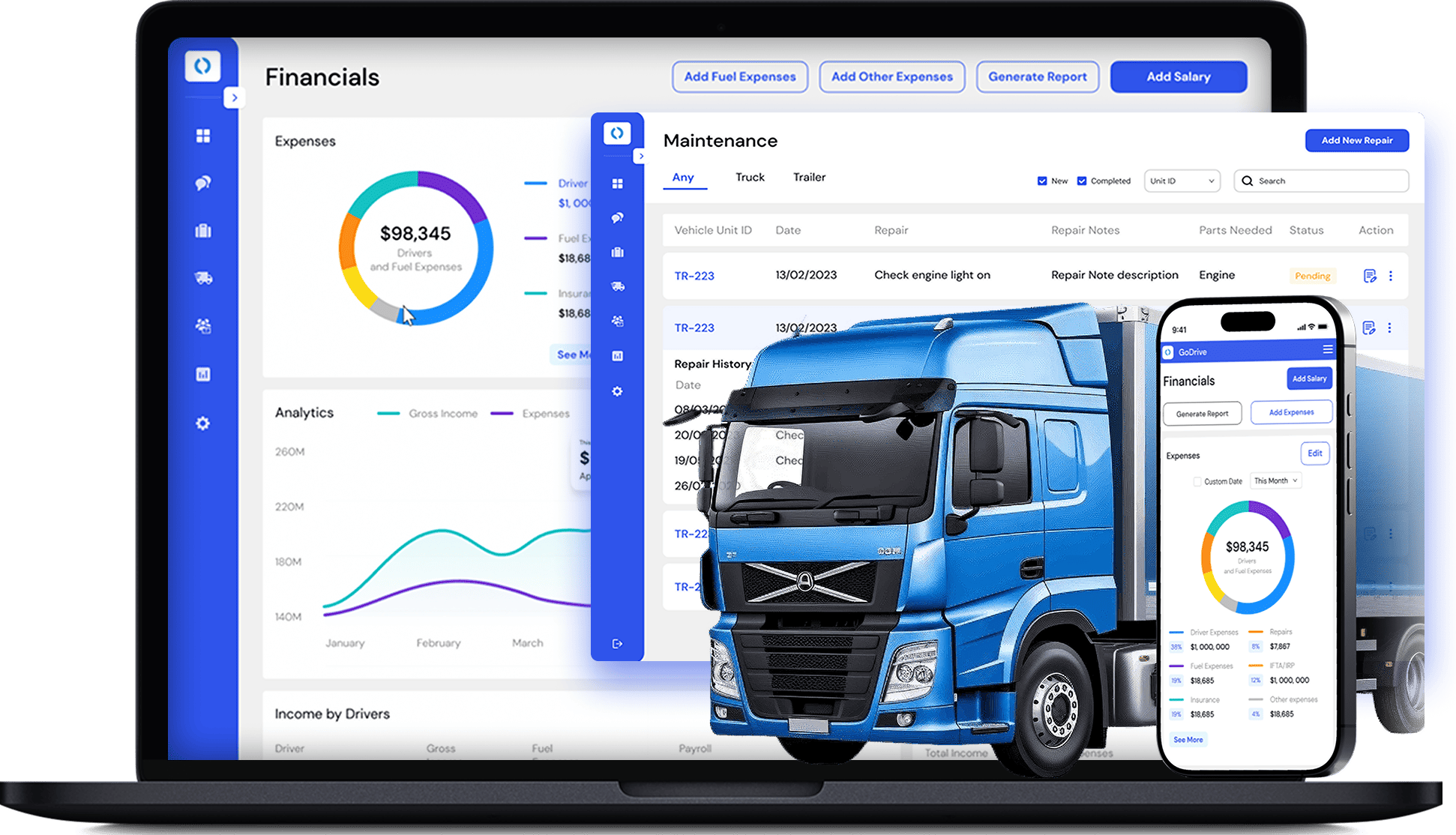
Trucking88 didn’t set out to "buy an ERP." They needed to run a trucking operation — and no off-the-shelf ERP modeled how dispatch, driver payroll, fleet maintenance, and invoicing actually connect in that business. So we built it: a custom operational platform that is, functionally, a purpose-built ERP for trucking.
Pick the ones that solve your biggest operational pain first. Add the rest as they earn their place.
General ledger, accounts payable/receivable, financial reporting, multi-currency, tax compliance — integrated with the operational data that drives it.
Real-time stock levels, multi-location visibility, automated reorder points, warehouse management, demand planning.
Purchase orders, vendor management, approval workflows, procurement-cycle reduction.
Production scheduling, bill of materials (BOM), quality-control tracking, resource capacity planning.
The operational core specific to your business — dispatch, scheduling, field coordination, service management.
Employee records, payroll calculated from operational data, attendance, leave — as a module, not a separate system.
Pipeline, contacts, deals — the customer-facing module of the operational backbone.
Cross-departmental dashboards, real-time analytics, predictive insights. AI for anomaly detection and natural-language operational queries, built with Claude.
We pick per project — off-the-shelf where it wins, custom where it must.
If your operations are standard — typical manufacturing, distribution, or services workflows that thousands of companies share — and you’re mid-market size, a well-implemented NetSuite or Acumatica (with an experienced partner) is often the better call. Those platforms have decades of refinement and 85% success rates when implemented with consultants. We won’t build you a custom version of something that already fits.
Custom modular ERP wins in three situations: your operations are genuinely unusual and no off-the-shelf platform models them; you’ve already been burned by a failed big-bang implementation and need a lower-risk path; or your "ERP" is really a purpose-built operational platform specific to your industry — like a dispatch system with finance and payroll built in. We’ll tell you honestly which situation you’re in before quoting.
On shipping systems their teams run the whole business on — module by module.
This system has been a dream of mine for almost a year. I have tried to build it myself and finally came to the conclusion I needed help. The NerdHeadz team has built me exactly what I was dreaming about and more! Working with them has been an absolute pleasure. I can't thank them enough.
We ship one module at a time, each delivering value before the next begins. No betting the company on a single go-live. The risk profile is the opposite of a traditional ERP project.
When your "ERP" is really a purpose-built operational system — dispatch with finance and payroll built in — we build the whole thing around how your business actually runs. We did exactly this for Trucking88.
If your operations are standard and a well-implemented NetSuite fits, we’ll say so. We don’t build custom versions of platforms that already work for your case.
Your operational system, your data, your infrastructure. No per-user licensing that scales forever, no consultant-gated changes. Any engineer can extend it after handoff.
Gartner puts the failure rate at 55–75%. The root cause is almost never technical — it’s the big-bang model: design everything, build everything, migrate everything, then flip one switch. By the time problems surface, you’ve spent years and millions, and rolling back isn’t an option. The McKinsey–Oxford study of 5,400 projects found they deliver 56% less value than predicted. We avoid this by building one module at a time, each delivering value before the next begins.
SAP S/4HANA enterprise rollouts run $1M–$5M+ and take 12–24 months. A custom modular ERP runs $80k–$400k and delivers its first working module in 6–12 weeks. You pay only for the modules you need, with no per-user license fees that scale forever. For SMB and mid-market businesses, a custom ERP gives you exactly what you need at a fraction of the total cost.
The first usable module ships in 6–12 weeks. A focused system with 2–3 modules: 3–6 months. A full operational platform with many modules: 6–12 months — but you’re using and getting value from each module as it ships, not waiting until the end. We deliver in phases specifically to avoid the failure mode that defines big-bang ERP.
Instead of replacing your whole operation in one go-live, we build one module at a time — starting with whatever operational pain costs you most. Each module ships as a working tool, proves its value, then earns the next. No single launch can sink the project, because there’s no single launch. The system grows into your operations instead of being dropped on top of them.
Yes, that’s often the goal — consolidating spreadsheets, standalone tools, and legacy systems into one unified platform. We also support hybrid approaches where the custom ERP integrates with tools you want to keep (your accounting software, an existing NetSuite instance, industry-specific systems).
When your operations are standard (typical manufacturing, distribution, or services workflows) and you’re mid-market or larger, a well-implemented NetSuite or Acumatica with an experienced partner is often the better call — those platforms have 85% success rates with consultants. Custom modular wins when your operations are genuinely unusual, when you’ve been burned by a failed implementation, or when your ERP is really a purpose-built operational platform.
Our clearest example is Trucking88 — a custom operational platform for trucking that’s functionally an ERP: dispatch, invoicing, driver payroll, fleet maintenance, built-in chat, and multi-tier admin, all in one system built around how a trucking business actually runs. Shipped module by module on Bubble.
Yes. We build multi-location inventory visibility, multi-currency financial handling, and multi-entity support into the modules that need them. This is one of the areas where custom development shines — modeling the exact multi-location/multi-entity structure of your business rather than forcing it into a template.
Because the system is modular and you own the code, adding or changing modules is straightforward — no consultant-gated change requests, no per-change licensing. As your business evolves, the ERP evolves with it. Your team can extend it with Claude Code or Cursor after handoff, or we stay on retainer.
Carefully and incrementally — which is another advantage of the modular approach. Instead of migrating all your data at once (a major source of big-bang failures), we migrate per module as each ships. We map fields, validate everything, and run the old and new systems in parallel during transition so nothing breaks.
You do. Full repository access, your infrastructure, your data. No per-user license fees, no vendor lock-in, no consultant dependency for changes. Any engineer can pick up the codebase after handoff.
Yes. Common AI features: anomaly detection (flagging unusual transactions or inventory movements), natural-language operational queries ("show me overdue invoices from logistics vendors"), demand forecasting, and document processing. We build these with Claude in the loop. AI works best as an analytical layer on top of clean operational data — which the unified ERP provides.
30-minute scoping call. Tell us where your operations hurt most — the inventory chaos, the dispatch bottleneck, the financial blind spots. We'll recommend the first module to build, a phased roadmap, and a fixed-price quote. Or we'll tell you NetSuite is the better call.