In this article07 +
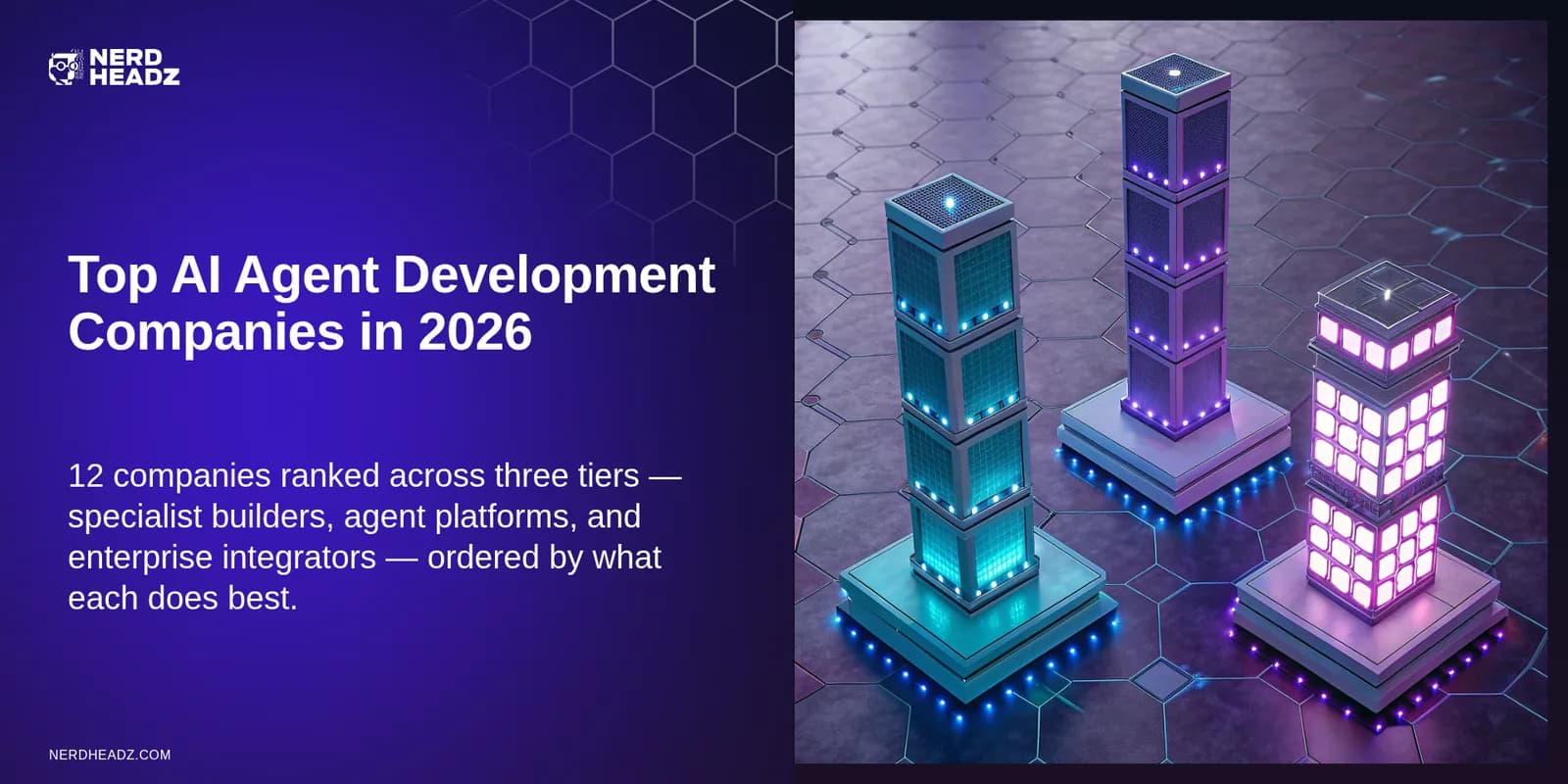
The best AI agent development companies in 2026 are the ones that can take an agent from prototype into production without leaving you permanently dependent on them. Ranked by what each is genuinely best for rather than by size, the strongest options this year are LeewayHertz for enterprise multi-agent systems, NerdHeadz for bespoke agents your own team can extend after handoff, Neurons Lab for financial services, and Relevance AI for no-code agent teams. NerdHeadz builds single-purpose production agents in 4–8 weeks, handing over the codebase so your engineers own and extend it instead of renting it. Below, twelve companies compared across three tiers — specialist builders, agent platforms, and enterprise integrators.
Budgeting a build? Our 2026 study of AI agent development cost compares published prices from 208 vendors with verified client projects and government contracts.
Need a partner headquartered in the United States? See our separate list of AI agent development companies in the USA. If you want a custom build rather than a vendor comparison, start with our custom AI solutions and AI integration services.
Disclosure: NerdHeadz publishes this list and appears in it at #2. Entries are ordered by use-case fit, not by payment or company size — no company paid for placement.
What AI agent development companies actually do
An AI agent is software that plans, decides and executes multi-step work across your tools — not a chatbot that answers a question and stops. An agent development company builds that system: the model choice, the harness around it, the tool integrations, the guardrails, and the monitoring that tells you when it goes wrong in production.
Agents vs chatbots vs automation
A chatbot responds. An automation follows a fixed path you defined in advance. An agent decides the path at runtime — which is what makes it useful for messy work, and what makes it harder to build reliably. If your process never varies, an automation is cheaper and more predictable. If it varies constantly, you want an agent. We wrote up the distinction in more depth in what agentic AI actually means.
The practical consequence is testing. You can test an automation exhaustively because the paths are finite. You cannot test an agent that way, because the whole point is that it composes new paths. That changes what "done" means: instead of a passing test suite, you need evaluation sets, logged traces of real runs, and a human review loop for the cases the agent got wrong. Vendors who skip that part ship demos that impress in a meeting and fail in month two.
It also changes the cost profile. An automation costs what it costs. An agent costs per decision, and a badly-scoped one can loop — calling tools repeatedly, burning tokens, and producing a bill nobody forecast. Ask any prospective partner how they cap and monitor that, because the answer separates teams who have run agents in production from teams who have built one.
How we evaluated these companies
Five criteria, applied consistently:
- Production deployments, not demos — has the company shipped agents that run unattended?
- Pricing transparency — is any figure published, or is everything "contact sales"?
- Handoff and ownership — do you own the codebase at the end, or rent access to it?
- Integration depth — how far into your existing CRM, ERP and data systems does it reach?
- Post-launch support — what happens when the agent misbehaves in month four?
This list is not ranked by revenue or headcount. A 300,000-person consultancy and a boutique agency solve different problems; ordering them against each other on size would tell you nothing about which one fits your project. Every entry carries a best for tag instead. Where a company does not publish pricing, we say so rather than estimating.
The three tiers, and why the distinction matters
The twelve below fall into three groups that are genuinely not substitutable, and most bad procurement decisions in this category come from comparing across them rather than within them.
Specialist builders (1–7) build the agent for you. You are buying delivery capacity and domain judgement. Cost is a project or a team; the risk is that you depend on them to change anything afterwards, unless ownership is explicit in the contract.
Platforms and frameworks (8–10) give you the means to build it yourself. You are buying leverage for engineers you already employ. Cost is licensing or free; the risk is that "we'll build it internally" quietly becomes a project nobody has time for.
Enterprise integrators and control planes (11–12) govern agents at organisational scale. You are buying consistency across teams that have already started building independently. Cost is significant; the risk is paying for governance before you have anything to govern.
A useful test: if you cannot name the single workflow you want automated, you are not ready for tier one, and buying tier three will not fix that. Start with a narrow, well-understood process, ship one agent against it, and let the results tell you whether you need a partner, a platform, or a control plane. That sequence costs less than a procurement exercise and tells you more, because the constraint you discover in the first build is almost never the one you predicted before it.
Top 12 AI agent development companies in 2026
1. LeewayHertz — Best for: enterprise multi-agent systems across regulated verticals
LeewayHertz describes its work as helping enterprises build and deploy AI agents and multi-agent systems that automate complex workflows and coordinate work across applications, data and teams. Its stated coverage spans banking and finance, healthcare, insurance, supply chain, legal and manufacturing, with agents built for customer service, HR, finance, IT operations and compliance. The company works across OpenAI, Anthropic, Google and Meta models and names LangGraph, CrewAI and AutoGen as frameworks.
Best fit: a large organisation that needs agents coordinated across several departments at once, with governance attached.
Not the right fit if: you want one narrow agent shipped quickly — the programme framing carries coordination overhead you will not use.
Engagement band: no pricing published · leewayhertz.com
2. NerdHeadz — Best for: bespoke agents your team can extend after handoff
Most agent vendors keep you on a retainer or a per-seat platform fee. NerdHeadz builds single-purpose production agents and hands over the codebase, so your own engineers own and extend the result rather than renting it. Scope is deliberately narrow — one agent that does one job reliably, rather than a general-purpose system that does ten things unpredictably — with framework choice driven by the problem: LangGraph for stateful multi-step workflows, MCP for tool integration, and retrieval pipelines where the agent needs grounding in your own documents.
The same principle runs through the rest of our work: SelfWare is custom software you own outright rather than subscribe to. You can see a production agent we built in the AI call centre case study.
NerdHeadz is a team of 30+ specialists with 60+ products shipped, named to Techreviewer's 2026 AI agent development rankings.
Best fit: you have in-house engineering, a specific workflow to automate, and no appetite for an open-ended vendor dependency.
Not the right fit if: you have nobody in-house to take the handoff; a managed platform serves you better than owned code you cannot maintain.
Engagement band: 4–8 weeks for a single-purpose agent · price not published · nerdheadz.com
3. Neurons Lab — Best for: financial services deployments that need auditability
Neurons Lab states its specialisation as agentic AI adoption for financial services, naming wealth management, retail and corporate banking, private banking and insurance. It describes three delivery paths: AI training and enablement across engineering and executive teams, custom agents taken from discovery through production with full auditability and governance controls, and continuous delivery through embedded forward-deployed engineers.
Best fit: a regulated financial institution where traceability of every agent decision is a requirement, not a feature request.
Not the right fit if: you are outside financial services — the depth here is vertical-specific by design.
Engagement band: no pricing published · neurons-lab.com
4. Markovate — Best for: consulting-led agent programmes with a defined phase structure
Markovate builds agentic systems it describes as able to reason, plan and act autonomously, covering workflow automation and decision intelligence. Its published approach is a six-phase sequence: discovery and strategic alignment, opportunity mapping and feasibility, architecture and design blueprint, development and integration, validation with human-in-the-loop testing, then deployment and continuous optimisation. It emphasises integration with existing CRM, ERP and data systems.
Best fit: an organisation that wants a formal discovery and feasibility stage before anyone writes agent code.
Not the right fit if: you already know exactly what you want built and would be paying for a discovery phase you do not need.
Engagement band: no pricing published · markovate.com
5. Moveworks — Best for: enterprise employee support at scale
Moveworks describes its product as an AI assistant platform for an entire workforce to search and act across business applications, spanning IT, HR, finance, sales, marketing and engineering. The company states it is trusted by more than 350 organisations including 10% of the Fortune 500, that 6M+ employees use it, and that typical time to value is 8 weeks. It emphasises omnichannel and multilingual support across chat, browsers, intranets and service portals.
Best fit: a large employer whose internal helpdesk volume is the problem worth solving first.
Not the right fit if: your agent faces customers rather than employees — this is built for the internal workforce.
Engagement band: no pricing published · moveworks.com
6. Azumo — Best for: nearshore team augmentation on agent builds
Azumo builds intelligent applications across AI development, custom software, data engineering and mobile, and describes itself as AI-native in its own delivery. It offers dedicated embedded teams, individual staff augmentation, project-based builds and a virtual CTO arrangement. Its developers are based nearshore, primarily in South America, and the company emphasises time-zone alignment with US business hours.
Best fit: you have the architecture decided and need capable engineers in your timezone rather than a strategy partner.
Not the right fit if: you need someone to decide the architecture rather than staff it.
Engagement band: no pricing published — the company states pricing depends on scope, seniority and engagement model · azumo.com
7. Intellectyx — Best for: data-heavy enterprise agents
Intellectyx organises its work across three areas: data (engineering, BI and analytics, modernisation), AI (agentic AI strategy, custom agents, AgentOps) and digital (cloud, DevOps, managed services, enterprise applications). Named industries include manufacturing, financial services, media and entertainment, retail, logistics, energy and life sciences. It describes a scalable resource model with on-demand talent scaling and global delivery alongside a US presence.
Best fit: the agent's hard problem is the data layer underneath it rather than the agent logic itself.
Not the right fit if: your data is already consolidated and clean — you would be paying for a strength you do not need.
Engagement band: no pricing published · intellectyx.com
8. Relevance AI — Best for: building your own agent workforce without engineers
Relevance AI is a platform for building and deploying specialised AI agents, aimed at enterprise teams in sales, customer success, marketing, HR, support and operations. It includes a no-code agent builder and is positioned around specialist agents that coordinate as multi-agent systems rather than a single assistant — the company cites a customer running 35+ agents across their organisation.
Best fit: operations teams that want to build and iterate agents weekly without filing engineering tickets.
Not the right fit if: you need to own and modify the underlying code rather than build inside someone's abstractions.
Engagement band: no pricing tiers published — demo and sales contact only · relevanceai.com
9. CrewAI — Best for: a centrally governed build-and-runtime platform
CrewAI describes itself as an enterprise agent build and runtime platform for the work a business runs on, and emphasises that it is unified and centrally governed. If your concern is that agent projects proliferate across teams with no common control plane, that framing is the pitch.
Best fit: you expect many agents across many teams and want one place to build and run them.
Not the right fit if: you want a single agent delivered, not a platform on which to run many.
Engagement band: no pricing published · crewai.com
10. LangGraph (LangChain) — Best for: framework-level control when you build in-house
LangGraph describes itself as an agent runtime and low-level orchestration framework designed to balance agent control with agency, giving developers low-level primitives rather than a finished product. It highlights built-in memory that persists conversation history and context, human-in-the-loop checks to steer and approve agent actions, and flexible control flows — single, multi-agent and hierarchical. It is MIT-licensed, open source and free to use.
Best fit: you have an engineering team and the reliability requirements are specific enough that you want to own the orchestration layer.
Not the right fit if: you have no engineers to own the orchestration layer — primitives are not a product.
Engagement band: free, MIT-licensed · langchain.com/langgraph
11. IBM watsonx Orchestrate — Best for: governing agents you did not build yourself
IBM describes watsonx Orchestrate as an agent management platform for building and managing all your AI agents in one control plane, aimed at IT, security and AI leaders. Its emphasis is governance: consistent access, policy and guardrails across agents, tools and workflows. It connects third-party agent environments — including agents running in Amazon Bedrock — and deploys across IBM Cloud, AWS and on-premise, connecting through APIs and open standards including A2A and MCP.
Best fit: you already have agents from several vendors and the problem is control, not construction.
Not the right fit if: you have no agents yet; this governs an estate, it does not build one.
Engagement band: published — free 30-day trial, Essentials from $530/month, Standard from $6,360/month, Premium on request · ibm.com
12. Accenture — Best for: enterprise-wide AI transformation programmes
Accenture's AI and data practice spans industrial AI, data services to build AI-ready foundations, generative AI implementation, AI strategy and value assessment, responsible AI, and workforce transformation, alongside its AI Refinery platform. Its framing is enterprise-wide: scaling AI across the organisation and what the firm calls business reinvention, including reshaping the workforce around it.
Best fit: the agent programme is one workstream inside a multi-year transformation with board sponsorship.
Not the right fit if: your budget and timeline are a single-quarter project.
Engagement band: no pricing published · accenture.com
Which companies are the best for AI agent development?
There is no single best — the honest answer is that it depends on which of three problems you have. If you need agents built and handed over, look at the specialist builders (entries 1–7). If you want to build them yourself, look at the platforms and frameworks (8–10). If you already have agents sprawling across teams, your problem is governance, and entries 11–12 address it. Picking from the wrong tier is the most common and most expensive mistake in this category.
What company is leading in AI agents?
No company holds a durable lead in 2026, and any list claiming otherwise is selling something. Enterprise platforms like Moveworks report the largest deployed footprints; frameworks like LangGraph have the widest developer adoption; specialist agencies ship the most production systems per engineer. Different measures, different winners. Ask instead which company has shipped an agent resembling yours, in your industry, that is still running unattended a year later.
Which AI agent is best for developers?
For developers building in-house, LangGraph is the most common starting point — MIT-licensed, free, and deliberately low-level so you keep control of the orchestration. Developers who want a governed runtime rather than primitives tend toward CrewAI. Teams whose agents need grounding in private documents will spend most of their effort on the retrieval layer rather than the agent framework, whichever they pick.
How to choose an AI agent development partner
Build in-house, buy a platform, or commission a bespoke agent
Build in-house when you have engineers and the agent is core to your product. Buy a platform when your use case is common — employee support, sales outreach, CX triage — and someone has already solved it. Commission a bespoke agent when the workflow is specific to your business and no platform fits, which is the case more often than platform vendors suggest.
What agentic AI development services should cost
Almost nobody in this category publishes pricing. Of the twelve companies here, two do: IBM lists watsonx Orchestrate from $530/month, and LangGraph is free. Everyone else routes to sales. That is worth knowing before you build a budget from public information — you cannot. Ask for a fixed-scope quote on a single narrow agent rather than an open-ended programme, and you will get a comparable number from most vendors.
Custom AI agent development: when bespoke beats a platform
A platform wins when your process resembles everyone else's. Bespoke wins when the thing you are automating is the thing that makes you different — and in that case the ownership question matters more than the build cost. A platform you rent is a dependency that scales with your usage; a codebase you own is an asset that does not. We build custom AI tooling on that basis.
What to ask on a vendor call
Five questions that separate production experience from a good deck:
- "Show me an agent you built that is still running unattended." Not a demo — a system in production with a name attached. The gap between "we built an agent" and "an agent we built is still running" is where most of this market lives.
- "What happens when it gets something wrong?" You are looking for a specific mechanism — human-in-the-loop approval, a confidence threshold, a rollback path — not reassurance.
- "How do you cap runaway cost?" Agents that loop are the most common production failure. A team that has hit it will answer immediately.
- "What do I own at the end?" Codebase, prompts, evaluation sets, or nothing but access. This determines whether year two costs the same as year one.
- "Who maintains it in month six?" Model versions change underneath you. Somebody has to re-run the evaluations when they do.
Common ways agent projects fail
Three patterns account for most of it. Scope too broad — a general-purpose assistant that does ten things unreliably instead of one thing dependably; narrow scope is the single strongest predictor of a working agent. No grounding — an agent reasoning over a model's general knowledge rather than your actual data, which is a retrieval problem before it is an agent problem. No owner — the agent ships, the champion moves teams, and nobody re-runs the evaluations when the underlying model updates. None of these are technology failures, which is why picking a partner on framework expertise alone tends to disappoint.
“The question that decides an agent project is not which model. It is who owns the repository on the last day of the engagement.”
The twelve companies above are not competing for the same project. A global integrator and a boutique agent shop win different work, and the most expensive mistake in this category is buying from the wrong tier rather than the wrong vendor. Decide first whether you want to own an agent, rent one, or run a program that contains one — the shortlist follows from that answer, not the other way round.
Whatever you choose, ask the ownership question early. Who holds the repository when the engagement ends, who can extend the agent six months later, and what happens to your workflow if you stop paying. Those three answers separate an asset from a subscription, and they are much harder to change after the contract is signed than before.
Need a production agent your own engineers will own afterwards? See how we approach AI agent development, or talk to our team about your workflow.
FAQ
Frequently asked questions
Which companies are the best for AI agent development?
It depends which of three problems you have: agents built for you (specialist builders), agents you build yourself (platforms and frameworks), or agents you already own and need to govern. Matching the tier to the problem matters more than the specific vendor.
What company is leading in AI agents?
No company holds a durable lead in 2026. Enterprise platforms report the largest deployments, frameworks have the widest developer adoption, and specialist agencies ship the most production systems per engineer — different measures produce different leaders.
What companies are leading in AI development?
The model labs lead on capability, the hyperscalers on infrastructure, and specialist agencies on delivery. For a buyer, the relevant leader is whichever has shipped a system resembling yours that is still running unattended.
Which AI agent is best for developers?
LangGraph is the most common starting point for in-house builds — MIT-licensed, free and deliberately low-level. CrewAI suits teams who want a governed runtime instead of primitives.