In this article05 +
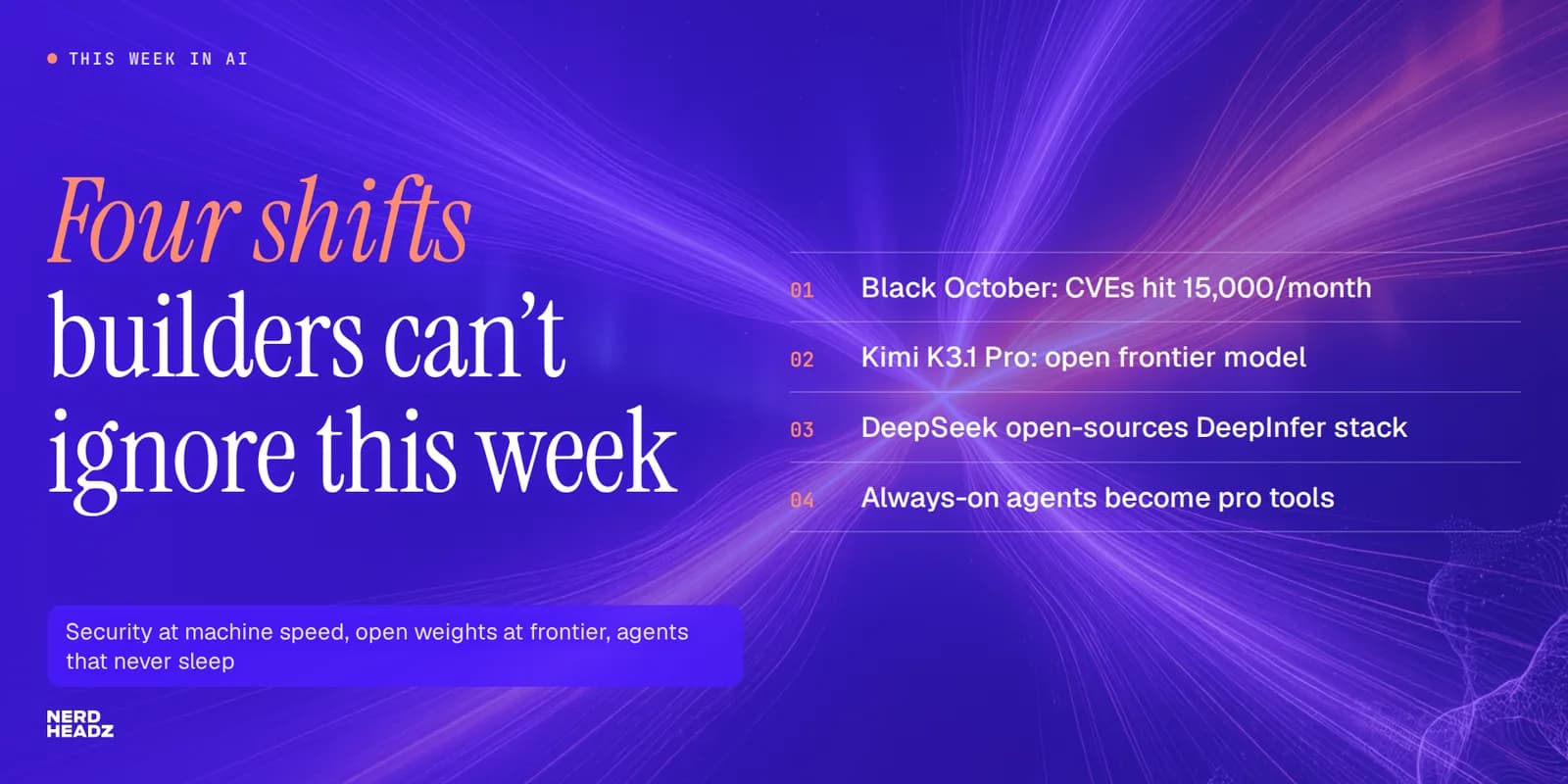
This week in AI was one of the most eventful we've tracked in months. We had a major open-weights frontier model release, a production inference stack going open source, the most concentrated wave of AI-accelerated security incidents the industry has seen, and always-on personal agents quietly crossing a quality threshold that matters for builders. A lot happened. Here's our read on what you should care about.
"Black October": AI-Accelerated Vulnerabilities Overwhelm Defenders
The headline story this week isn't a model release — it's a security emergency that the industry is now calling "Black October." Over roughly 48 hours, a cluster of critical disclosures landed simultaneously: PHP2Shell, an unauthenticated remote code execution vulnerability in PHP's core engine affecting WordPress, Drupal, and Joomla; a CVSS 10 flaw in GitLab affecting releases going back to 2014; Node.js shipping an RCE fix for its Brotli decoder; a supply chain compromise via LiteLLM 1.107.0 that included a password stealer; a certificate authority whose keys were reportedly trivially weak; and Quest Diagnostics disclosing exposed patient data. Monthly CVE volume reportedly jumped from roughly 4,000 to 15,000 since April.
What makes this different from a normal bad week in security is the AI dimension. The PHP2Shell discovery was made in part using AI models as part of OpenAI's Patch the Planet program. A state-aligned threat group used an open agentic penetration testing framework to hit over 2,250 Microsoft 365 tenants at roughly 2,900 sign-in attempts per minute, reaching privileged access in some cases in under three hours. AI is accelerating both sides of the equation: discovery and exploitation.
We've been shipping production AI for clients long enough to know that agent permissions and secret management are an afterthought on most teams. That stops being acceptable now. The advice circulating among serious security practitioners this week: double your security budget allocation, shut down every zombie test environment and legacy CI/CD pipeline, rotate credentials across every service, and push your security team to automate detection and response — because the threat is moving at machine speed. The same agents you're building can be turned against you. Our piece on AI writing code faster than teams can trust it is more relevant than ever.
Kimi K3.1 Pro: Open Weights Reaches Frontier in One Month Gaps

Moonshot launched Kimi K3.1 Pro this week — a 2.8 trillion parameter mixture-of-experts model with 104 billion active parameters and a 1-million-token context window. Independent benchmarking placed it fourth on the Artificial Analysis Intelligence Index, behind only Opus 5.5, Sonnet 5.5, and Muse Wonder Full, with its strongest gains in agentic tasks and full-project coding. The open-weights release is scheduled for November 4.
The framing that matters: two months ago, the prediction was that we'd see a frontier-class open-weights model by year end. It arrived in October. The gap between open weights and closed frontier models is now measurable in weeks, not quarters. For builders evaluating whether to route workloads to a hosted closed model or run open weights on their own infrastructure, that calculation just shifted materially. Moonshot also launched Kimi Hosted Agents alongside — a managed 24/7 execution environment for long-running and multi-agent work, which signals that model companies are moving further into the harness layer.
If you're planning app development services that rely on long-context or agentic inference, the arrival of a 1M-token open-weights model at this capability level is a genuine architectural inflection point worth reassessing against your current stack.
DeepSeek Open-Sources Its Production Inference Stack

DeepSeek timed a significant open source release to PyTorch Conf this week: DeepInfer, their customized production inference stack built on top of vLLM with significant additions. The headline number is that their system serves 155 trillion tokens per day per cluster with reported margins near 80%. DeepInfer includes support for prompt caching with up to 72-hour lifetimes — six times longer than what OpenAI announced for their own caching — and a range of optimizations for prefill/decode disaggregation and load balancing.
The asterisk: DeepSeek held back their most proprietary components, specifically their ultra-optimized KV cache implementation and certain load balancing internals. What they've released is still a substantial reference implementation for anyone running large-scale open model inference. For teams self-hosting models — something we're doing more of for clients with data residency requirements — DeepInfer gives you a credible open baseline to build from rather than assembling something entirely bespoke.
Always-On Agents Cross the "Pro Tool" Threshold

Two competing always-on personal agent products reached reviewable quality this week. Anthropic's Duet, a persistent agent that monitors your work environment and surfaces things you might have missed, is being called the first in this class that feels like a genuine professional tool — even with some integration rough edges remaining. OpenAI's Dots, meanwhile, has been put through practical paces: catching errors in documents, handling email, booking appointments, and running tasks from Slack.
The more interesting development underneath both of these is what Anthropic released for Claude Code: a Mods system that lets developers write TypeScript plugins that reshape how the agent interacts with them — controlling what the agent surfaces, when it interrupts, and what it delegates. It's middleware for the human-facing side of the agent harness. As we wrote in our analysis of Claude's evolving safety and behavior layers, the interesting design surface is increasingly the interface between the agent and the human, not just between the agent and tools. Claude Mods makes that layer programmable.
We keep seeing clients ask when agents will be ready for real workflows. The answer this week is: the first wave is here. If you're building products that incorporate agents, this is the moment to start designing the attention interface — what does the agent show the human, when, and in what form — as a first-class product concern. Talk to us if you're mapping out that architecture.
Practitioner Takeaway
This week's single most important action for any team building AI products: run a security audit of every agent you have in production or staging, with specific focus on what credentials it can access, what environments it can reach, and what happens if it's compromised or used as an attack vector. Black October is a preview of the operating environment going forward. Agents that aren't hardened against misuse are insider threats by default. Rotate secrets, kill zombie environments, and treat agent permission scopes the same way you'd treat production database access — because that's effectively what they are.
“The threat is moving at machine speed — and your security posture was designed for a slower era.”
Black October marks a genuine inflection point: AI is now accelerating the vulnerability discovery cycle faster than most teams can patch, while state actors are using agentic tooling to compress attack timelines to hours. The model side of the stack is moving just as fast — open weights at frontier quality, open-source production inference, and always-on agents that professional teams are actually using. Next week, watch for the Kimi K3.1 Pro open-weights drop on November 4 and whether the security community's coordinated response to PHP2Shell produces a durable patch cycle or exposes deeper systemic gaps.
FAQ
Frequently asked questions
What is "Black October" in AI security and why does it matter for developers?
Black October refers to a concentrated wave of AI-accelerated vulnerability disclosures and exploits that hit in late October 2026, including PHP2Shell, a GitLab CVSS 10 flaw, supply chain compromises, and state-actor attacks using agentic penetration testing tools. Monthly CVE volume reportedly tripled since April. It matters because AI is compressing both discovery and exploitation timelines — developers running agents in production need to treat credential management and permission scoping as critical security surfaces, not afterthoughts.
How does Kimi K3.1 Pro compare to frontier closed models, and when does the open-weights version release?
Independent benchmarking placed Kimi K3.1 Pro fourth on the Artificial Analysis Intelligence Index, behind only Opus 5.5, Sonnet 5.5, and Muse Wonder Full, with its biggest gains in agentic and coding tasks. It's a 2.8 trillion total parameter mixture-of-experts model with a 1-million-token context window. The open-weights release is scheduled for November 4, 2026, which would make it the first open-weights model at this capability level.
What did DeepSeek release with DeepInfer and what can builders do with it?
DeepSeek open-sourced DeepInfer, their production inference stack built on vLLM, capable of serving 155 trillion tokens per day per cluster with prompt caching up to 72 hours. They held back their most proprietary KV cache optimizations, but what's available gives teams self-hosting large open models a credible reference implementation for high-throughput inference — especially useful for teams with data residency requirements who can't route traffic through closed API providers.