In this article05 +
Why Agent Memory Changes Everything
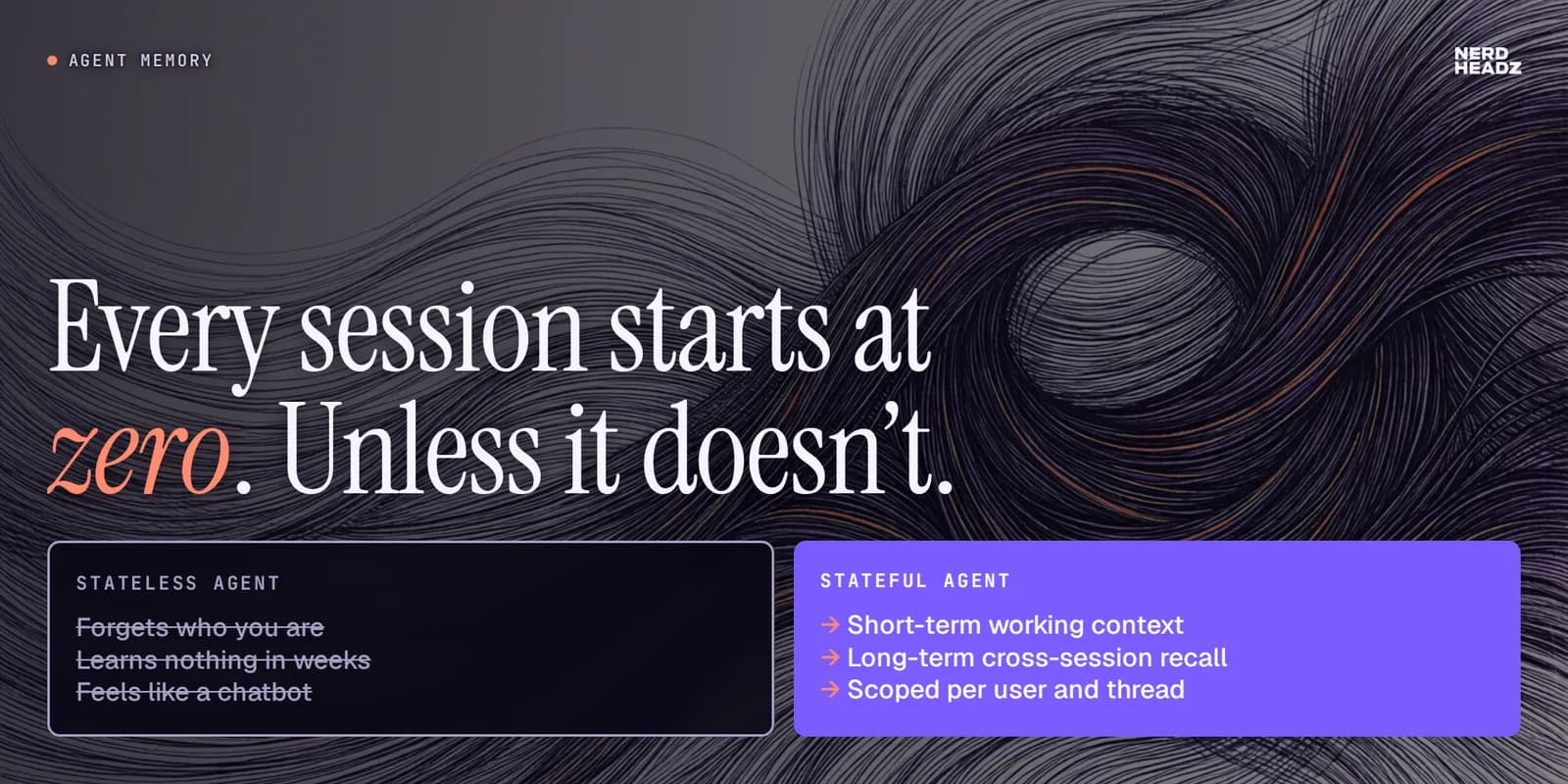
Memory is not a nice-to-have for AI agents — it is the architectural primitive that makes autonomous behavior possible. Without it, every conversation starts at zero. The agent has no idea who you are, what you asked yesterday, or what rules it learned from prior interactions.
Most enterprise teams discover this the hard way. They ship a capable model, users interact with it for weeks, and then realize the system has learned absolutely nothing. Each session is a blank slate, and the product feels perpetually new rather than progressively smarter. Oracle's documentation on Agent Memory frames this as the defining challenge as AI systems evolve from single-turn assistants into autonomous, long-running agents — and they are right.
At NerdHeadz, we build AI agent systems for clients across industries, and the memory layer is consistently the piece that determines whether an agent feels like a breakthrough or just another chatbot.
The Two Memory Layers That Actually Matter

Agent memory architecture splits cleanly into two categories, and understanding the difference is critical before you start designing any stateful agent.
Short-Term Memory: The Working Context
Short-term memory handles what is happening right now. During an active session, the agent needs to track the current task state, recent turns, and intermediate progress — without dumping the entire conversation history into the model's context window on every call.
The practical solution is thread context cards and conversation summaries. Instead of sending 40 turns of raw dialogue, the agent sends a compact, structured summary of where the task stands. This reduces token overhead dramatically while keeping the model oriented. For agents running multi-step workflows — anything from code generation pipelines to customer support escalations — this is the difference between a coherent agent and one that hallucinates its own prior steps.
Long-Term Memory: What Persists Across Sessions
Long-term memory is where agent intelligence compounds over time. User preferences, learned rules, domain-specific facts from earlier interactions — all of it can be stored and retrieved across sessions using semantic search, keyword search, or hybrid strategies.
This is not just retrieval-augmented generation bolted onto a chatbot. Long-term memory requires careful scoping — tying records to the correct user, agent, and thread — so that one user's preferences never bleed into another user's context. That scoping problem is exactly where many homegrown memory stacks fall apart in production.
Working on something similar? Talk to our team about your project.
Why Most Memory Stacks Fail at Scale
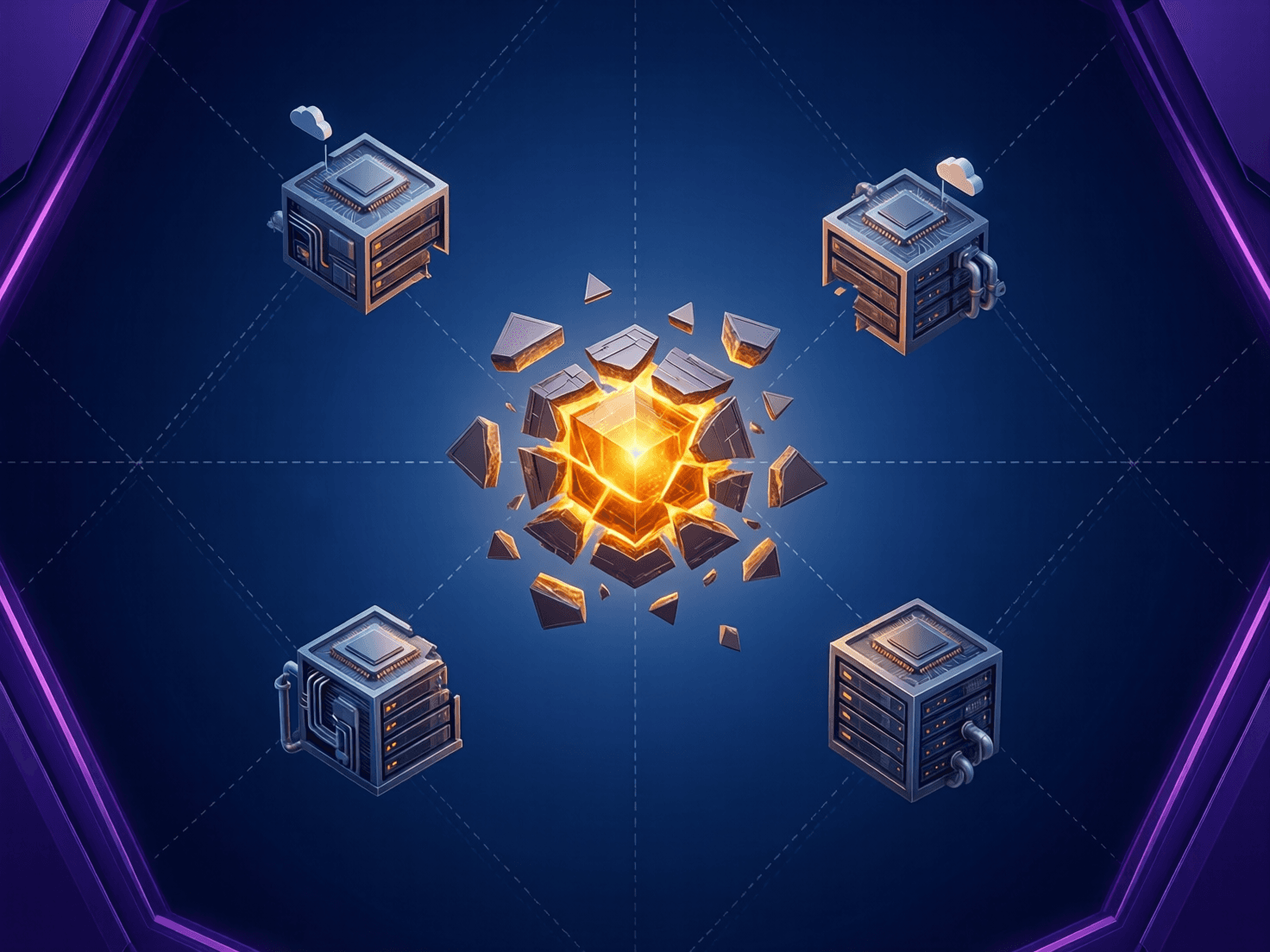
The standard approach to agent memory involves stitching together separate systems: a vector store for semantic search, a relational database for structured records, a graph store for relationships, and a key-value store for session state. Each system adds operational overhead, a new failure point, and a new integration surface.
This fragmentation is especially painful in enterprise environments, where reliability and security requirements make every additional dependency a liability. Our post on multimodal embeddings and agent memory covers how embedding quality directly impacts retrieval accuracy — and a fractured memory stack makes it nearly impossible to optimize that layer consistently.
The better architecture treats memory as a unified capability: one platform handling working memory, long-term storage, semantic retrieval, profile management, and linked memory records through a single SDK. That consolidation is not just an engineering preference — it is a prerequisite for maintainable production systems.
Security Is Not an Afterthought

Agent memory introduces a class of security problems that pure stateless LLM calls never face. Memory extraction, summarization pipelines, and cross-session retrieval all require explicit security assessment before deployment.
The integrating application owns end-user authentication, authorization, and memory scoping. If those boundaries are not enforced correctly, one user's sensitive context can surface in another user's session. In regulated industries — healthcare, finance, legal — that is not a theoretical risk; it is a compliance failure.
Any agent memory system we build at NerdHeadz includes explicit scoping controls baked into the architecture from day one, not layered on after the fact. This is a principle we apply whether we are working with managed memory platforms or custom-built retrieval systems.
Building Stateful Agents That Work in Production

The gap between a demo agent and a production agent almost always comes down to statefulness. A demo can impress in a 10-minute session. A production agent needs to remember a customer's history, adapt to their preferences, and maintain coherence across dozens of sessions over months.
Frameworks like LangGraph and similar orchestration tools handle the workflow layer well, but they depend on an external memory backend to deliver true persistence. The architectural decision is whether to build that backend yourself — with all the maintenance overhead that implies — or to integrate a purpose-built memory layer that handles storage, retrieval, and scoping as a managed capability.
Our AI development services team has navigated this decision across multiple client deployments. The answer depends on data residency requirements, scale expectations, and how much of the infrastructure the client wants to own long-term. There is no single right answer, but there is always a wrong one: ignoring the memory layer until users complain.
Ready to build? NerdHeadz ships production AI in weeks, not months. Get a free estimate.
“Memory is not a nice-to-have for AI agents — it is the architectural primitive that makes autonomous behavior possible.”
Agent memory is the infrastructure layer that transforms capable models into genuinely useful autonomous systems. Getting it right means choosing the correct short-term and long-term strategies, enforcing strict security scoping, and avoiding the operational complexity of fragmented multi-system stacks. The teams that invest in a coherent memory architecture early are the ones shipping agents that actually get smarter over time.
FAQ
Frequently asked questions
What is agent memory in AI systems?
Agent memory is the persistent storage layer that allows AI agents to retain context, user preferences, and learned facts across multiple sessions. It divides into short-term memory — which maintains working context within an active session — and long-term memory, which stores and retrieves information across sessions using semantic or keyword search.
How is agent memory different from a standard RAG system?
Standard retrieval-augmented generation retrieves from a static document corpus. Agent memory is dynamic — it writes new records based on interactions, scopes those records to specific users and threads, and updates over time as the agent learns. RAG is a read-only retrieval pattern; agent memory is a read-write persistence layer.
What are the biggest security risks with agent memory?
The primary risk is improper memory scoping, where one user's stored context surfaces in another user's session. Memory summarization and extraction pipelines also require assessment to prevent sensitive data leakage. The application layer — not the memory SDK — is responsible for enforcing authentication, authorization, and correct per-user memory boundaries.
Spotted via 🔳 Turing Post