In this article05 +
When the UI Disappears, What's Left?
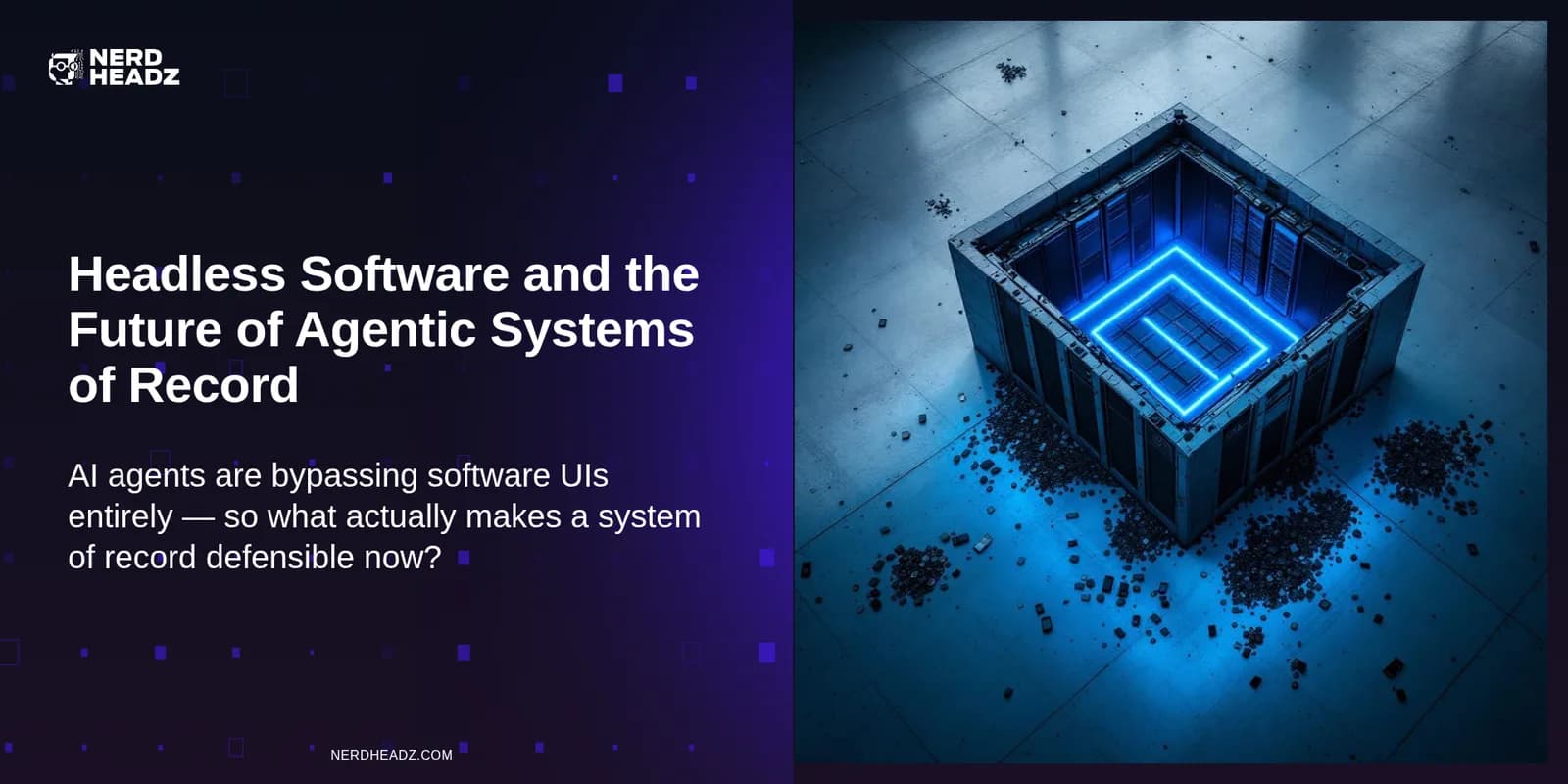
Headless software agents are no longer a theoretical future — they are an architectural reality reshaping how enterprise software creates and defends value. When a major SaaS platform repositions its core product around API access rather than its interface, the implicit message is clear: in an agentic world, the UI is no longer the product. The data layer is.
A16z recently explored this dynamic in depth, and it surfaces a question we think about constantly at NerdHeadz: if an AI agent can read from and write to a system of record without ever touching the UI, what actually makes that system worth keeping? The switching cost calculus is changing fast, and builders who understand the new rules will have a meaningful edge over those still optimizing for screen-level UX.
The UI Was the Moat — Until It Wasn't

For two decades, enterprise software earned its stickiness through interfaces. Sales teams didn't just use their CRM — they lived inside it. Pipeline views, activity feeds, and approval workflows became muscle memory baked into daily rituals. The database underneath was critical, but the UI was what drove adoption, enforced data hygiene, and created the shared organizational vocabulary that made migration feel impossible.
That stickiness is unwinding. AI agents don't navigate dashboards — they call APIs, parse context, and execute actions in milliseconds at scale. The emergence of standardized tool-access protocols means a well-configured agent can do what a human user does in a browser session, only faster, more consistently, and without needing a seat license.
Working on something similar? Talk to our team about your project.
The implication isn't that existing systems of record become worthless. It's that the layers of defensibility shift dramatically — downward into data models, permissions, and compliance logic, and outward into network effects and real-world execution.
What Actually Survives the Shift

The old stickiness scorecard was built around human behavior: how often people logged in, whether the system was read-write or write-only, how many undocumented SOPs were encoded in workflow rules. In a world where agents do most of the interacting, those human-centric factors erode. But several others deepen.
Operational Logic and Institutional Context
Agents need explicit rules to act safely. The undocumented approval chains, regional compliance requirements, and exception-handling logic that lived informally in human brains now need to be surfaced and formalized for agents to operate correctly. This actually raises the value of well-structured operational logic — it doesn't disappear with the UI, it becomes the thing agents depend on most.
At NerdHeadz, when we build AI agent development solutions for clients, one of the first questions we ask is: where does the business logic actually live? The answer is almost never "in the database schema." It lives in years of admin configurations, workflow rules, and edge-case handling that most organizations haven't fully documented.
Compliance-Critical Data as a Structural Lock-In
Payroll, financial ledgers, HR records — these don't become less important in an agentic world. They become more so. In a fully agentic environment, one of the hardest unsolved problems is authorization: which agents are permitted to act, on whose behalf, with what audit trail? A system that becomes the identity and permissioning layer for agent-to-agent interactions holds a structural position that is genuinely hard to displace — not because of the raw data it holds, but because of the trust architecture it enforces.
Proprietary Data Generated Through Action
The most defensible data isn't imported data — it's data your product uniquely causes to exist. Response rates, exception patterns, approval timing, agent performance traces: these create a data exhaust that compounds over time. Systems that close the loop from action to outcome to feedback generate compounding context that general-purpose alternatives simply cannot replicate from a standing start.
This is a core principle we apply when scoping RAG and LLM development engagements — retrieval quality is only as good as the proprietary signal you've accumulated. Generic data produces generic agents.
Three Paths for Software Buyers Right Now

The market is currently splitting along three distinct trajectories.
The first is incumbents with agents bolted on — using the existing system's APIs and CLI, either through native agent products or custom-built integrations on top. This path preserves institutional context but inherits all the technical debt of software designed for human interfaces, not machine readability.
The second is the full DIY approach: building a custom data model, permissions layer, audit trail, and agent stack from scratch. This offers maximum control but dramatically underestimates the complexity of recreating the 20% of a system — the exceptions, approvals, and compliance edge cases — that separates a useful proof-of-concept from a production replacement.
The third, and most interesting, is AI-native software built from the ground up for agentic interaction. These systems treat agent orchestration as a first-class feature. The schema is designed around tasks, intents, and outcomes rather than human-readable dashboards. Permissioning is built for agents, not just users.
For technically underserved verticals — field services, construction back-office, industrial workflows — this third path represents a significant opportunity. The buyer's operations are complex, the existing software is legacy, and the likelihood of a successful DIY build is low. That combination is exactly where purpose-built, agentic-first software wins.
The New Object Model

Most "DIY database" thinking underestimates how much value lives in the object model itself. Incumbent software was designed around human work artifacts: opportunities, tickets, candidates, invoices. Agentic systems need a fundamentally different schema — one that captures reasoning state, delegation chains, exception handling, and coordination across systems.
If you're building for the agentic era, the native objects aren't "leads" and "accounts." They're tasks, policies, threads, and outcomes. This isn't just a schema migration — it's a rethinking of what the system is for.
Our work in AI development services consistently shows that clients who try to retrofit agentic logic onto human-centric data models hit a ceiling quickly. The teams that move fastest are the ones willing to redesign the information architecture from the ground up.
Ready to build? NerdHeadz ships production AI in weeks, not months. Get a free estimate.
“Agents may kill muscle memory as a moat, but operational logic and institutional context just became more important than ever.”
The shift to headless software and AI agents doesn't eliminate the value of systems of record — it relocates it. Operational logic, compliance architecture, proprietary data exhaust, and real-world execution connectivity are now the durable moats, while UI familiarity and seat-count stickiness fade. The builders who design for this new reality from day one — with agent-native schemas, explicit permissioning, and closed-loop data generation — are the ones who will define the next generation of enterprise software.
FAQ
Frequently asked questions
What does "headless software" mean in the context of AI agents?
Headless software exposes its data and functionality through APIs rather than a graphical user interface, allowing AI agents to read from and write to the system programmatically without a human navigating screens. This model is becoming standard as AI agents replace human users for many routine software interactions.
What makes a system of record defensible when AI agents bypass the UI?
When AI agents bypass the UI, defensibility shifts from interface stickiness to operational logic, compliance architecture, and proprietary data generation. Systems that enforce permissioning for agent-to-agent interactions, encode complex business rules, and generate unique data exhaust through closed-loop action and feedback are significantly harder to displace than those that simply store records.
Should companies build their own agentic systems of record or buy AI-native replacements?
Most organizations outside of large enterprises with dedicated engineering teams are better served by AI-native purpose-built software than by DIY agent stacks. Recreating the first 80% of a system of record is increasingly feasible with modern tools, but the remaining 20% — compliance edge cases, exception workflows, and audit requirements — demands specialized knowledge that takes years to encode and is rarely worth rebuilding from scratch.