In this article05 +
What Are AI Embeddings and Why Do They Matter?
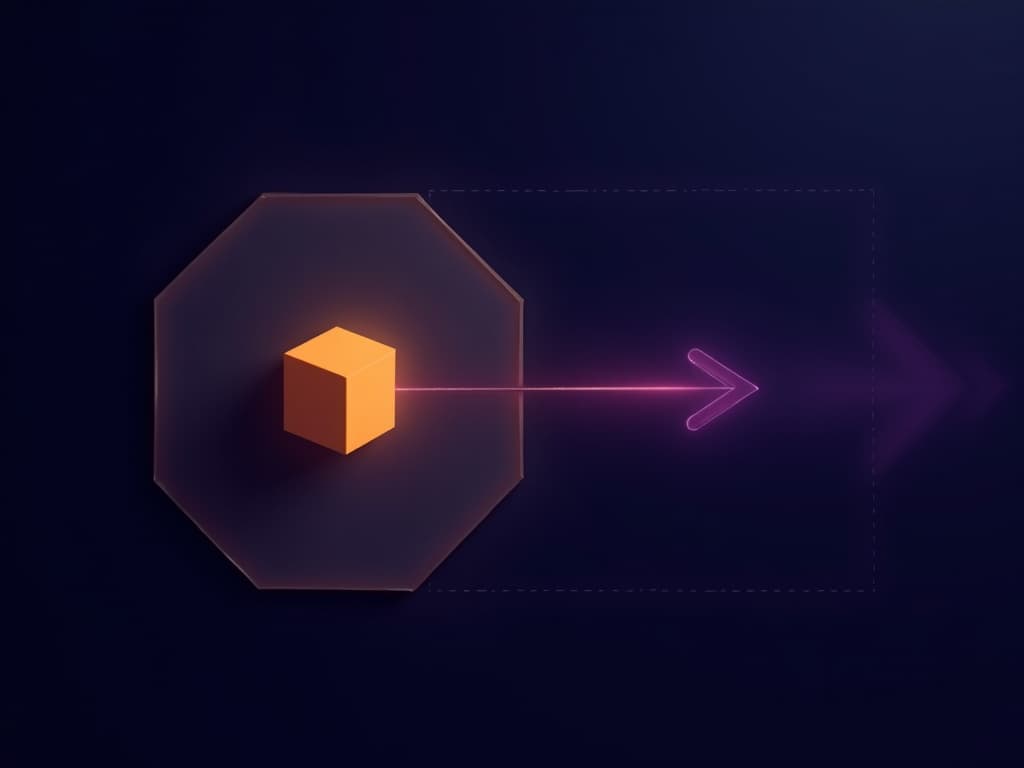
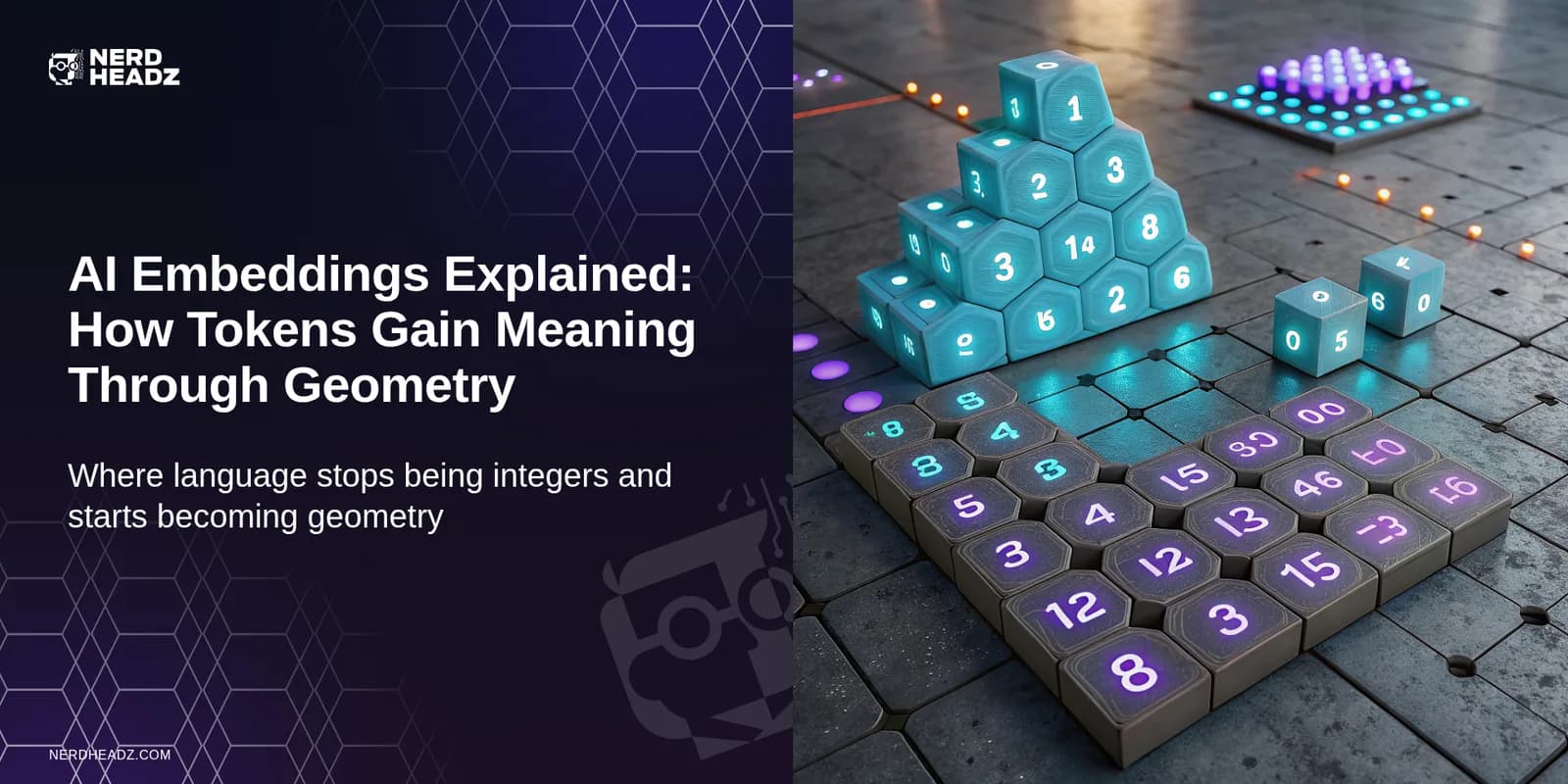
AI embeddings are the mechanism that transforms raw token IDs into dense numerical vectors, where geometric distance encodes semantic meaning. Without embeddings, a language model is staring at meaningless integers — the number 14,382 doesn't inherently mean "cat" any more than it means "bank." Embeddings are the layer that changes that, and understanding them is essential for anyone building production AI systems.
We covered how language gets broken into tokens in our AI tokens explainer, so this post picks up exactly where that one ends. Once you have tokens, you need a way to make them *mean something* to a neural network — and that's the job of embeddings. The core concept comes from Turing Post's deep dive on embeddings, which we've reframed here through the lens of what we build every day at NerdHeadz.
---
From Integers to Geometry: The Core Shift

Tokenization gives you a position in a vocabulary list. Embedding takes that position and maps it into a continuous, high-dimensional space where relationships between concepts become measurable.
The idea traces back to Geoffrey Hinton's work on distributed representations — the insight that knowledge shouldn't live in isolated slots, but in overlapping patterns across shared units. One unit participates in many concepts at once. Two concepts that share structure activate overlapping patterns, and that overlap *is* similarity. By the early 2000s, Yoshua Bengio's neural probabilistic language model made this concrete: learn a vector for every word, then train the whole system end-to-end to predict language. That basic move never changed. Everything since — BERT, GPT, Gemini — starts from the same place.
The result is deceptively simple: similar words produce similar vectors. "Cat" and "dog" end up near each other in the embedding space. "Bedroom" and "room" cluster together. A model that sees "the cat is walking in the bedroom" can generalize to "a dog is running in a room" because the geometry says these sentences live in roughly the same neighborhood.
Working on something similar? Talk to our team about your project.
---
Key Concepts Every Builder Should Know

Before going further, here are the terms you'll encounter constantly when working with AI embeddings in real systems.
Vector — an ordered list of numbers representing an object in mathematical space. In the context of language, each number captures some latent property learned during training.
Embedding space — the specific vector space a model learns, where distances and directions encode meaning. If two embeddings are close, the underlying concepts are semantically related. Every embedding space is a vector space, but not every vector space is an embedding space.
Dense vectors — vectors where most values are non-zero. Embeddings are dense by design because spreading meaning across many dimensions generalizes better than concentrating it in a few sparse features.
Semantic similarity — how close two vectors are in meaning, typically measured via cosine similarity or dot product. This is what makes search work without exact keyword matching.
Latent space — the broader transformed feature space where hidden structure becomes explicit. When a model learns to compress documents into embeddings, the latent space reveals relationships the raw text never stated directly.
These aren't academic definitions. They're the vocabulary we use when scoping RAG and LLM development projects — retrieval-augmented generation lives and dies by how well embeddings represent the knowledge you're indexing.
---
How Embeddings Work Inside Transformers

In a transformer model, embeddings are the very first layer. The model looks up a learned vector for each input token, then adds a positional encoding so the network knows where in the sequence each token sits. Everything else — attention, feed-forward layers, output projections — operates on those vectors.
Positional encoding evolved significantly as models scaled. The approach that now dominates is RoPE (Rotary Position Embedding), used in LLaMA, Mistral, and most frontier models built in the last two years. Instead of adding a fixed positional signal, RoPE rotates the query and key vectors in attention by an angle proportional to position. The dot product between any two positions then depends only on their relative distance, not their absolute location in the sequence. This makes attention inherently position-aware and generalizes well to sequences longer than those seen during training.
For builders, the practical implication is clear: models using RoPE handle long-context tasks more gracefully, which matters enormously in document Q&A, agentic workflows, and anything requiring extended reasoning chains.
---
Why Embeddings Are the Foundation of Production AI

Every serious AI feature we ship at NerdHeadz touches embeddings at some layer. Semantic search uses them to find relevant content without keyword matching. RAG pipelines embed documents into a vector store and retrieve the nearest neighbors at query time. Fine-tuned classifiers operate in embedding space. Multimodal systems align image and text embeddings so you can search images with natural language.
The shift from discrete symbols to continuous geometry is what makes all of this possible. It's the reason "a dog ran through the house" and "a puppy sprinted inside" return as relevant results to the same query, even though they share no words.
Our AI development services are built on this foundation — whether we're wiring up a vector database, tuning an embedding model on domain-specific data, or building a full retrieval pipeline from scratch.
Ready to build? NerdHeadz ships production AI in weeks, not months. Get a free estimate.
“Similar words map to similar vectors — and that single shift from discrete symbols to continuous geometry powers everything we build with modern AI.”
AI embeddings are the bridge between raw token IDs and the geometric meaning that makes modern language models actually useful. From Hinton's distributed representations to RoPE-powered transformers, every leap in AI capability has depended on better ways to encode meaning as vectors. If you're building anything with language, search, or retrieval, embeddings aren't a detail — they're the foundation.
FAQ
Frequently asked questions
What are AI embeddings in simple terms?
AI embeddings are dense numerical vectors that represent words, sentences, or other data objects in a continuous mathematical space. Items with similar meanings are mapped to nearby points, so the model can measure semantic relationships using geometric distance rather than exact string matching.
How are embeddings different from tokens?
Tokens are the discrete units a model uses to split text — essentially integer IDs assigned to words or word fragments. Embeddings take those integer IDs and map them into high-dimensional vectors where meaning, context, and relationships become encoded in the geometry of the space.
What is RoPE and why do modern LLMs use it?
RoPE (Rotary Position Embedding) is a positional encoding technique that rotates query and key vectors in attention layers by an angle proportional to their sequence position. Because the resulting dot product depends on relative distance between tokens rather than absolute position, models using RoPE generalize better to long sequences and are now standard in most frontier language models.