In this article06 +
The Rental Market Has a Data Problem — And AI Is Solving It
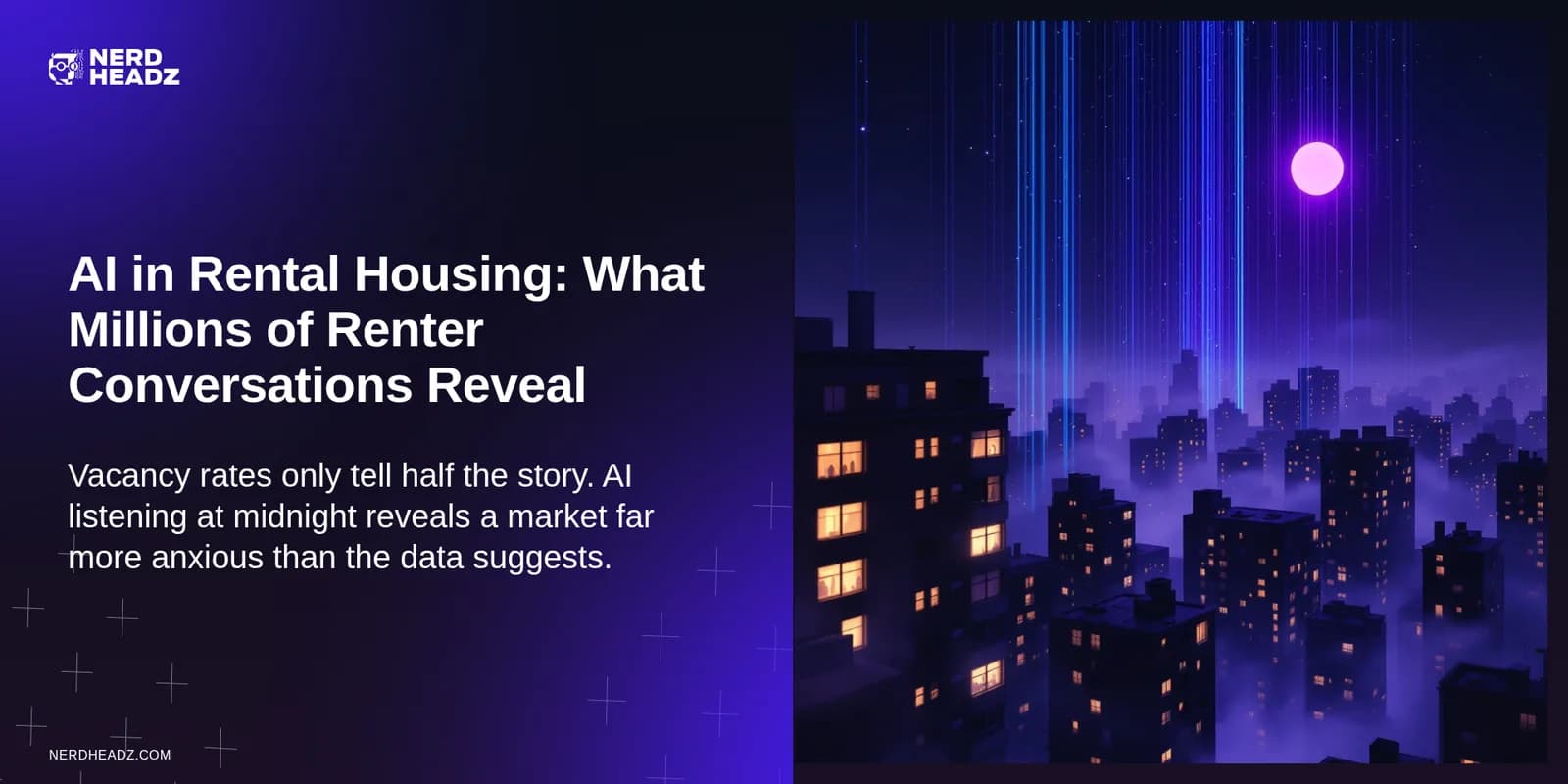
The rental housing market has always been measured from the supply side: units built, vacancies posted, rents listed. But that scorecard misses the 46 million American households navigating the other side of the transaction — the search, the anxiety, the unanswered texts at 11 PM. A detailed analysis of millions of AI-handled renter conversations, covered by a16z, reveals a demand-side picture that looks nothing like the headline numbers. For us at NerdHeadz, this data confirms what we see in the products we build: AI in rental housing is not a convenience feature. It is filling a structural gap that human operations simply cannot close.
The supply story, on its face, looks encouraging. Builders completed over 600,000 apartments in 2024, the most since 1986. National rents have been flat to slightly declining for three consecutive years. But half of all renters still spend more than 30% of their income on housing, and a national apartment deficit of roughly 5 million units persists beneath the surface. The headline numbers are improving. The lived experience of renters is not keeping pace.
What Renters Actually Ask — and When They Ask It

The clearest signal in conversation data is what renters lead with: price. The share of opening messages that focus on rent, fees, or move-in specials has been climbing since mid-2024, across every major metro, regardless of building class. Luxury renters and workforce housing renters open with the same nervous questions. The anxiety is not a function of what someone can afford — it is a function of market conditions that feel unstable to everyone inside them.
Timing compounds the problem. More than half of all apartment tours happen between noon and 3 PM, when leasing offices are already at peak load. Meanwhile, a third of renters who eventually complete an application made first contact outside normal business hours. The leasing office closes at 6 PM. Renter intent does not. That gap — between when people are ready to act and when someone is available to respond — is precisely where AI in rental housing creates the most immediate value.
Working on something similar? Talk to our team about your project.
The Funnel Is Leaking in Predictable Places

The conversion path from inquiry to signed lease is not mysterious. It leaks at two consistent points: getting renters to show up for a tour, and getting them to start an application. Once renters begin paperwork, roughly four in five finish it. The chaos lives upstream.
Tour timing is one of the most fixable variables in the entire process. Book a tour for the same day and show-up rates hold strong. Push it a week out and no-show rates more than double. In a fast-moving market, that lag costs both sides. The unit may sign before the tour happens. The renter loses time they cannot afford. Instant scheduling, automated reminders, and AI-guided self-tours directly address this — not as product polish, but as a conversion lever with measurable impact.
Response speed matters just as much on the back end. When a human leasing agent takes over a conversation that AI has already warmed, answering within hours yields a 26% close rate. Wait three days and that figure drops to less than a third of that. The clock is the deciding variable, and AI keeps the clock from running out on either party.
The Markets Where Stress Goes Unanswered

Not all rental markets are equal, and the conversation data makes the differences visible in a new way. Renters ask about deals most aggressively in the cities where the fewest deals are actually posted — the inverse of what conventional wisdom would predict. Listings show what landlords advertise. Conversations reveal what renters want but cannot find.
The metros where anxiety increased fastest are not the Sun Belt cities that dominate housing headlines. Boston, Baltimore, Minneapolis, and Detroit saw the sharpest climbs in price-anxiety signals, while cities with heavy concession activity barely moved. In New York, renters who get past price immediately fixate on qualification: income documentation, credit requirements, guarantors. In San Francisco, 49 inquiries stack up behind every signed lease — nearly double the national average — and only 37% of booked tours actually occur. Two cities, two different leaks, the same narrow result.
Understanding which part of the funnel is failing in a given market is the kind of insight that RAG and LLM development can systematically surface — pulling patterns from conversation history that no human team has the bandwidth to review at scale.
What AI-Handled Conversations Are Becoming

The shift happening inside these conversations is as important as the volume. In early 2024, the median renter journey from first message to signed lease took about 9 days and 3 messages. By late 2025, that journey had grown to 14 or 15 days and 7 messages. Longer is better here — more questions asked and answered before commitment means better-informed decisions and higher-quality leads reaching leasing teams.
The multi-channel pattern is equally significant. Two years ago, roughly a third of renters who signed had used more than one communication channel. That figure has climbed to 61%, spanning email, SMS, web chat, and voice. AI in rental housing is not replacing one channel — it is threading the entire conversation across all of them without losing context.
Voice conversations have crossed a meaningful threshold as well. The median AI-handled call has grown from 46 seconds — essentially a recitation of office hours — to about a minute and forty seconds, matching the length of human-handled calls. The system that greets a renter can now actually carry the conversation. That is not a marginal improvement in chatbot quality. It is a different category of product.
Building this kind of multi-channel, context-aware AI system is core to what our AI development services are designed to deliver — systems that hold the thread across channels and hand off to human agents at exactly the right moment.
Loyalty Is the Overlooked Outcome

The renters who fought hardest to secure an apartment hold on to it longest. Renewal rates are highest in the same Northeast and Midwest metros where anxiety signals are strongest, and they climb as building class decreases — 57% renewal in Class A, 63% in Class C. The stress and the loyalty are not opposites. They are expressions of the same underlying scarcity.
This has a direct implication for operators. Retention is not just a customer satisfaction metric in rental housing — it is a vacancy cost metric. Every renewed lease is a unit that does not need to be re-leased, re-toured, and re-converted. The same AI systems that reduce friction in acquisition also reduce churn by keeping residents informed and maintenance requests resolved without delay. Plumbing, appliances, and HVAC make up nearly half of all maintenance conversations. Fast, organized intake is not a luxury feature. It is the service layer that determines whether a resident renews.
Ready to build? NerdHeadz ships production AI in weeks, not months. Get a free estimate.
“In crowded markets, renters ask everything up front because they may not get a second conversation.”
The rental market's real story is not in vacancy rates or construction starts — it is in the millions of conversations happening at midnight, on weekends, and between anxious renters who cannot afford to miss the right unit. AI in rental housing is answering those conversations at scale, and the data shows renters are responding by asking more questions, staying in the funnel longer, and making better decisions. The operators who build AI into every stage of the leasing funnel are not just improving efficiency — they are closing a structural gap that manual operations have never been equipped to fill.
FAQ
Frequently asked questions
How is AI being used in rental housing today?
AI handles renter inquiries, schedules tours, sends reminders, manages application follow-up, and processes maintenance requests across email, SMS, web chat, and voice channels. These systems operate around the clock, covering the significant volume of renter contact that occurs outside standard leasing office hours.
Does AI actually improve lease conversion rates in apartment buildings?
Yes. Conversation data shows that renters who exchange five or more messages convert to signed leases at nearly three times the rate of single-message inquiries. AI enables that depth of conversation at any hour, which directly increases the share of inquiries that reach the application stage.
What are renters most anxious about when searching for an apartment?
Price and qualification dominate. The share of opening renter messages focused on rent, fees, and specials has been rising since mid-2024 across all building classes and income levels. In tight markets, renters also ask heavily about application requirements — income documentation, credit thresholds, and guarantor policies — because rejection is a real and common outcome.
Which rental markets have the highest renter stress right now?
Based on conversation data, New York, Boston, Baltimore, and Minneapolis show the highest unrelieved stress signals — meaning renters are asking about deals and qualifying criteria far more than available listings would suggest is warranted. San Francisco stands out for extreme competition, with roughly 49 inquiries generated per signed lease.
Spotted via a16z