In this article06 +
Most AI Projects Don't Fail at the Tech Layer
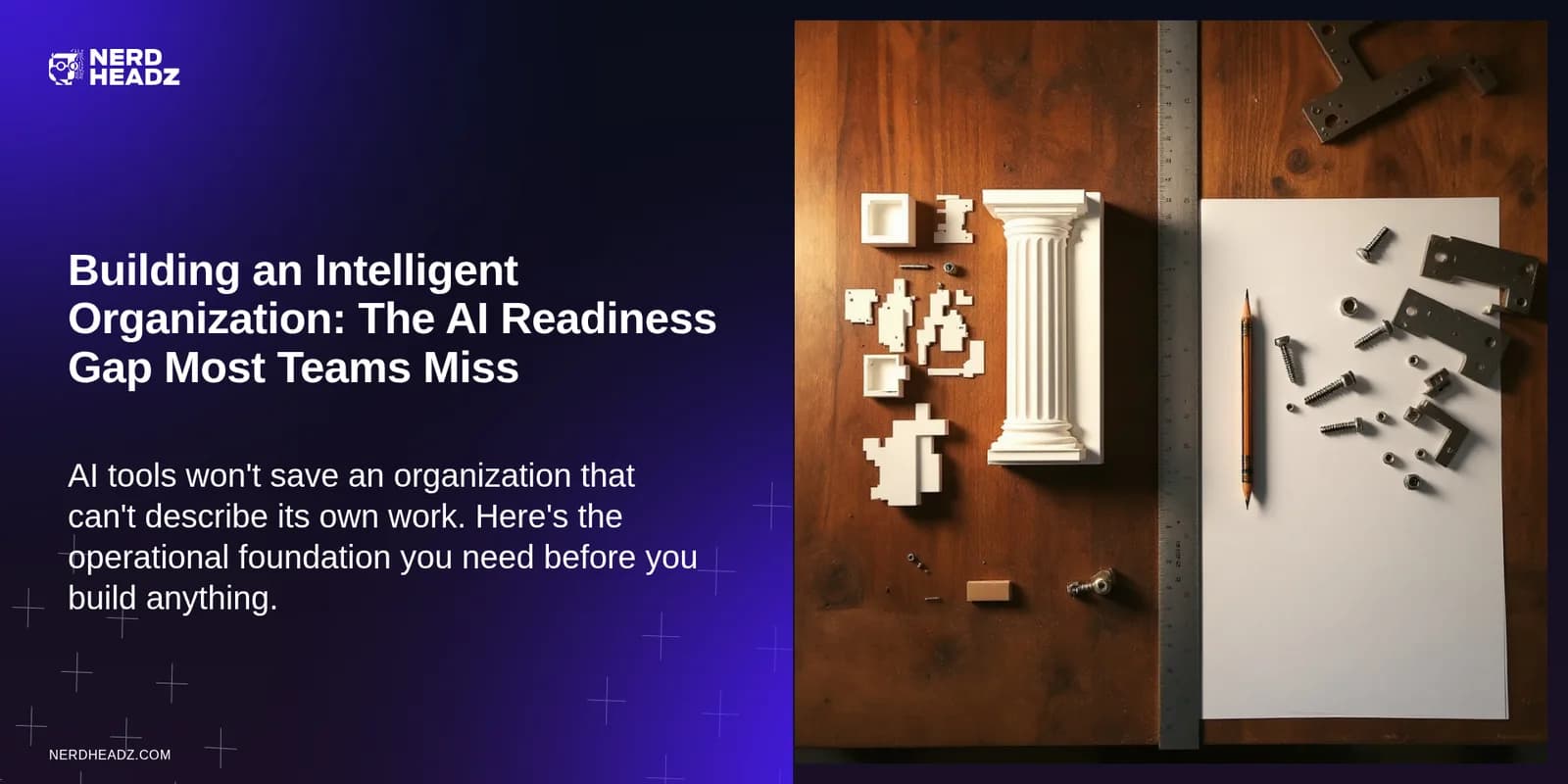
Intelligent organization AI initiatives are stalling across every industry — and the reason almost never shows up in the postmortem. Teams run a successful proof of concept, leadership gets excited, and then the rollout quietly dies. Not because the model underperformed. Because the organization had no operational foundation for the model to stand on.
The real question isn't which AI tool to buy. It's whether your company can describe its own work in a form machines can act on. That distinction — between having AI and being ready for AI — is what separates pilots from production systems. TheFocus.AI has written about this framing as a core diagnostic, and it maps exactly to what we see in our own client engagements at NerdHeadz.
The Hidden Bottleneck: Organizational Legibility

Organizational legibility is a simple concept with massive operational implications. It means your processes, rules, and exceptions are documented clearly enough that a machine — or a new hire — could follow them without asking anyone.
Most organizations aren't there. The rules that actually govern daily work live in senior employees' heads. Exceptions to the process are handled by whoever has the most context. Edge cases get resolved through Slack messages, not documented policies. When you layer AI on top of that, you don't get intelligence — you get faster chaos.
We think about this in terms of maturity levels. At the lowest level, an organization's knowledge is entirely tribal. Work gets done, but the "how" isn't transferable. At a higher level, that knowledge has been captured, structured, and made machine-readable. Only at that point does AI stop being a buzzword and start becoming infrastructure.
Our post on why AI starts with organizational legibility goes deeper on this diagnostic — it's worth reading before scoping any AI project.
Working on something similar? Talk to our team about your project.
What "Making Your Work Legible" Actually Looks Like

The legibility work is unglamorous. It doesn't make for a good demo. But it's the thing that determines whether your AI investment compounds or evaporates.
In practice, this means auditing your systems, data, and workflows — not to produce a 40-slide deck, but to answer specific questions. Which rules govern your invoice approval process? Who makes the exception call when a vendor submits a duplicate? What data lives in your ERP versus a spreadsheet on someone's desktop?
From there, the goal is to translate that tribal knowledge into a form machines can act on: schemas, validation logic, canonical data models, decision trees with documented edge cases. This isn't just documentation for its own sake. It's the prerequisite for building AI that produces outputs your team will actually trust.
Once that foundation exists, the returns are real. Invoice processing that took 15 minutes can be handled in 30 seconds. Talent reports that required half a day of analyst time can run in under a minute. The speed gains aren't from the model — they're from having clean, structured, machine-readable inputs to feed the model.
Connecting Proprietary Data Changes the Game

Generic AI uses generic data. That's fine for generic problems. For anything that requires knowledge of your business — your contracts, your customers, your historical decisions — generic models hit a ceiling fast.
The shift happens when AI is grounded in your proprietary data with full source traceability. An AI that can answer questions about *your* invoices, *your* surveys, and *your* historical documents — and cite the source for every answer — is a fundamentally different tool than a general-purpose chatbot. It's the difference between a smart assistant and an informed colleague.
This is where RAG and LLM development comes in. Retrieval-augmented generation lets you bolt enterprise knowledge onto a powerful language model without fine-tuning or retraining — you get the intelligence of a frontier model with the specificity of your own data. Teams that have done this work describe it as the moment AI stopped feeling like a toy and started feeling like infrastructure.
Building Systems That Learn, Not Just Execute

The highest-value AI systems don't just process inputs and return outputs. They improve over time. Every interaction — every flagged anomaly, every human correction, every edge case resolved — teaches the system something new. Competitive advantage compounds when the system gets better with use.
This is the architecture we build toward in our AI agent development work: systems with feedback loops, anomaly detection, and human-in-the-loop correction mechanisms baked in. The goal isn't to remove humans from the process — it's to make human judgment scalable.
Getting there requires the earlier work to be done correctly. An agent operating on messy, undocumented, tribal-knowledge-dependent processes will amplify your existing dysfunction. An agent operating on legible, structured, well-governed processes will compound your existing strengths.
The Two Engagements That Actually Move the Needle

From what we've observed across dozens of AI engagements, two starting points consistently deliver value fast.
The first is an honest assessment: where does your organization actually sit on the AI maturity curve? Not where leadership thinks it sits — where it actually sits, department by department. That diagnostic, done right, takes one to two weeks and produces a prioritized roadmap without upsell pressure.
The second is a focused build: pick one process — monthly close, hiring, invoicing, onboarding — formalize the tribal knowledge embedded in it, and ship a production system against that single workflow. Get a win, learn from it, then expand.
Both tracks share the same principle: start with legibility, build for traceability, ship to production quickly. No multi-month discovery phases. No strategy decks that never become software.
Ready to build? NerdHeadz ships production AI in weeks, not months. Get a free estimate.
“The bottleneck isn't the technology — it's whether your organization can describe its own work in a form machines can act on.”
Building an intelligent organization isn't about adopting the latest AI tools — it's about doing the foundational work that makes those tools effective. Organizations that invest in legibility, structured data, and traceable AI outputs don't just run better pilots; they build compounding advantages that widen over time. The technology is ready. The question is whether your organization is.
FAQ
Frequently asked questions
What does it mean for an organization to be "legible" to AI?
Organizational legibility means your processes, rules, and exceptions are documented clearly enough for a machine to follow without human intervention. Tribal knowledge — rules that exist only in employees' heads — must be captured and structured before AI can act on it reliably.
Why do most AI initiatives stall at the proof-of-concept stage?
Most AI pilots fail to scale not because the technology underperforms, but because the organization lacks the structured data, documented processes, and governance foundations required to support a production system. The bottleneck is organizational, not technical.
What is retrieval-augmented generation (RAG) and why does it matter for enterprise AI?
RAG is an architecture that grounds a large language model in your proprietary data — documents, databases, historical records — so it returns answers specific to your business with source traceability. It delivers the intelligence of a frontier model with the specificity of your internal knowledge base, without requiring model retraining.
How long does it take to build a production AI system for an enterprise workflow?
A focused AI build targeting a single well-defined workflow — invoicing, onboarding, reporting — typically takes two to six weeks when the organizational legibility work has been completed first. Skipping that foundational step significantly extends timelines and increases the risk of production failure.
Spotted via 🔳 Turing Post