In this article05 +
The Threshold We've Been Watching
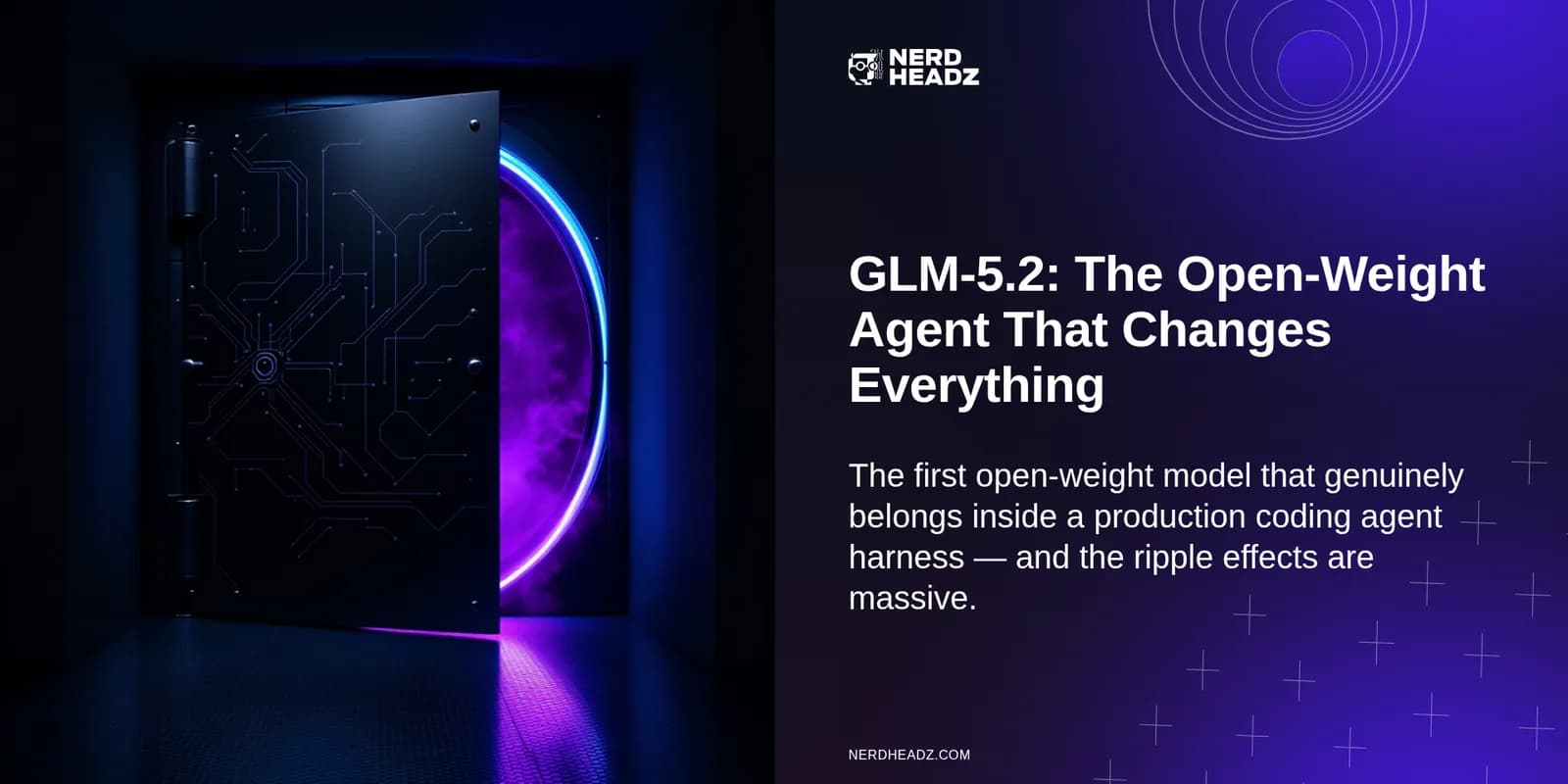
The first open-weight model that genuinely belongs inside a production coding agent harness has arrived — and the frontier labs should be paying attention.
For the past year, the practical question for teams building autonomous coding agents wasn't which closed model to use — it was whether open-weight models were even viable. According to analysis from Interconnects, GLM-5.2 from Z.ai has crossed a capability threshold that no open model has cleared before. We've been tracking exactly this inflection point, because it changes the calculus for every AI system we architect at NerdHeadz.
GLM-5.2 was released with MIT licensing on June 16th, 2026. That licensing detail alone matters enormously for product teams — it removes the legal ambiguity that has made enterprise adoption of capable open models slow and painful.
Why This Release Is Different From Every Other "Impressive" Open Model

Version number releases in AI are notoriously misleading. A minor bump can hide a capability leap that unlocks entirely new use-case categories — or it can be exactly as incremental as it sounds. GLM-5.2 falls firmly in the first category.
The clearest signal is arena-based agent leaderboard performance. GLM-5.2 is placing alongside OpenAI and Anthropic's latest offerings in autonomous agent evaluations — not close to the open-weight tier, but actually mixed in with the frontier. That has not happened before with an open model in agentic settings.
Community reaction from researchers and practitioners who have run the model themselves has been unusually unified. The last time we saw this level of consensus around an open-weight release was DeepSeek R1 — a comparison that carries real weight given how transformative that moment was for reasoning model capabilities across the industry.
The model performs best at maximum thinking effort, and that's how we'd recommend running it. The additional inference cost is worth it for the quality ceiling it unlocks.
What "Agent-Ready" Actually Means in Practice

There's a specific bar a model has to clear before it belongs in a production agent harness. It isn't just benchmark scores — it's whether the model holds context correctly across multi-step tool calls, whether it degrades gracefully when given ambiguous instructions, and whether it produces outputs that downstream subagents can parse reliably.
GLM-5.2 clears that bar. It works as a general coding agent. Early adopters have run it inside Claude Code-style harnesses and report that the capabilities feel immediately right — not "impressive for open-weight" right, but just right.
For teams building autonomous development pipelines, agentic QA systems, or multi-agent orchestration, this matters at the architecture level. Our AI agent development practice has been constrained by the open-closed capability gap in exactly this domain. GLM-5.2 moves the constraint.
Working on an agent workflow and wondering whether an open model can carry the load? Talk to our team about your project.
The Economic Pressure This Creates

Closed frontier labs — particularly those whose revenue is heavily driven by coding agent workloads — are now facing a credible open alternative for the first time. The parallel to DeepSeek R1's impact on chain-of-thought reasoning is direct. When DeepSeek R1 shipped, it proved that open-weight labs could replicate what closed labs had positioned as a durable moat. GLM-5.2 does the same for agentic coding.
This creates meaningful pricing pressure in the enterprise segment. Teams that are currently routing high-volume coding agent traffic through premium closed APIs now have a viable alternative path. The inference providers who serve open models — and there are several well-capitalized ones — just hit another inflection point in their business case.
For product teams, the practical implication is that the build-vs-buy calculus on agent infrastructure shifts. Self-hosted or third-party open-model inference for coding agent workloads is no longer a compromise — it's a legitimate architectural choice.
The capability gap between the U.S. closed frontier and Chinese open-weight labs currently sits at roughly six to nine months. That gap has held surprisingly stable even as closed labs have dramatically scaled compute. GLM-5.2's arrival approximately 204 days after Claude Opus 4.5 puts it squarely in that window — and suggests the gap is not widening the way many expected.
The Broader Trajectory for AI-First Development Teams

Complex multi-model workflows are becoming the norm. Teams are already running separate models for planning, primary code generation, and subagent dispatch within the same pipeline. GLM-5.2 slotting into the primary coding role in those architectures — at open-weight inference costs — changes the unit economics of building AI-first products.
The deeper pattern here is that major capability leaps in open models are now coming faster and from more places. Kimi K2 demonstrated that breakthrough open-weight performance could emerge from labs outside the traditional research hierarchy. GLM-5.2 demonstrates that those breakthroughs can now land directly in the agent tier that matters most to developers.
We build on top of these models at NerdHeadz. Understanding what AI development services actually look like when open-weight agents become viable at the frontier — that's the work happening in our engineering practice right now.
---
Ready to build? NerdHeadz ships production AI in weeks, not months. Get a free estimate.
“The first open-weight model that genuinely belongs inside a production coding agent harness has arrived — and the frontier labs should be paying attention.”
GLM-5.2 is not another incremental open-weight release — it is the first model that makes open-weight agents viable at the coding frontier, changing infrastructure decisions for every serious AI product team. The six-to-nine month capability lag between closed and open labs has held, and the economic and architectural implications are now impossible to ignore. Teams that build their agent infrastructure assuming closed-model dependency should be revisiting that assumption today.
FAQ
Frequently asked questions
What makes GLM-5.2 different from previous open-weight AI models for agent workflows?
GLM-5.2 is the first open-weight model to compete directly with frontier closed models on autonomous coding agent benchmarks. It performs reliably across multi-step tool calls and agentic coding harnesses — a bar no previous open-weight model had cleared at this quality level.
How does GLM-5.2 affect the cost of building AI coding agents?
GLM-5.2's MIT license and open-weight availability mean teams can run it through third-party inference providers or self-hosted infrastructure, dramatically reducing per-token costs for high-volume coding agent workloads compared to premium closed API pricing.
How long is the capability gap between closed frontier AI labs and open-weight Chinese models?
The current capability lag is approximately six to nine months. GLM-5.2 arrived roughly 204 days after Claude Opus 4.5, placing it squarely in that window and suggesting the gap has not widened despite significant compute scaling by closed labs.
Spotted via Interconnects by Nathan Lambert