In this article05 +
The Gap Between "It Works" and "It Ships"
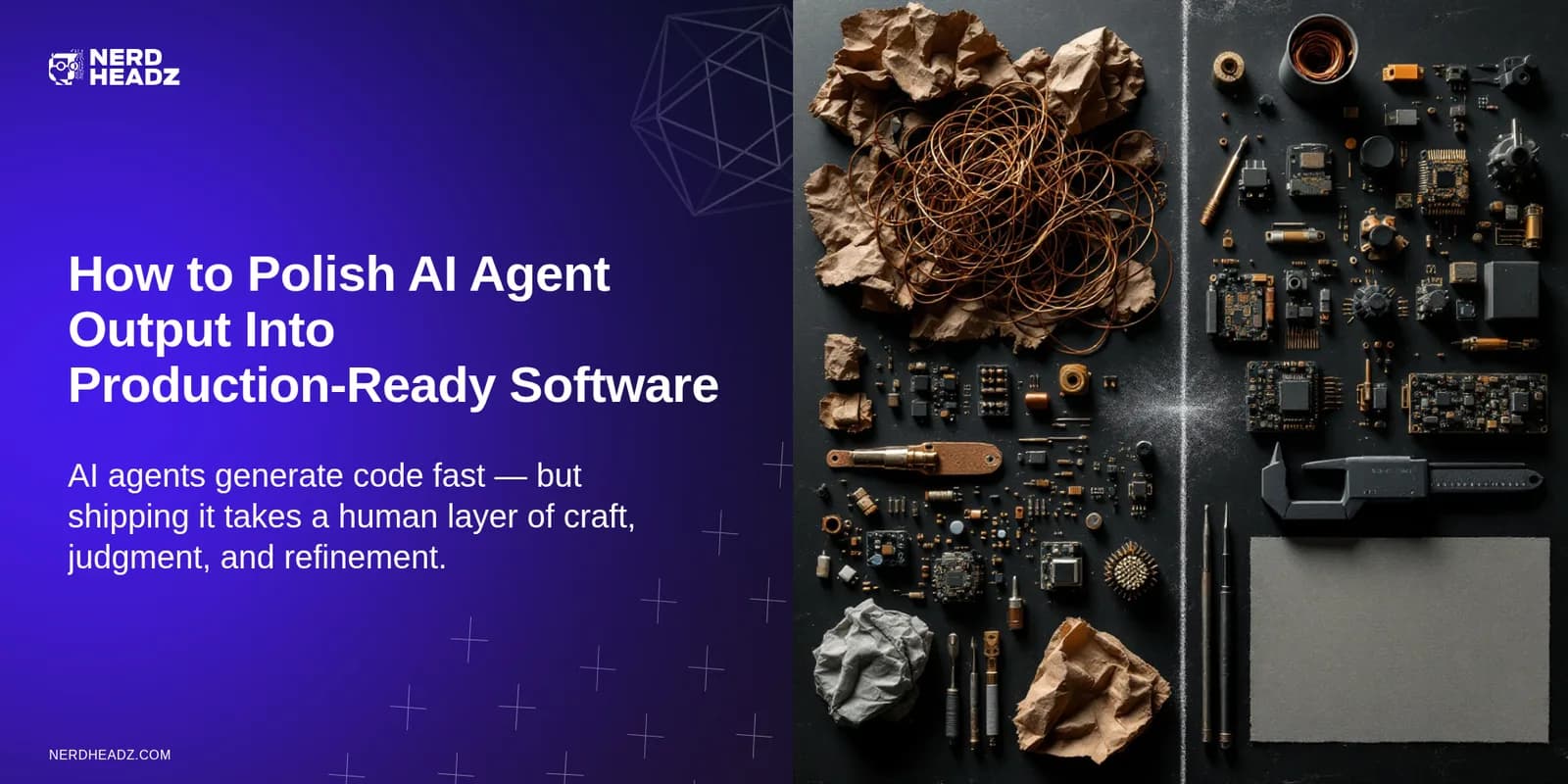
AI agents write code faster than any human developer alive. But speed and production-readiness are not the same thing. At NerdHeadz, we've learned this distinction the hard way — and now we engineer for it from day one.
The Every ecosystem of AI-powered tools offers a useful window into what it looks like when builders take AI-generated output seriously enough to actually ship it. Their suite spans writing, email, file organization, and voice dictation — products that only work if the underlying code meets a real quality bar. That framing is exactly how we think about AI agent output at NerdHeadz: the agent gets you to 70%, but the final 30% is where professional software lives.
Why AI Agent Output Needs a Refinement Layer

AI agent output is structurally optimistic. Agents solve the problem in front of them, not the problem three steps ahead. They handle the happy path brilliantly and often leave edge cases, error states, and performance considerations as exercises for the reader.
This isn't a flaw — it's a feature of how large language models reason about code. Understanding what agents do well versus where they need human oversight is core to how modern AI development actually works. You deploy agents where generation speed matters most, and you apply engineering discipline where correctness is non-negotiable.
In practice, this means treating every agent-written module as a first draft. A strong first draft, often — but a draft.
Working on something similar? Talk to our team about your project.
Three Layers Where We Consistently Polish Agent Code

1. Error Handling and Edge Case Coverage
Agents default to the success path. A function that fetches user data will usually handle a clean API response beautifully and completely ignore what happens when the API is down, returns a malformed payload, or times out after 30 seconds.
Our first pass on any AI agent output is a systematic audit of failure modes. We ask: what are every meaningful way this function can receive bad input, encounter a broken dependency, or face an unexpected environment — and does the code handle all of it gracefully?
2. State Management and Side Effects
Agents often generate code that works perfectly in isolation and breaks subtly in context. A React component might manage its own state locally when it should be reading from a shared store. A database write might succeed without properly invalidating a cache. An async function might create race conditions that only appear under load.
This is where building real AI agent systems differs from running one-off prompts. Production systems have shared state, concurrent users, and long-running sessions. Polishing agent output means auditing every side effect and making sure state transitions are intentional and safe.
3. Readability and Long-Term Maintainability
AI-generated code is often technically correct but architecturally noisy. Variable names carry no meaning. Logic that belongs in a shared utility gets duplicated across three files. A function that should be twenty lines becomes sixty because the agent was solving for immediate correctness, not long-term clarity.
We refactor aggressively. Not because the agent failed, but because software that can't be read by a human six months from now is a liability regardless of who wrote it. Clean code isn't aesthetic preference — it's operational infrastructure.
Building a Workflow That Scales

The teams shipping the best AI-assisted software aren't using agents as autopilots. They're using them as force multipliers on a structured workflow. Generate fast, review carefully, refactor deliberately, test exhaustively.
We've seen this pattern mature significantly as agent capabilities have grown — a shift we've tracked closely in our coverage of how AI agents are evolving in production environments. The tools keep getting better at generation. The discipline around refinement is what separates teams shipping production software from teams shipping demos.
A few principles that govern our refinement workflow:
- Own the spec before you run the agent. Garbage prompts produce garbage output. The clearer the specification, the less time we spend in cleanup.
- Review at the boundary layer, not line by line. Focus human attention on the interfaces between modules — the data contracts, the API shapes, the event flows — where agent mistakes compound the fastest.
- Write tests the agent didn't write. Agents test what they built. Humans should test what the system is supposed to do. The gap between those two things is where bugs live.
The Real Cost of Skipping the Polish

Shipping agent output without a refinement pass isn't faster — it's a deferred cost that compounds. Subtle bugs surface in production. Edge cases become incidents. State management issues become data integrity problems. A codebase that grows on top of unreviewed agent output becomes increasingly expensive to maintain.
The math only works if the agent genuinely accelerates the development cycle, not if it just moves the hard work downstream. That's why the refinement layer isn't optional overhead — it's what makes the speed advantage real.
Ready to build? NerdHeadz ships production AI in weeks, not months. Get a free estimate.
“Raw AI agent output is a starting point, not a finish line — the polish is where real software is made.”
AI agent output changes the economics of software development, but it doesn't eliminate the need for engineering judgment. The teams winning with AI are the ones who treat agent-generated code as a powerful starting point, not a finished product. At NerdHeadz, the polish is where we earn our keep.
FAQ
Frequently asked questions
Can AI agents write production-ready code without human review?
Not reliably. AI agent output excels at generating functional first drafts quickly, but production software requires systematic review of error handling, state management, and maintainability — areas where agents consistently leave gaps that only surface under real-world conditions.
What parts of AI-generated code need the most polishing?
The three highest-risk areas are error handling and edge cases, state management and side effects, and long-term readability. Agents prioritize the happy path and immediate correctness; human engineers must audit failure modes, shared state interactions, and architectural clarity before any code ships.
How do professional teams integrate AI agents into a development workflow?
Effective teams use agents as force multipliers on a structured process: write a tight specification first, let the agent generate, review at module boundaries rather than line by line, and write tests that cover what the system should do — not just what the agent built. This workflow captures the speed benefit while maintaining production quality.
Spotted via Every