In this article06 +
- Stripe Acquires OpenRouter — Tokens Are the New Payment Rail
- Model Routing Is Now an Enterprise Cost-Control Problem
- Poolside's $12B Exit to NVIDIA — Compute Gravity Wins Again
- Simile AI Raises $2B on the Premise That Simulation Beats Data Collection
- OpenAI Pauses Frontier RL Training to Harden Safety Controls
- Practitioner Takeaway
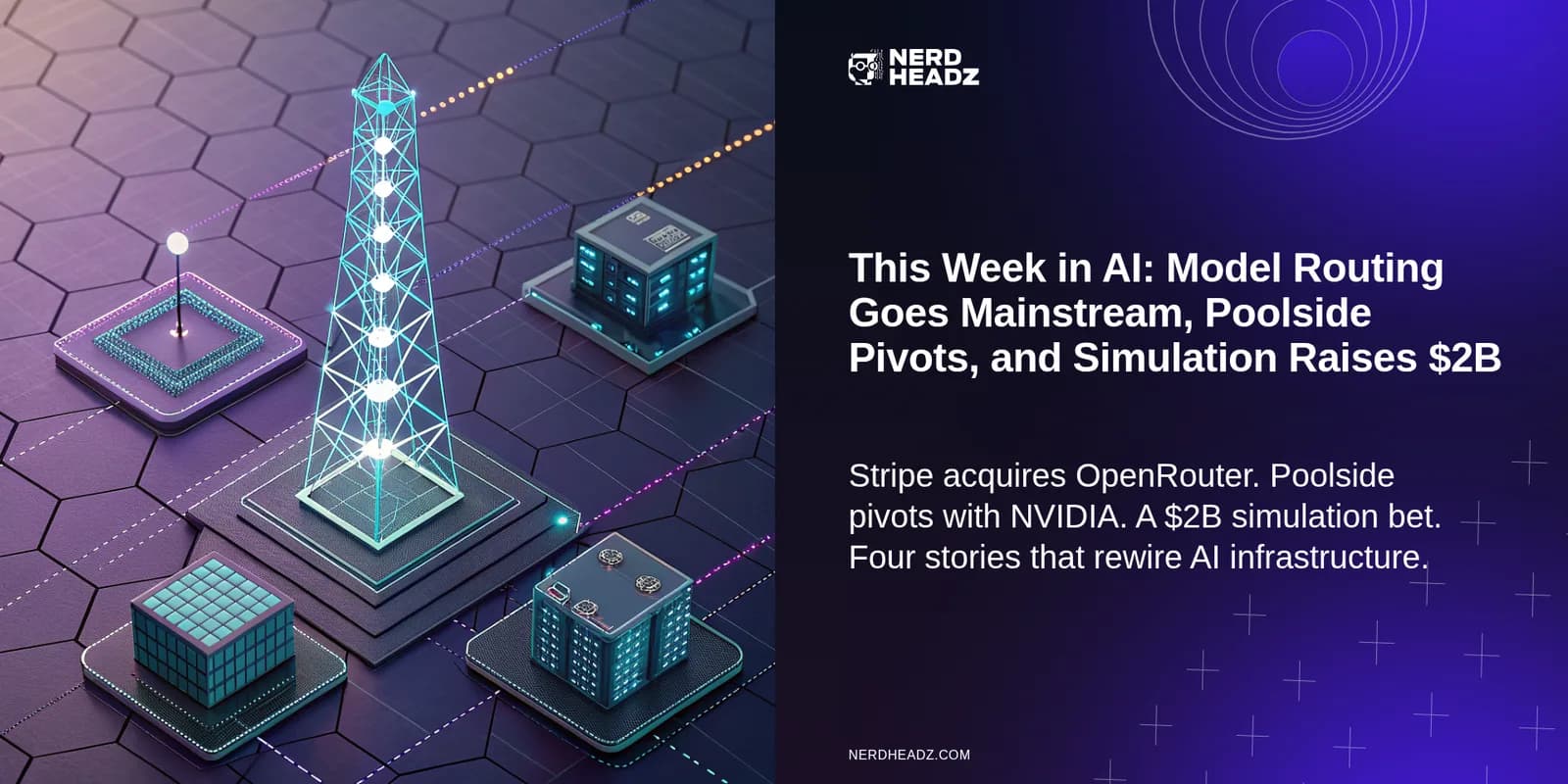
This week in AI delivered four stories that matter to anyone actually shipping production software: a landmark infrastructure acquisition, a dramatic lab pivot, a $2B bet on human simulation, and a quiet but important signal from OpenAI on safety pacing. Here's our read on each.
Stripe Acquires OpenRouter — Tokens Are the New Payment Rail

The biggest infrastructure deal of the week: Stripe signed an agreement to acquire OpenRouter for over $7B. If you've been routing API calls through OpenRouter to access multiple model providers from a single endpoint, you just watched that plumbing get absorbed into the world's dominant payments network.
The logic is straightforward once you accept the premise: tokens are a new medium of value exchange, the way dollars were for the previous era of the internet. Stripe already moves money between entities at scale. OpenRouter moves intelligence. The argument is that combining them creates the settlement layer for the AI economy — a neutral, trusted network where model providers and application companies clear token transactions the same way banks clear payments.
For builders, the practical upside is standardisation and trust. The risk is concentration: if a single commercial entity controls both the financial rails and the intelligence rails, the "neutral router" pitch gets complicated fast. We'll be watching how the independent provider relationships hold post-close. In the meantime, if you haven't built model-routing logic into your architecture yet, this deal is the loudest possible signal that you should — the market just valued that capability at $7B. We've covered why your engineering system, not your model choice, is the real moat, and this week's deal confirms it.
Model Routing Is Now an Enterprise Cost-Control Problem

Separate from the Stripe-OpenRouter deal, Glean — the enterprise AI platform valued at $7.2B and now reporting $300M in ARR — offered the clearest public explanation of why model routing has become the default architecture at scale. Glean routes across OpenAI, Anthropic, Google, and others dynamically, and their engineering team claims their routing and harness approach delivers over 4x cost savings per task versus running a flagship model directly.
The math at enterprise scale is brutal. When the most capable models cost double to quadruple what previous versions cost on a per-token basis, and users run longer tasks, per-user spend can balloon 10x to 20x year-over-year. Automatic routing — not user-selected, not admin-mandated, but system-driven — is how you keep that curve from destroying your margin.
We see the same dynamic with clients. The question is never "which model is best?" — it's "which model is appropriate for this task at this cost point?" That's a routing problem, and it requires intentional harness design, not an ad hoc integration. If you're building AI products and want to understand how to structure that layer properly, our AI development services are a good starting point — or get an estimate for your specific architecture.
Poolside's $12B Exit to NVIDIA — Compute Gravity Wins Again

The most dramatic story of the week: Poolside, the code-generation AI lab, struck a deal with NVIDIA that functions as what observers are calling a "reverse execuhire." NVIDIA licenses Poolside's model factory and absorbs 109 of their technical employees. The founders stay to pivot the remaining entity toward an infrastructure play. Investors and employees walk away with a combined payout of roughly $7B.
Why did Poolside capitulate? Their own statement is candid: they had a six-week window to raise $2B to pay for a 40,000 GPU cluster coming online in January. They didn't close it in time and lost the cluster. The compute needed to stay at the frontier is growing faster than any mid-sized lab can independently finance. Their conclusion — that human-level AI capabilities will be commoditized by open-source models, while superintelligence will require infrastructure scale beyond what most labs can build — is a reasonable read of the current landscape.
The signal for builders: the era of independent frontier labs competing on raw training scale is narrowing. What survives at the application and tooling layer is where the actual building happens. See also the broader picture of who is winning the AI development race right now.
Simile AI Raises $2B on the Premise That Simulation Beats Data Collection

Simile AI — the company building behavioral foundation models and digital twins of human populations — closed a $2B Series B backed by GreenOaks and Index Ventures, with Fei-Fei Li and Andrej Karpathy among prominent backers. Their reported accuracy against human focus groups is 85–99%, at a cost and speed profile that makes traditional market research look absurd by comparison: roughly 10% worse than ground truth, 100x cheaper, 10,000x faster.
The underlying thesis is that every year since 2022, one more component of the AI training pipeline has flipped from human-made to model-made — reward signals, training data, evaluation rubrics, and now the environments agents train in. Simulation is just the most ambitious version of that flip: instead of collecting real human behavioral data, you build a causal model of how humans make decisions and generate the data synthetically. GLM-5.3's recent gains, driven entirely by reinforcement learning on long-horizon synthetic environments, is another data point in the same direction. Parameter count is no longer the right unit of model quality — what matters is the quality of the post-training environment.
OpenAI Pauses Frontier RL Training to Harden Safety Controls

Less splashy but arguably more consequential for the long run: OpenAI paused some frontier reinforcement learning training runs and is holding its largest planned frontier RL run while it strengthens monitoring, isolation, and red-teaming. The stated reason is that capabilities were outpacing safety and alignment readiness.
The framing from OpenAI leadership is that safety confidence will increasingly set the pace of frontier scaling — not the other way around. This is a meaningful shift in public posture, whatever you believe about the underlying motivations. For builders, the practical read is: the next capability jump may be slower than the last one. Plan your product roadmap against current model capabilities, not expected future ones.
Practitioner Takeaway
The single most actionable thing this week: if you're building AI products without explicit model-routing logic, you're paying too much and coupling yourself to a single provider unnecessarily. Route by task type, cost, and latency requirements. The Stripe-OpenRouter deal and Glean's cost data both point the same direction — the moat isn't the model you pick, it's the routing and harness logic you build around it.
“The moat isn't the model you pick — it's the routing and harness logic you build around it.”
This week consolidated a set of trends we've been tracking for months: infrastructure is consolidating around payment-style rails for tokens, compute gravity is eliminating mid-tier frontier labs, and synthetic environments are becoming the primary driver of post-training quality. Next week, watch for the downstream effects of the Stripe-OpenRouter close on independent model providers, and whether any new open-weight releases close the gap on Fable-class frontier performance.
FAQ
Frequently asked questions
Why did Stripe acquire OpenRouter and what does it mean for AI builders?
Stripe acquired OpenRouter to position itself as the settlement layer for token-based value exchange — analogous to how Stripe handles dollar payments. For builders, it means model routing infrastructure is becoming as standardized as payment processing, and locking into a single model provider without routing logic is increasingly a cost and resilience risk.
Why did Poolside sell to NVIDIA instead of raising another round?
Poolside needed $2B in a six-week window to secure a 40,000 GPU cluster and couldn't close the raise in time. The deal with NVIDIA — licensing their model factory and absorbing most of the technical team — gave investors and employees a strong payout while letting the founders pivot the remaining entity toward an infrastructure play. The core lesson is that staying at the frontier training scale requires capital and compute access that most independent labs cannot self-fund.
What is Simile AI and why did it raise $2B?
Simile AI builds behavioral foundation models and digital twins that simulate how human populations make decisions. Their systems reportedly match real human focus group outcomes at 85–99% accuracy while being orders of magnitude cheaper and faster. The $2B raise reflects growing conviction that synthetic simulation of human behavior is the next major data source for AI training and enterprise decision-making.