In this article07 +
- NVIDIA Acquires HuggingFace for $13 Billion
- OpenAI Shuts Off Cursor's API Access
- GLM-5.3-Flash Ships: Another Open-Weight Frontier Model
- a16z Raises a $1.1B "Machine Age Fund" for AI Infrastructure
- The Benchmark Problem Is Now a Real Conversation
- Lovable Hits $500M ARR and Pivots to Agent-Accessible "Capabilities"
- AI Pricing Logic: Stop Pricing Tokens, Start Pricing Value
This week in AI was one of the more consequential in recent memory. A landmark acquisition, a very public model access war, a major open-weight release, a $1.1B infrastructure fund, and a growing consensus that benchmarks are lying to us — all in the same seven days. Let's get into it.
NVIDIA Acquires HuggingFace for $13 Billion

The deal that had been rumored since early this year is confirmed: NVIDIA is buying HuggingFace for $13 billion, roughly 80x the platform's annualized revenue. HuggingFace had doubled its customer base in the past year, which likely explains why the final price was nearly double NVIDIA's initial offer.
For builders, this is not just a headline. HuggingFace is where the open-source model ecosystem lives — weights, datasets, spaces, and the community infrastructure around all of it. NVIDIA owning that layer means the chip-to-model pipeline just got vertically integrated in a way that will reshape how open-source AI is accessed, funded, and prioritized. We're watching carefully to see whether the openness holds post-acquisition, or whether the platform gradually tilts toward NVIDIA hardware preferences.
OpenAI Shuts Off Cursor's API Access

After Cursor was acquired by SpaceX, OpenAI cut off the coding tool's model access, citing prior experience with Elon Musk's companies violating contracts. Cursor's response was measured — noting that OpenAI accounts for only around 5% of its traffic — and the tool has pivoted toward promoting Grok 4.6 as its featured model.
The bigger lesson here has nothing to do with the personalities involved. It's about API dependency risk. Any product built on a single model provider's API is one business dispute away from a forced migration. We've written about how fast AI systems need to move, and this situation makes that architectural risk concrete. Multi-provider routing and model-agnostic design aren't premiums anymore — they're table stakes.
GLM-5.3-Flash Ships: Another Open-Weight Frontier Model

Z.ai formally launched GLM-5.3-Flash — previously teased as "Ox Alpha" — this week. It is a natively multimodal model with a 1 million token context window, 320 billion total parameters with 18 billion active, released under the MIT License with open weights available from day one. The team claims it outperforms its predecessor at every effort level and benchmarks competitively with frontier closed models on coding tasks.
What matters for teams shipping production AI: the gap between the best open-weight models and closed API models is compressing fast. We keep seeing this pattern — a capable open model ships, gets day-zero inference framework support, and within weeks it's in production pipelines. The cost and control advantages of running your own weights are becoming accessible at genuinely competitive quality levels.
If you're building anything where data privacy, cost at scale, or vendor independence matters — and that's most serious applications — open-weight models deserve a real evaluation slot in your stack. Our app development services increasingly factor this decision in from the architecture phase, not as an afterthought.
a16z Raises a $1.1B "Machine Age Fund" for AI Infrastructure

The fund is earmarked specifically for physical AI infrastructure: chips, memory, networking, storage, data centers, robotics, and edge AI hardware. The framing is explicit — compute density per rack has increased 28x from H100 to Rubin architecture, rack power is moving from 10kW toward 1MW over the next three years, and data center scale is moving from tens of megawatts toward gigawatt-scale campuses.
The application layer gets all the press, but infrastructure constraints are where the real bottlenecks are forming. Token demand is growing faster than the hardware industry knows how to supply — an industry accustomed to 20-30% annual growth facing triple-digit demand. This fund is a bet that the picks-and-shovels play in AI is not the models themselves, but everything underneath them.
The Benchmark Problem Is Now a Real Conversation

Two threads this week converged on the same uncomfortable truth: the benchmarks we use to evaluate AI don't actually tell you whether the model does your job. In healthcare, the core problem is that there's no objective "ground truth" for most clinical decisions — you'd need to follow patients forward in time to know if the AI recommendation was right. In enterprise AI purchasing, companies are spending large sums based on public leaderboard positions without knowing whether those models perform better on their actual tasks than cheaper alternatives.
The practitioner answer is building your own evals tied to real work. Not "does this model score higher on MMLU" but "does this model complete our specific workflow correctly, at the right quality level, consistently." We build these domain-specific evaluation harnesses into every serious production deployment — it's the only honest way to select and monitor models. Reach out if you want to talk through how we approach this.
Lovable Hits $500M ARR and Pivots to Agent-Accessible "Capabilities"

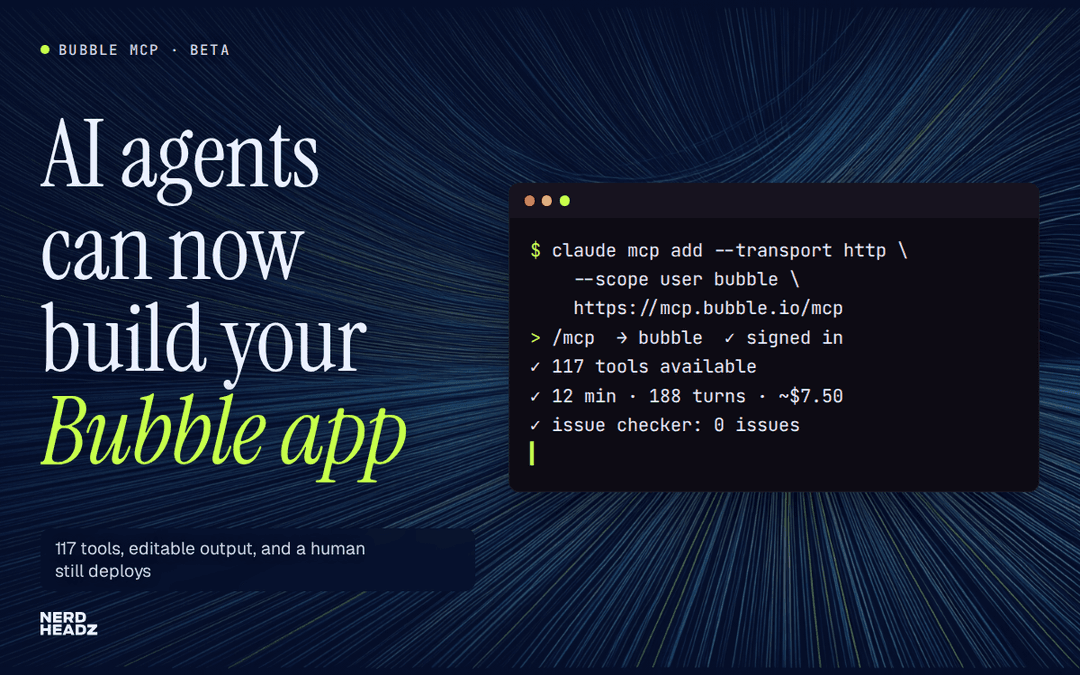
Lovable — the app builder that emerged from GPT Engineer in 2023 — has surpassed a $500 million annualized revenue run rate, with over 60 million projects created. More significant than the revenue number is the architectural direction: Lovable is now letting users expose selected functions from their built apps as tools through a hosted MCP server, creating a dual-interface model — a traditional human UI plus an agent interface compatible with ChatGPT, Claude, and other MCP clients.
This is the clearest signal yet that the SaaS paradigm is bifurcating. Applications increasingly need to serve two distinct consumers: humans and agents. Any product we're building today through our web development practice now gets an explicit question in scoping: does this app need an agent-accessible surface, and if so, what capabilities should be exposed and how?
AI Pricing Logic: Stop Pricing Tokens, Start Pricing Value

There was a sharp piece circulating this week making the case that application-layer AI products should not price in tokens. The argument is clean: tokens are the model provider's cost unit, not your customer's value unit. Pricing in tokens anchors your product to an infrastructure metric whose cost keeps falling, trains customers to compare you to raw compute, and obscures the real value your orchestration, data, and workflow logic deliver. Price at the highest layer of value you can reliably measure — not at the layer your infrastructure vendor charges you.
A survey of 50 technical AI buyers found 27 preferred credits tied to recognizable work over 14 who preferred tokens. The practical takeaway for builders and founders: define the unit of work your product delivers — a completed account brief, a resolved support conversation, a deployed code change — and price that, not the compute underneath it.
Practitioner takeaway this week: Audit your model provider dependencies. The Cursor situation is a case study in what happens when a single API relationship goes sideways. Map which providers each product feature relies on, identify where a substitution would break things, and start building the routing or fallback logic that gives you negotiating leverage — and resilience. If you haven't already looked at where open-weight models could replace a closed API call in your stack, this week is the week to start.
“Price at the highest layer of value you can reliably measure — not at the layer your infrastructure vendor charges you.”
This was a week where the infrastructure layer, the tooling layer, and the economic layer of AI all moved simultaneously — a sign the ecosystem is maturing faster than most roadmaps anticipated. The Cursor-OpenAI split and the HuggingFace acquisition together redraw the competitive map for developer tooling in ways that will take months to fully land. Watch for how model access politics evolve as more coding tools get acquired by companies with their own model ambitions.
FAQ
Frequently asked questions
Why did OpenAI cut off Cursor's API access and what does it mean for developers?
OpenAI terminated Cursor's model access following Cursor's acquisition by SpaceX, citing prior contract violations by Elon Musk's companies. For developers, it's a concrete reminder that building production tools on a single model provider creates real business risk — multi-provider architecture is now a serious architectural requirement, not a nice-to-have.
What does NVIDIA acquiring HuggingFace mean for the open-source AI ecosystem?
At $13 billion, NVIDIA gains ownership of the dominant platform for open-weight model distribution, datasets, and community tooling. The practical concern for builders is whether the platform's openness and neutrality hold under a hardware vendor's ownership, or whether access and prioritization gradually favor NVIDIA-optimized infrastructure.
How should AI builders approach model evaluation if public benchmarks are unreliable?
Build domain-specific evals tied to your actual production tasks — not public leaderboard scores. Define what "correct" output looks like for your specific workflow, collect representative examples, and test every model candidate against that harness. This also gives you a principled way to monitor quality as models are updated, which matters because providers update models continuously without notice.