Answer over your knowledge base
Staff and customers ask in plain language; get answers grounded in your real docs.
Retrieval-augmented generation that grounds LLMs in your real data — the full pipeline (ingestion, chunking, embedding, retrieval, re-ranking, generation), tuned so answers are accurate, current, and cited. RAG quality is retrieval quality, and that’s what we build for.
RAG LLM development — retrieval-augmented generation — is the practice of connecting large language models to your company's actual data so they answer questions from real information, not from whatever the model memorized during training. At NerdHeadz, RAG development means building the full pipeline: ingestion, chunking, embedding, retrieval, re-ranking, and generation — not just wiring a vector database to an API and hoping the answers are good enough.
The loudest failure mode in RAG systems is "the AI is hallucinating." But nine times out of ten, the model never saw the right information. The retrieval layer returned the wrong chunks, or the chunks were too large to be useful, or the document was never ingested properly in the first place. RAG quality is retrieval quality. Everything else — model choice, prompt engineering, output formatting — is secondary to whether the system can find the right information before generating an answer. We build RAG pipelines in TypeScript and Python, with React and Next.js for the user-facing layer, and Claude Code accelerating the iteration cycle across the full stack.
Data ingestion is 70% of the work. Document structure, chunking strategy, and metadata design determine retrieval quality more than the vector database or the model. We handle PDF extraction, HTML parsing, structured data mapping, and document hierarchy preservation. A support article chunked by paragraph loses its section headings. A legal contract chunked at 512 tokens splits clauses mid-sentence. We design chunking strategies per document type because there is no universal chunk size that works for everything.
Retrieval strategy, not just embeddings. Plain vector similarity search is rarely the right answer for production RAG systems. We build hybrid retrieval — semantic search for meaning, keyword search for exact terms, re-ranking models to sort results by actual relevance, and query rewriting to handle the gap between how users ask questions and how documents store answers. When AI agents are the consumer of RAG output, retrieval precision matters even more — an agent that acts on the wrong context takes the wrong action.
Evaluation harness from day one. Before shipping a RAG system, we build a gold-standard question-and-answer set from your actual documents. We measure retrieval recall separately from answer quality, so when things regress you know which half of the pipeline is failing — did the system retrieve the wrong chunks, or did it generate a bad answer from the right chunks? This distinction is the difference between debugging for hours and fixing the problem in minutes.
Model choice is the last decision, not the first. Once retrieval is solid, model choice is a cost-and-latency tradeoff, not a quality gate. Claude, GPT, open-source models — they all generate good answers when fed the right context. They all generate bad answers when fed the wrong context. We pick the model after the retrieval pipeline proves it can find the right information consistently.
Staff and customers ask in plain language; get answers grounded in your real docs.
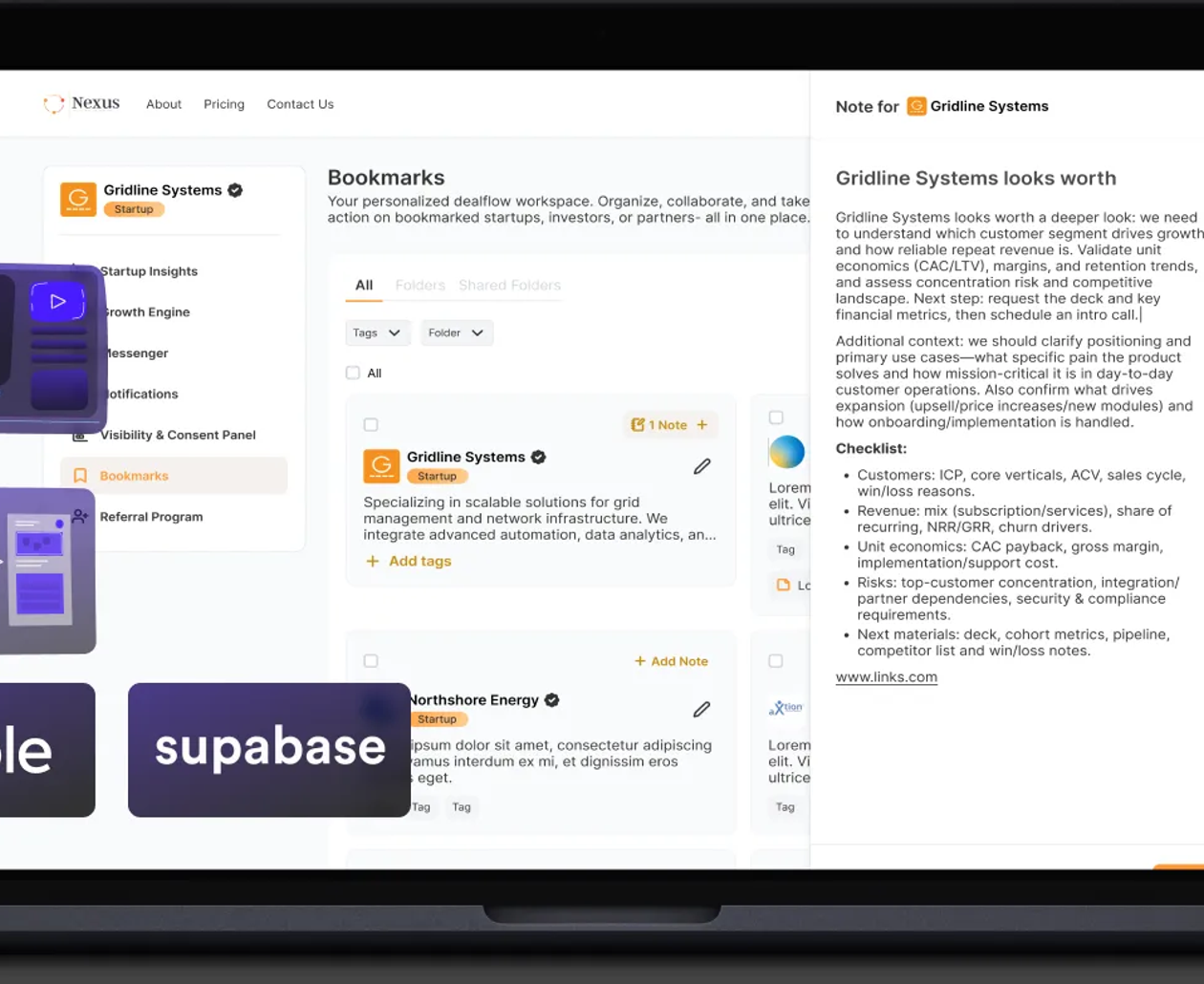
The engine behind PovNexus — retrieval over a venture-intelligence corpus.
AI that cites the policy, contract, or doc it answered from.
Every answer auditable and traceable to a permissioned source.
RAG works well for a specific set of data shapes — and fails predictably on others.
- Works well: large, well-structured document corpora — policy manuals, technical documentation, product specs, support knowledge bases. Internal knowledge bases where ground truth exists and changes at a manageable pace. Question-answering over versioned technical content where accuracy is verifiable. - Usually doesn't work: messy corpora with conflicting sources — garbage in, confident-garbage out. Queries that require synthesis across dozens of documents (RAG helps, but it's not a substitute for reasoning across a full corpus). Real-time fast-changing content without automated ingestion pipelines to keep the index current. - Doesn't work: RAG as a fix for bad data hygiene — if your source documents are contradictory, incomplete, or outdated, RAG surfaces those problems faster, it doesn't solve them. RAG as a substitute for a search UI when users actually want to browse, filter, and explore rather than ask a question.
RAG & LLM development is one specialization within our AI development services practice. Depending on what you're building:
- If the RAG system powers an autonomous workflow — not just answering questions but taking actions based on retrieved context — AI agent development covers the orchestration layer on top of retrieval. - If the primary interface is conversational — users chatting with a system that retrieves and answers — AI chatbot development handles the conversation design and channel deployment. - For teams building a full product with RAG as one component, custom software development covers end-to-end delivery from UI to infrastructure. - RAG prototyping is one of the fastest vibe coding use cases — we often build and validate a retrieval pipeline in days before committing to a full production build.
RAG (Retrieval Augmented Generation) connects large language models to your own data sources — documents, databases, knowledge bases — so AI responses are grounded in accurate, company-specific information rather than general knowledge.
NerdHeadz builds document Q&A systems, customer support knowledge bases, internal search tools, content generation engines, and AI assistants that reference proprietary data with high accuracy.
NerdHeadz implements chunking strategies, embedding optimization, re-ranking models, and evaluation frameworks to minimize hallucination and ensure the AI retrieves and generates accurate answers from your data.
RAG systems can connect to PDFs, Word documents, databases, APIs, CRMs, help centers, wikis, Notion, Google Drive, Confluence, and most other structured or unstructured data sources.
A basic RAG implementation takes 4–8 weeks. More complex systems with multiple data sources, fine-tuned retrieval, and production-grade evaluation typically take 8–16 weeks.
Talk to an AI for a 60-second scope, or book a 30-min call with the founder.