In this article05 +
The Benchmark Illusion Hiding the Real AI Divide
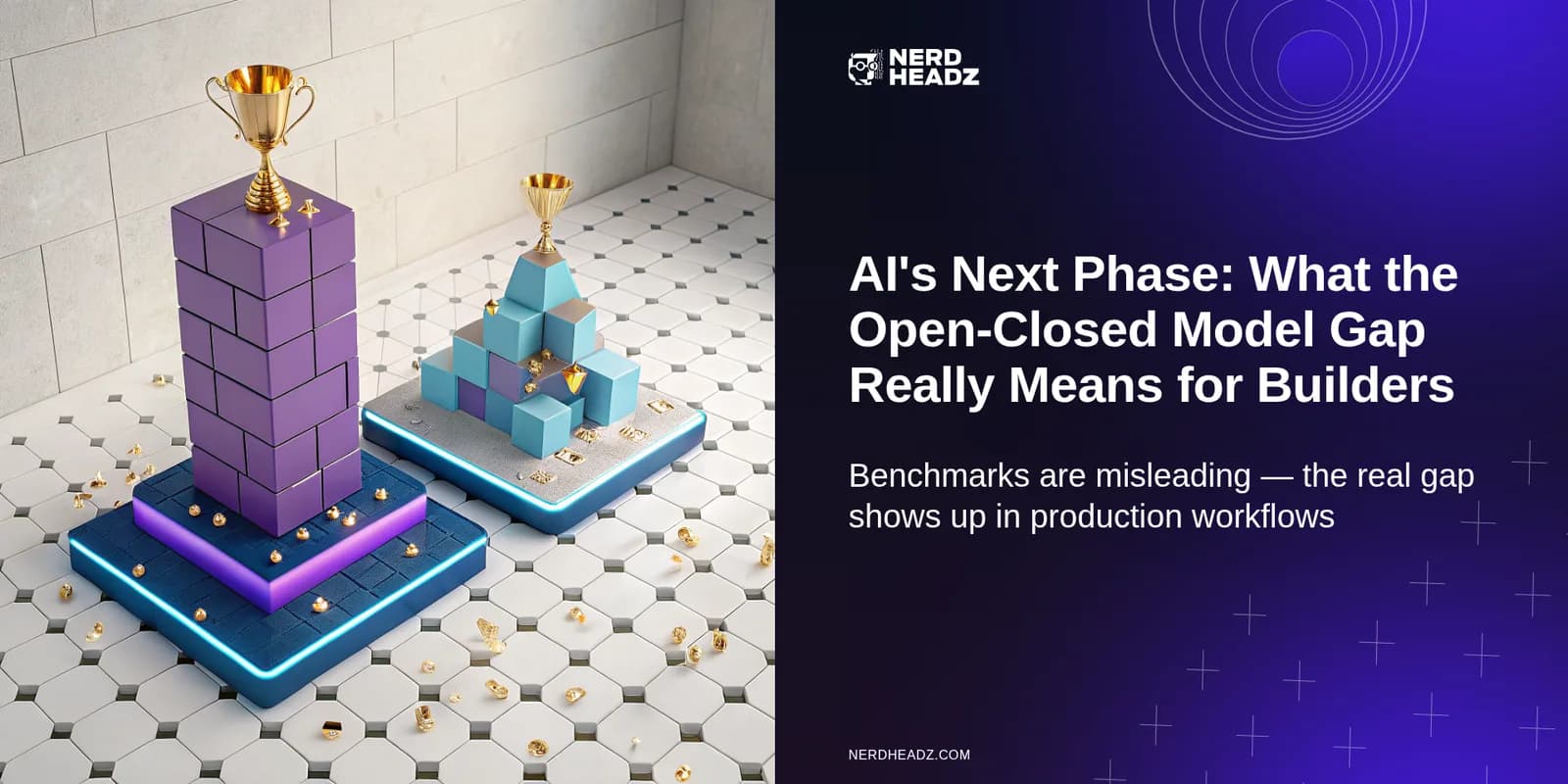
The open-closed AI model gap is not what the leaderboards suggest. Scores on reasoning benchmarks keep climbing for open-weight models, but there is a much cleaner test that cuts through the noise: does the model hold up inside an agentic workflow running unsupervised for hours? Right now, the answer for open models is almost universally no — and that gap has direct consequences for what builders can ship today.
Nathan Lambert's ongoing analysis at Interconnects tracks this divide carefully, and it shapes how we think about model selection at NerdHeadz. We have been integrating AI into production systems long enough to know that benchmark wins rarely translate cleanly into reliable, cost-effective agent behavior. The distinction matters enormously when you are scoping a client project around autonomous workflows.
---
Why Agentic Performance Is the Real Litmus Test

Agentic capability — the ability to reason through multi-step tasks, recover from errors, and operate reliably without human babysitting — is the single most important axis separating frontier closed models from the open-weight field right now.
Claude Code demonstrated this sharply in late 2025. Developers running autonomous coding sessions reported a qualitative leap in reliability that no benchmark had predicted. The closest open-model equivalent simply does not exist yet, and we are now well past the six-month mark with no serious challenger emerging. Our engineering team puts the realistic window for a true open-model match at twelve months or more, not three.
This is why, when clients ask us whether they can cut infrastructure costs by swapping a frontier model for an open-weight alternative on an agentic task, the honest answer is: not yet for complex, high-stakes workflows. For narrow, well-defined pipelines with predictable inputs, open models are already competitive. For anything requiring broad judgment and recovery, the closed frontier still dominates.
Working on something similar? Talk to our team about your project.
---
The American Open-Source Surge Is Real, But Specialization Is the Story

Something important is shifting in the open-model ecosystem. Nvidia's Nemotron, Google's Gemma 4, and a cluster of newer American labs are quietly reclaiming ground that Chinese labs held for the better part of two years. Gemma 4 is now matching or outperforming equivalently sized Qwen models — models that were the default choice for researchers for years — and its move to a fully permissive Apache 2.0 license has accelerated adoption sharply.
But the more important trend is where these open models are actually landing. They are not eating into Claude Code or Codex territory. They are powering enterprise automation pipelines, cost-sensitive agent deployments, and post-training research workloads. That is a substantial market, but it is a different market. As we explore in our breakdown of Gemma 4 and the shift toward Google's open model ecosystem, the model quality gains are real — the question is always fit-for-purpose.
For builders, this means the architecture decision is becoming more nuanced. A mixed deployment — frontier closed model for the high-judgment core, a well-tuned open model for the high-volume periphery — is often the right answer in 2026.
---
The Power Concentration Problem Every Builder Should Understand

The competitive picture at the frontier is not just a technical story. It is increasingly a structural one. Compute concentration data from Epoch AI puts Google at roughly 25% of available AI training compute, with Meta and OpenAI each around 11%. Anthropic sits at approximately 6%. Every Chinese lab operates at a fraction of these numbers.
This compute asymmetry explains why no open-weight equivalent to the most capable frontier reasoning models has appeared, and why it will take longer than many expect. The labs closing that gap are not doing so by being clever — they are doing so by spending billions on infrastructure that smaller players simply cannot match.
For the products we build at NerdHeadz, this shapes how we think about long-term architecture. Locking a product too tightly to a single frontier provider creates dependency risk. Building modular interfaces that can absorb model swaps — as we do across our app development services — is increasingly standard practice rather than an optional engineering luxury.
---
Where This Leaves Product Teams in the Next 12 Months

The near-term reality for teams building AI-powered products is a two-tier landscape that will sharpen, not flatten. Closed frontier models will keep pulling ahead on the tasks that require the most judgment, while open models become more capable and more trusted for automation at scale.
The teams that win are not the ones waiting for the gap to close. They are the ones designing systems that exploit the current strengths of each tier intelligently. That means clear task decomposition, honest evaluation of where agent failure is costly, and model interfaces that don't assume today's winner is permanent.
AI is simultaneously concentrating capability at the largest labs and enabling very small, specialized teams to operate at a quality level that was impossible two years ago. The middle — undifferentiated knowledge work that doesn't lean into either extreme — is where the disruption will be most felt. Building products that serve the specialists at both ends is where we see the most durable opportunity.
Ready to build? NerdHeadz ships production AI in weeks, not months. Get a free estimate.
“The real open-closed AI model gap doesn't show up on leaderboards — it shows up the moment you run a production agent overnight.”
The open-closed AI model gap is a product design constraint as much as a technical one — and teams that treat it that way will make better architecture decisions in 2026. Benchmark scores tell you almost nothing; production agent behavior tells you everything. The builders who understand which tier of model belongs where in their stack are the ones who will ship reliable, cost-effective AI products while others are still waiting for parity that may be further away than anyone admits.
FAQ
Frequently asked questions
What is the open-closed AI model gap and why does it matter in 2026?
The open-closed AI model gap refers to the performance difference between publicly available open-weight models and proprietary frontier models from labs like Anthropic, OpenAI, and Google. In 2026, this gap is most visible in agentic workloads — tasks requiring multi-step reasoning, error recovery, and unsupervised operation — where closed models still significantly outperform open-weight alternatives despite benchmark parity on simpler evaluations.
Can open-weight models replace frontier closed models for AI agents?
For narrow, well-defined automation pipelines, open-weight models are already competitive and cost-effective. For complex agentic workflows requiring broad judgment, reliable recovery from errors, and sustained performance over long sessions, closed frontier models like those powering Claude Code and Codex remain the stronger choice. A hybrid architecture — frontier models for high-stakes reasoning, open models for high-volume peripheral tasks — is the practical standard in production systems today.
How should product teams choose between open and closed AI models?
Product teams should evaluate model choice based on task complexity, failure cost, and deployment volume rather than benchmark rankings. Frontier closed models are best for autonomous, judgment-heavy workflows where failure is expensive. Open-weight models excel in cost-sensitive, well-scoped automation tasks. Building model-agnostic interfaces from the start allows teams to swap models as the landscape evolves without rebuilding core product logic.
Spotted via Interconnects by Nathan Lambert