In this article05 +
Your LLM Isn't the Bottleneck — Your Harness Is

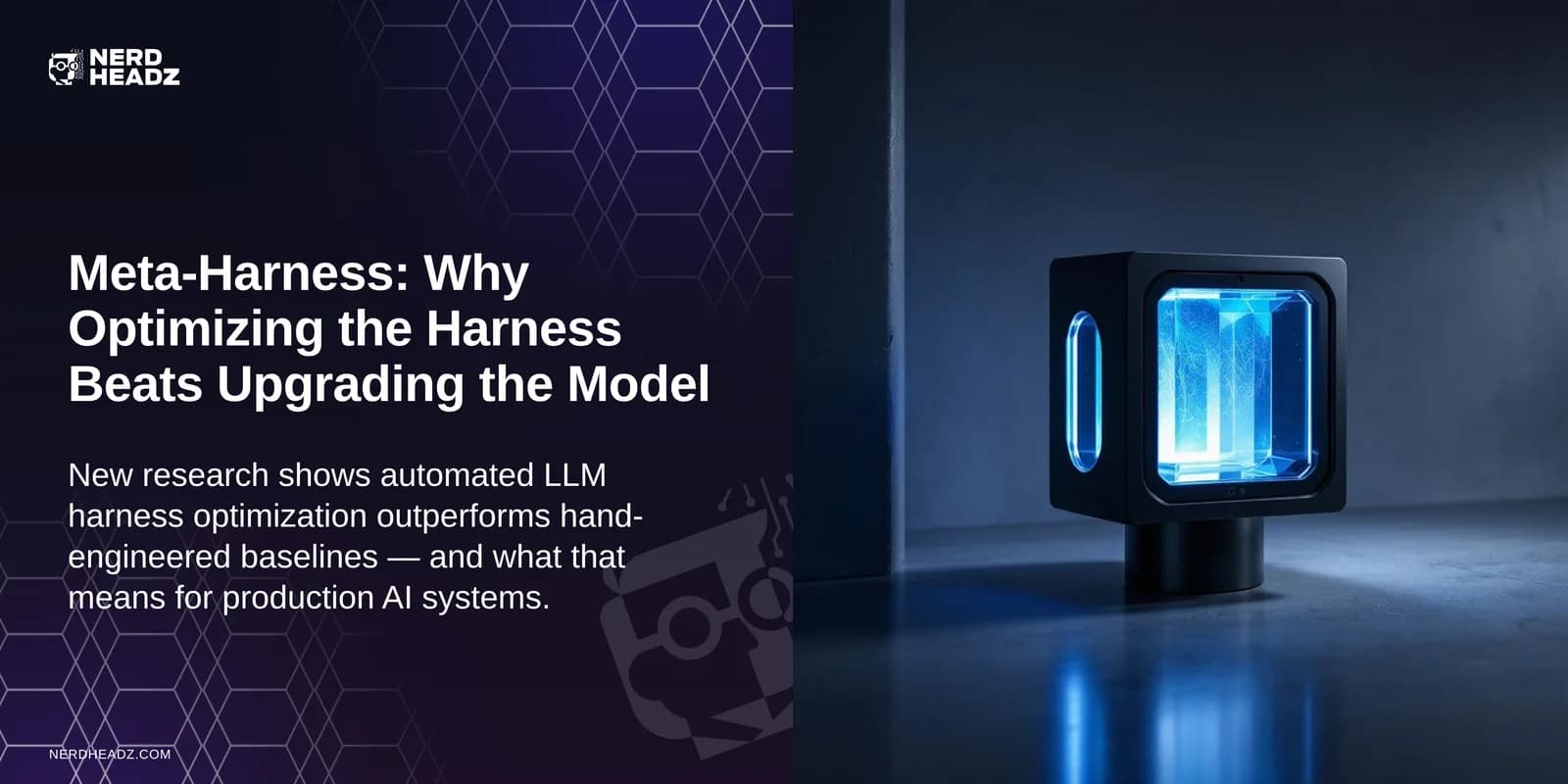
Most teams chasing better AI performance instinctively reach for a bigger model. New research from arXiv on Meta-Harness: End-to-End Optimization of Model Harnesses argues that's the wrong lever. The harness — the code governing what information gets stored, retrieved, and passed to your model — is where most production AI performance is won or lost, not in the model weights themselves.
This confirms something we've been arguing at NerdHeadz for a while. As we covered when Stanford's research showed the harness matters more than the model, the scaffolding around your LLM is the real differentiator in production systems. Meta-Harness takes that insight and operationalizes it with automation.
What Meta-Harness Actually Does

Meta-Harness is an outer-loop optimization system that searches over harness code rather than model parameters. Instead of a human engineer iterating on prompts and retrieval logic by hand, an agentic proposer examines source code, scores, and execution traces from all prior candidate harnesses — stored in a structured filesystem — and uses that rich history to propose better versions.
This is a meaningful architectural departure from existing text optimizers, which typically compress feedback so aggressively that useful signal is lost. Meta-Harness preserves the full context of prior attempts, giving the optimizer enough information to reason about *why* a harness succeeded or failed, not just *that* it did.
The Results Are Hard to Dismiss
The benchmark numbers from the paper make the case clearly:
- On online text classification, Meta-Harness beat a state-of-the-art context management system by 7.7 accuracy points while using 4× fewer context tokens.
- On retrieval-augmented math reasoning across 200 IMO-level problems, the discovered harness improved accuracy by 4.7 points on average across five held-out models.
- On agentic coding tasks (TerminalBench-2), automated harnesses surpassed the best hand-engineered baselines outright.
What makes the math reasoning result particularly significant is the generalization: a single optimized harness improved performance across five different models it had never seen during optimization. That's not overfitting to one model's quirks — that's a fundamentally better information architecture.
Why This Matters for Production AI Systems

Working on something similar? Talk to our team about your project.
The practical implication here is direct: if you're building a RAG pipeline, an AI agent, or any LLM-powered application, the decisions about *how* to retrieve, *what* to include in context, and *how* to structure that information for the model are at least as important as which model you choose. These are harness decisions, and right now most teams are making them manually and incrementally.
Manual harness engineering works up to a point. Senior engineers develop intuitions about context window management, retrieval chunking strategies, and prompt structure. But those intuitions are slow to develop, hard to transfer across projects, and nearly impossible to systematically validate at scale. Meta-Harness points toward a future where that optimization loop is automated.
For teams building on top of RAG architectures specifically, this research reinforces a point we make constantly in our guide to implementing retrieval-augmented generation: retrieval quality and context construction are your primary performance levers, not the model sitting at the end of the pipeline.
The Agentic Proposer Is the Key Innovation

It's worth dwelling on *how* Meta-Harness generates better harnesses, not just *that* it does. The agentic proposer has access to the full history of what was tried — source code, not just summaries — along with scores and execution traces. This is richer feedback than any text optimizer working from compressed outputs alone.
The system treats harness optimization as a code search problem, not a prompt tuning problem. That framing matters because harnesses aren't just prompts — they're programs. They have logic, conditionals, retrieval calls, and state management. Optimizing them requires reasoning about behavior over time, not just about what words appear in a single context window.
This is precisely the kind of system architecture our AI agent development work is moving toward: agents that improve their own operational context, not just their outputs.
What Teams Should Take Away

LLM harness optimization is not an academic curiosity. It's the next frontier for any team that has already picked a capable base model and is now trying to squeeze real-world performance out of it. The marginal gains from switching from GPT-4o to a competitor are often smaller than the gains available from restructuring how your application manages context.
The Meta-Harness paper makes this case with rigorous benchmarks, and its generalization results suggest that well-optimized harnesses encode something genuinely transferable about how to structure information for language models.
Ready to build? NerdHeadz ships production AI in weeks, not months. Get a free estimate.
“The harness is where most production AI performance is won or lost — not in the model weights.”
Meta-Harness demonstrates that automating the optimization of LLM harnesses — the code that controls what your model sees — delivers measurable, generalizable performance gains that model upgrades alone cannot match. For any team building serious AI applications, the harness deserves the same engineering rigor as the model itself. The gap between hand-engineered and optimized harnesses is closing fast, and the teams who act on this now will hold a durable advantage.
FAQ
Frequently asked questions
What is an LLM harness and why does it matter for performance?
An LLM harness is the code layer that determines what information is stored, retrieved, and presented to a language model at inference time. It directly controls context quality, and research shows that optimizing the harness often yields larger performance gains than switching to a more powerful model.
What is Meta-Harness and how does it work?
Meta-Harness is an automated outer-loop optimization system that searches over harness code for LLM applications. It uses an agentic proposer with access to source code, scores, and execution traces of all prior harness candidates to generate progressively better versions without human intervention.
How much does LLM harness optimization improve accuracy?
According to the Meta-Harness paper, automated harness optimization improved text classification accuracy by 7.7 points while using 4× fewer tokens, and improved retrieval-augmented math reasoning by 4.7 points on average across five held-out models — demonstrating that harness improvements generalize across different LLMs.