The Real Deployment Problem Nobody Talks About Enough
The hardest part of shipping a production AI system isn't the initial training run. It's what happens after. Models go stale. Users change. Domains evolve. And the architecture most teams ship on day one — static weights, retrieval bolted on the side — starts showing cracks within months.
Continual learning in LLMs is the discipline that addresses this directly. Recent parallel research from Carnegie Mellon, the University of Maryland, and Google-affiliated teams has put the problem back at the center of AI research with unusual urgency, and the findings have real consequences for how we approach AI system architecture at NerdHeadz.
The core tension is this: a model that updates too aggressively drifts. A model that never updates goes stale. Neither outcome is acceptable in a production system that clients depend on daily.
What "Continual Learning" Actually Covers

Continual learning in LLMs is not a single technique — it is a family of challenges that spans three distinct layers.
The first is continual pre-training, where a model needs to absorb new general knowledge without overwriting what it already understands about language and the world. The second is continual fine-tuning, where a deployed model must specialize further to a domain, a workflow, or a user population without collapsing its general capabilities. The third — and most underappreciated — is continual alignment, where the model's behavioral guardrails must remain stable even as its knowledge base shifts underneath them.
A 2026 survey covering the full landscape of the field is direct about the state of the art: current methods work in constrained settings, but smooth learning across tasks and time remains unsolved. We've run into all three of these layers on real client projects, and the bottleneck is almost always the third: keeping alignment intact while everything else adapts.
Working on something similar? Talk to our team about your project.
Why the "Sleep" Metaphor Is Technically Precise

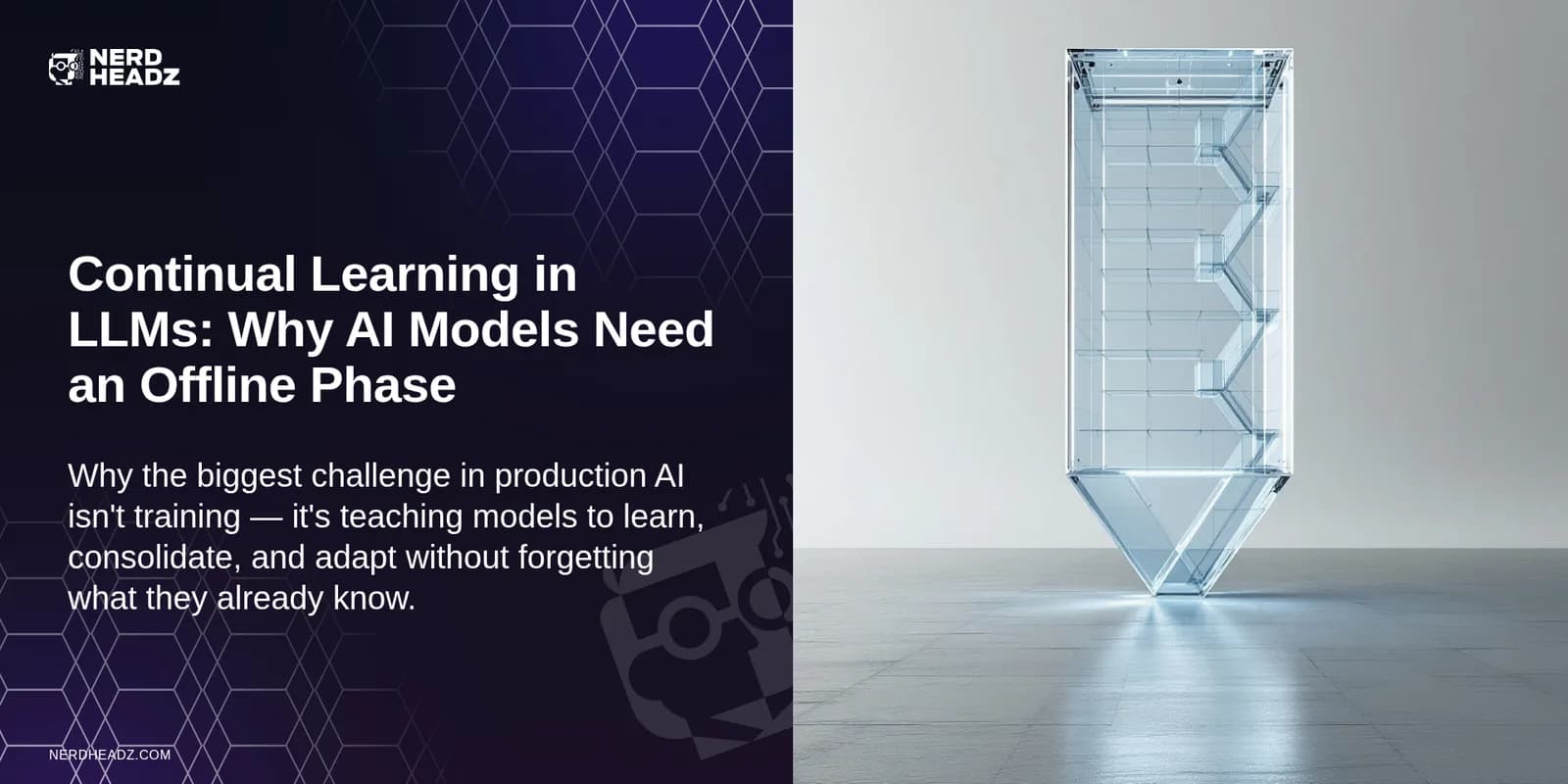
The sleep framing isn't poetic decoration — it identifies a structural problem in how LLMs update. Models don't need rest in any biological sense. What they need is an offline consolidation phase that sits between experiencing new information and deciding what should permanently change.
Continuous live updating is risky because gradient-based updates during active inference can destabilize the model's existing representations — a well-documented problem in classical machine learning called catastrophic forgetting. Doing nothing leaves the system frozen in time. The sleep paradigm proposes a third option: the model interacts, accumulates experience, then enters an offline pass where it decides what deserves to persist.
The CMU/Maryland work approaches this from the inference side. Long-context reasoning is expensive because the KV cache grows with every token the model attends to. Hybrid architectures can compress older context into fast weights, but compression without additional computation creates reasoning gaps. Their proposed offline recurrent passes over recent context show the largest accuracy gains precisely on tasks requiring multi-step reasoning — not on simple recall. Memory is not only storage, it is processing. That distinction changes how we think about system design.
The Google-affiliated work frames this as a two-step production architecture. A "Knowledge Seeding" phase consolidates short-term in-context learning into more durable parameters. A "Dreaming" phase then uses model-generated synthetic data to rehearse what was recently learned before the next interaction cycle begins. The separation between live interaction and parameter consolidation is the key architectural insight — and it maps cleanly onto how we'd structure an AI system that needs to improve with use rather than just accumulate context.
Understanding why this works mechanically connects back to how models represent knowledge in the first place. If you want the foundation, our breakdown of how tokens gain meaning through geometry explains the embedding layer dynamics that make consolidation both necessary and non-trivial.
The Agent Problem Makes This More Urgent

Static document ingestion is the easy version of this problem. Agents make it exponentially harder.
An agent's experience isn't a clean stream of text. It includes tool call results, failed reasoning paths, user corrections mid-task, environmental feedback, and repeated workflows that should generalize. Each of those signals carries different persistence requirements: some should be discarded immediately, some should persist for a session, and some should modify the model's long-term behavior.
Recent research on lifelong learning for LLM agents frames the challenge through three lenses — perception, memory, and action — and the findings confirm that naive repeated fine-tuning cycles don't compound. They collapse. Poorly internalized experience degrades the model's subsequent behavior rather than improving it. This is why the offline consolidation phase isn't just a nice architectural feature — it's load-bearing.
For teams building agent systems, this connects directly to how retrieval-augmented architectures handle knowledge boundaries. Our guide on implementing retrieval-augmented generation covers the retrieval side of the equation — but the continual learning research makes clear that retrieval alone is not a permanent substitute for parametric memory updates done safely.
What This Means for Production AI Builds

The practical takeaway for any team building AI systems today is that the learning architecture deserves as much design attention as the model selection.
Three questions worth answering before you ship:
At what boundary does your system distinguish between temporary session context and information that should influence future behavior? Without an explicit answer, you're either leaking everything into parameters or discarding everything — neither of which is correct.
How does your system handle conflicting signals? A user corrects the model one day and praises the same behavior the next. An offline consolidation phase gives you a moment to resolve that conflict before it creates inconsistency.
What's your rollback story? Any system that updates parametrically needs a version-controlled path back. This is infrastructure work, not ML work — but it's equally non-negotiable.
The teams that think about these questions during architecture design rather than after the first incident are the ones that ship AI systems that actually improve with use rather than just accumulate technical debt.
Our AI development services are built around exactly this kind of production-grade thinking — architecture that anticipates the full lifecycle of a deployed system, not just the launch day.
Ready to build? NerdHeadz ships production AI in weeks, not months. Get a free estimate.
Continual learning in LLMs is no longer a research curiosity — it's an architectural requirement for any AI system expected to remain useful past its initial deployment. The offline consolidation phase, whether framed as sleep, dreaming, or knowledge seeding, represents the field's most promising answer to the forgetting problem. The teams that build this separation into their systems from day one will have a compounding advantage over those that treat learning as a one-time event.
“Memory is not only storage — it is processing. That distinction changes how we build AI systems.”