The Role Nobody Was Training For — Until Now
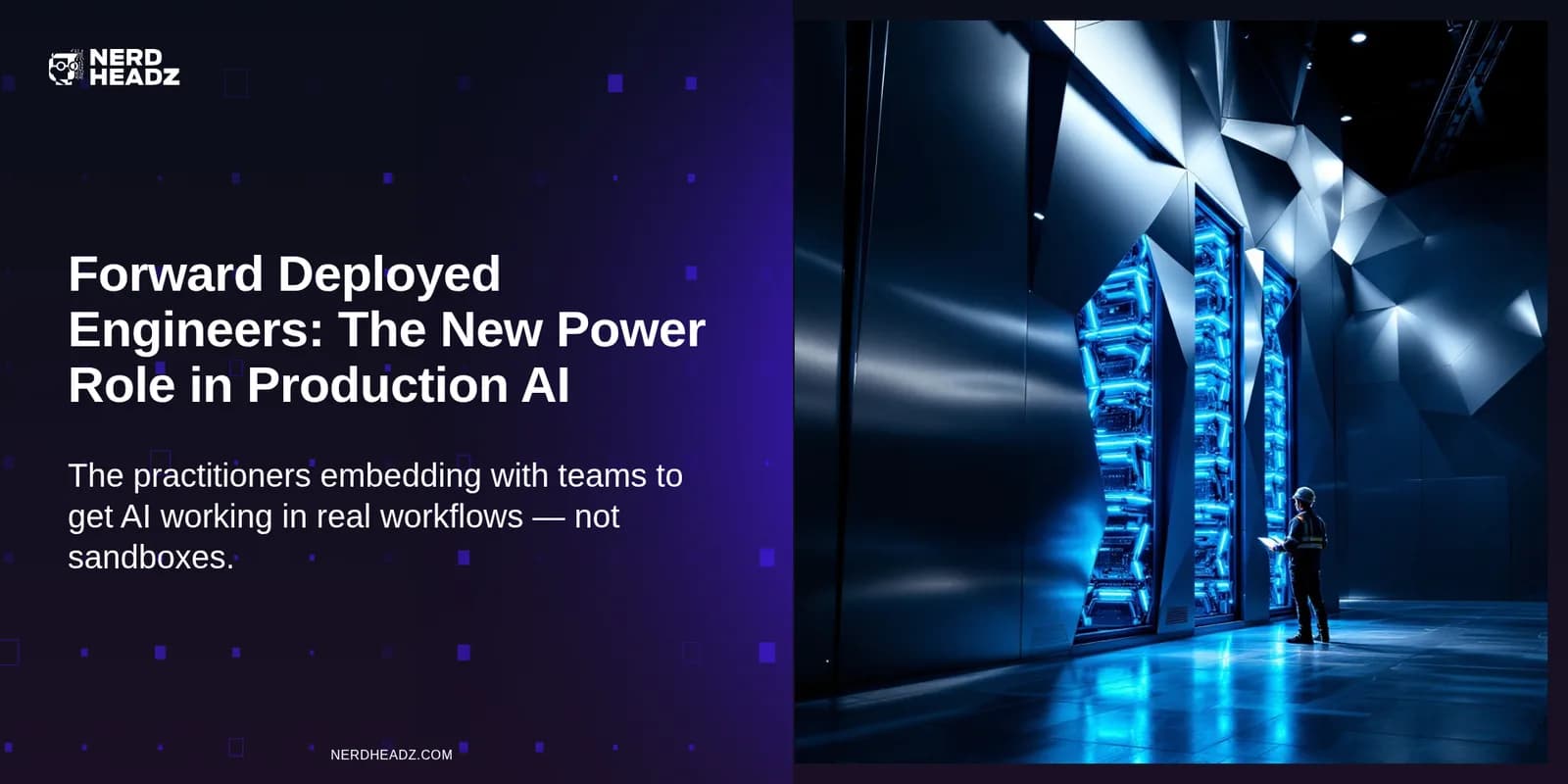
Forward deployed engineers are practitioners who embed directly with customers or product teams to get AI systems working in production — not in sandboxes, not in demos, but in real workflows with real data and real consequences. The role is gaining formal recognition across the industry as organizations like OpenAI, Anthropic, and AI communities such as Latent Space's AI Engineer community begin building dedicated tracks around it.
At NerdHeadz, we've been doing this work without the title for years. What's shifting now is the infrastructure, the tooling, and the expectations — and builders who understand all three are in a category of their own.
Why Forward Deployed Engineers Are Having a Moment

The demand for FDEs isn't arbitrary. It tracks directly with a structural problem: most teams can get an AI feature working in isolation. Few can get it working reliably when it's connected to a messy production environment, inconsistent data sources, and users who don't behave the way the demo assumed.
The gap between a demo and a deployed system is where forward deployed engineers live — and it's wider than most founders expect.
Three converging pressures are driving this:
Benchmark scores aren't deployment scores. The latest frontier models show incremental improvements across standard evaluations, but teams shipping production AI consistently report that real-world performance diverges from benchmarks in ways that matter. Document parsing faithfulness, agentic cooperation, and API cost efficiency all behave differently in the field than in controlled tests. An FDE's job is to close that gap.
Agent harness design is now a first-class engineering discipline. Research is emerging showing that raw activity metrics — token counts, tool call frequency — explain agent success poorly. Harness quality, how the agent is structured to receive feedback and route decisions, matters far more. Teams building around observability, traces, and continual improvement loops are outperforming those focused purely on model selection.
The open-weight ecosystem is maturing fast. Roughly one in three AI teams ran an open-weights model in production recently, up sharply from nine months prior. The gap between open and closed frontier models has compressed to approximately four months. This means FDEs now have a credible local-first or hybrid stack to work with — and the tooling to support it is closing in fast.
Working on something similar? Talk to our team about your project.
What FDEs Actually Do Differently

The FDE mindset isn't about picking the best model. It's about building the right system around whatever model fits the constraint set — cost, latency, data residency, compliance, or capability.
In practice, this means understanding failure modes at the infrastructure level. One of the more subtle production bugs circulating in the AI engineering community right now involves multi-turn reinforcement learning loops where re-tokenizing updated conversations after tool calls silently corrupts gradient signals. The model receives training updates based on sequences it never actually sampled. The fix — maintaining a strict token buffer across turns — is simple once you know it exists, but invisible until something breaks in a way that's hard to trace.
This is the kind of issue an FDE catches. A product manager doesn't see it. A data scientist running offline evals won't reproduce it. It requires someone who understands the full stack from token representation through to deployment behavior.
For teams building agentic products, we've written in depth about how Claude Opus 4.8 changes dynamic workflow design — the same systems thinking applies whether you're using Anthropic, an open-weight model, or a hybrid stack.
The Infrastructure Layer FDEs Own

Production AI in 2025 isn't a model plus a prompt. It's a model, a harness, a sandbox, memory and state management, an observability layer, and pricing logic — all integrated and tested against real user behavior.
The industry is moving toward vertically integrated agent stacks where the execution environment, the policy layer, and the model are managed together. Google's managed agent API now provisions sandboxed Linux environments with code execution and web access in a single API call. OpenAI's Codex is expanding to persistent remote operation with mobile steering. The abstraction is shifting from "chatbot" to "managed execution environment."
For teams building custom software, this creates both opportunity and complexity. The opportunity is that you can now ship agent-powered features that would have required significant infrastructure investment twelve months ago. The complexity is that each layer of the stack introduces new failure modes — and someone on the team needs to own the full picture.
Understanding how agentic systems of record are evolving is foundational context for any team making architecture decisions right now.
Building Like a Forward Deployed Engineer

The practical shift FDEs represent is moving from "what can this model do" to "what does this system need to reliably do, and how do we build for that."
That means starting with production constraints, not capabilities. It means instrumenting for observability before optimizing for performance. It means treating harness design, prompt routing, and feedback loops as engineering problems with the same rigor as the model selection itself.
It also means staying current on the open-weight ecosystem. Models like Step 3.7 Flash — a 196B parameter mixture-of-experts architecture with only 11B active parameters — are demonstrating that local-first deployments can now compete with frontier APIs on agentic tasks at a fraction of the inference cost. An FDE evaluates these tradeoffs quantitatively, not by reputation.
The teams winning in production AI right now aren't necessarily using the most powerful models. They're using the most appropriate models, built into the most thoughtfully instrumented systems, maintained by engineers who own the full deployment lifecycle.
Ready to build? NerdHeadz ships production AI in weeks, not months. Get a free estimate.
Forward deployed engineers represent a maturation in how the industry thinks about AI — from model capability to system reliability. The teams that internalize this shift, building with harness design, observability, and production constraints as first-class concerns, are the ones shipping AI that actually works. The role is new in name only; the discipline has always been what separates demos from deployed products.
“The gap between a demo and a deployed system is where forward deployed engineers live — and it's wider than most founders expect.”