In this article08 +
Key takeaways
The short version
- An MVP is the simplest working product you can launch to test whether people actually want your idea.
- Build only the features that solve your core problem; nice-to-haves can wait until the MVP proves its value.
- Launch to a small group of early adopters, be honest about what the MVP does, and track how they use it.
- Judge feedback by what users do, not just what they say, and don't let one loud voice set your priorities.
- Growing engagement, returning users, and early adopters who keep paying are strong signs your MVP is working.
Building a Minimum Viable Product (MVP) is one of the smartest ways to test a business idea without wasting time or budget. Instead of pouring resources into a full product, you build only the core features that solve a real problem for your target market.
This approach helps you:
- Validate product market fit: confirm that real people want what you're building.
- Gather user feedback: learn directly from the people using your product.
- Reduce development costs: spend less early in the app development cycle.
An MVP isn't a shortcut. It's about launching with purpose and learning fast, so you can turn a product concept into a viable product that gains traction.
What is a Minimum Viable Product (MVP)?

A Minimum Viable Product (MVP) is the simplest working product you can launch to test a business idea. It includes just enough core features to deliver value and prove interest, without paying for full software development.
Instead of building a polished solution upfront, you focus on essential functionality to:
- Test your assumptions
- Gather user feedback
- Check whether there is market demand
- Confirm the idea is feasible, while keeping costs and time-to-launch low
The goal is to find out what matters most to your target users and let their behaviour guide your next steps. Each version is a learning opportunity, and the product improves through repeated rounds of changes (an iterative process).
Early examples like Dropbox and Airbnb didn't start with complex apps. They focused on a viable product first, refined their concept, and scaled only after proving there was traction.
An MVP is a strategy for building smarter. It lets you validate an idea with minimal resources, improve the user interface over time, and increase your chances of reaching product market fit.
Benefits of an MVP
Test Market Demand with Minimal Investment
Launching a product comes with uncertainty. Will customers embrace it? Does the idea address a genuine need?
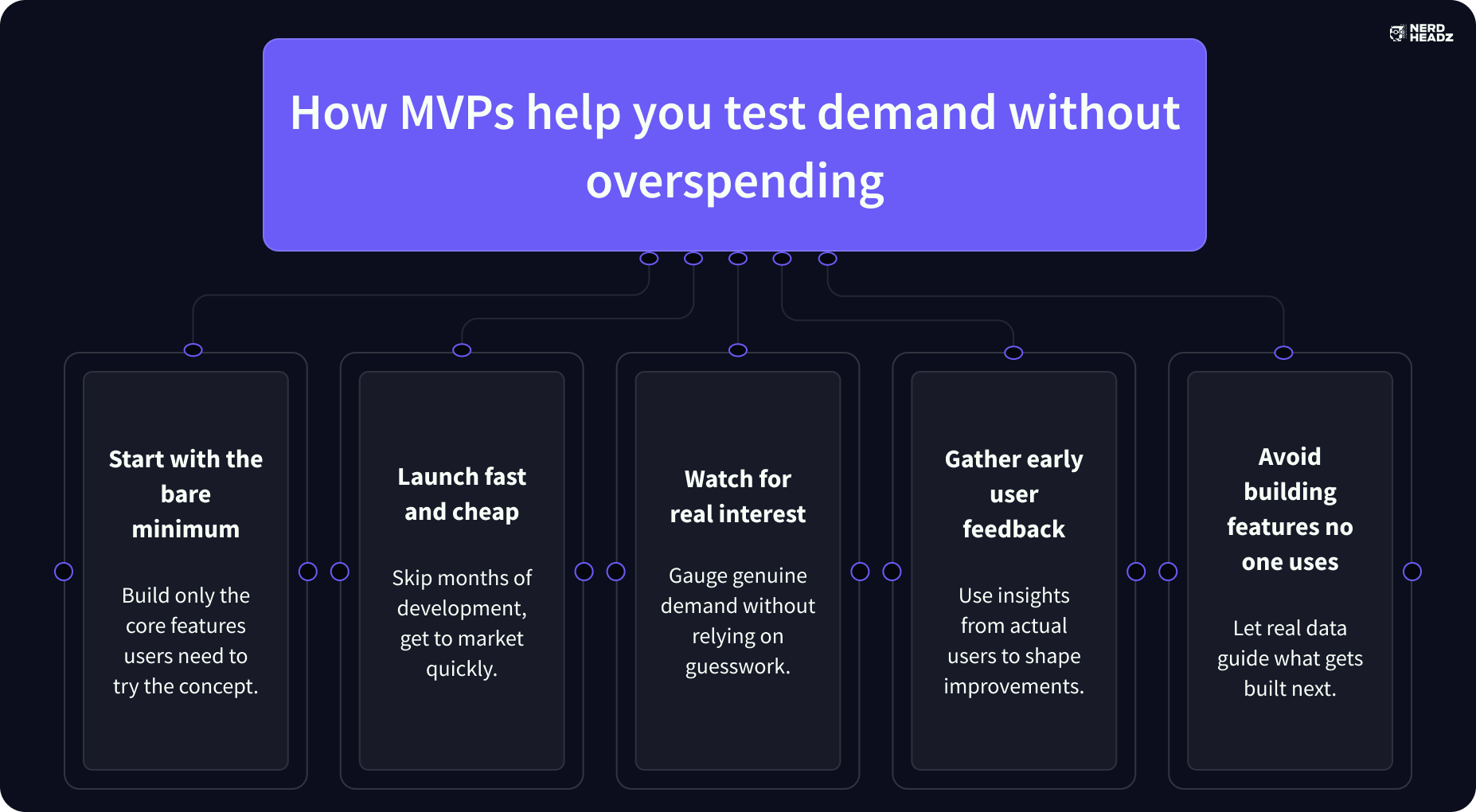
An MVP helps answer these questions without exhausting your resources. By launching with only essential features, you can measure interest and spot customer pain points early.
You get answers before committing to significant expenses, which reduces risk. Feedback from early adopters (the first users willing to try something new) offers insights no amount of guessing can replace, saving both time and money.
Twitter and Spotify both started with MVPs. They launched simplified versions, adjusted based on user reactions, and expanded over time, making decisions from real-world data rather than guesses.
Reduced Time to Market
Getting your product to customers quickly helps you stay relevant and meet demand before competitors do. An MVP speeds things up because you build only what's needed for the product to work, instead of delaying launch with extra features.
A faster launch means:
- Earlier feedback: real users start telling you what works sooner.
- Real-time adjustments: you can make changes based on what truly matters to your audience.
- A head start on learning: your idea is tested in real-world conditions.
Instagram, for example, launched as a simple photo-sharing app. Its creators prioritised speed and let users shape how it evolved.
Collect Valuable User Feedback Early
Building a product involves many assumptions about what customers want. An MVP lets you test those assumptions early and learn what works, straight from your intended audience.
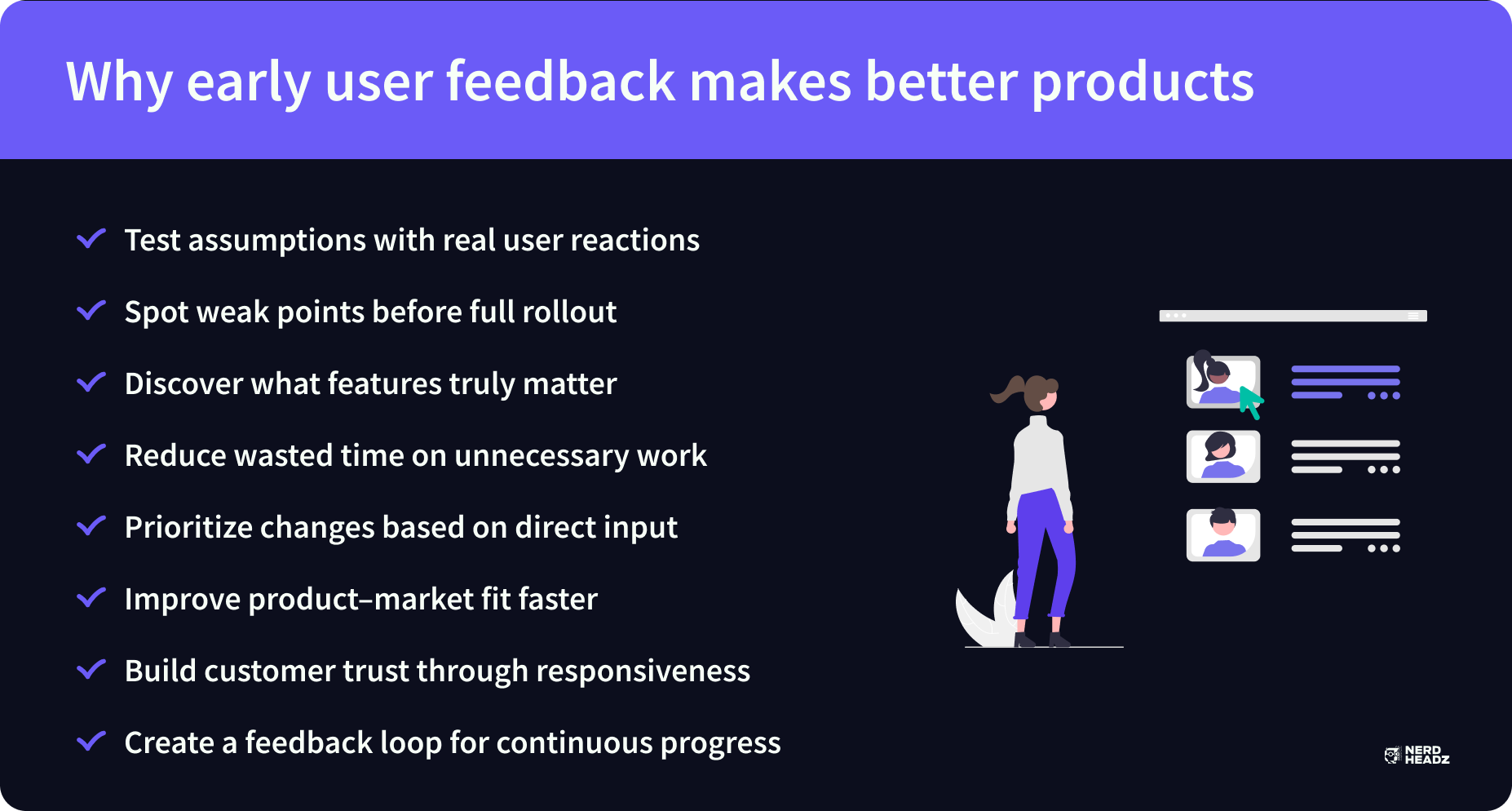
When users interact with the simplest version of your product, their reactions show:
- Which areas need improvement
- Which parts already connect well with them
Focusing on what real customers prioritise saves time and cuts wasted effort. Listening instead of guessing keeps development sharp and efficient.
Dropbox began with a simple demo video showing its core idea. Watching how potential users responded helped the team shape the product into what it became.
Avoid Over-Building & Save Resources
Packing a product with features might seem like a good plan, but it often leads to wasted effort. Doing too much early drains resources and pulls focus away from the core problem.
An MVP avoids this by including only what's needed to test your idea. You don't waste time on features that may never be used, your first version is built efficiently, and you start learning from real users sooner.
Airbnb's first version was bare-bones. It only let hosts list spaces and travellers book them.
Steps to Build a Minimum Viable Product
Step 1: Identify the Problem & Target Audience
Without a clear understanding of the problem and the people facing it, it's hard to move forward strategically. This step is the foundation of your MVP.
Define the problem in specific terms. Ask:
- "What gap exists in the current market?"
- "What frustrations do people face that this product can resolve?"
Speak to potential users directly, or watch how they use existing solutions. This often reveals patterns or unmet needs that help you refine your idea.
Know your audience. Consider their demographics, behaviours, and preferences. Are you targeting professionals, students, or hobbyists? Each group has different expectations that will shape your MVP's design. Surveys, interviews, and forums can clarify who your ideal users are and what they value.
Spotify is a good example. It addressed a clear problem: people wanted access to music without downloading files or breaking copyright laws. Because it understood its audience, Spotify built an MVP focused on easy streaming with a straightforward library, which made its offer compelling from the start.
Step 2: Map Out Essential Features
Too many features overcomplicate the build and dilute your core value. Instead, pinpoint the core capabilities that serve your idea's main purpose.
Go back to the problem you identified and make sure every feature on your list helps solve it.
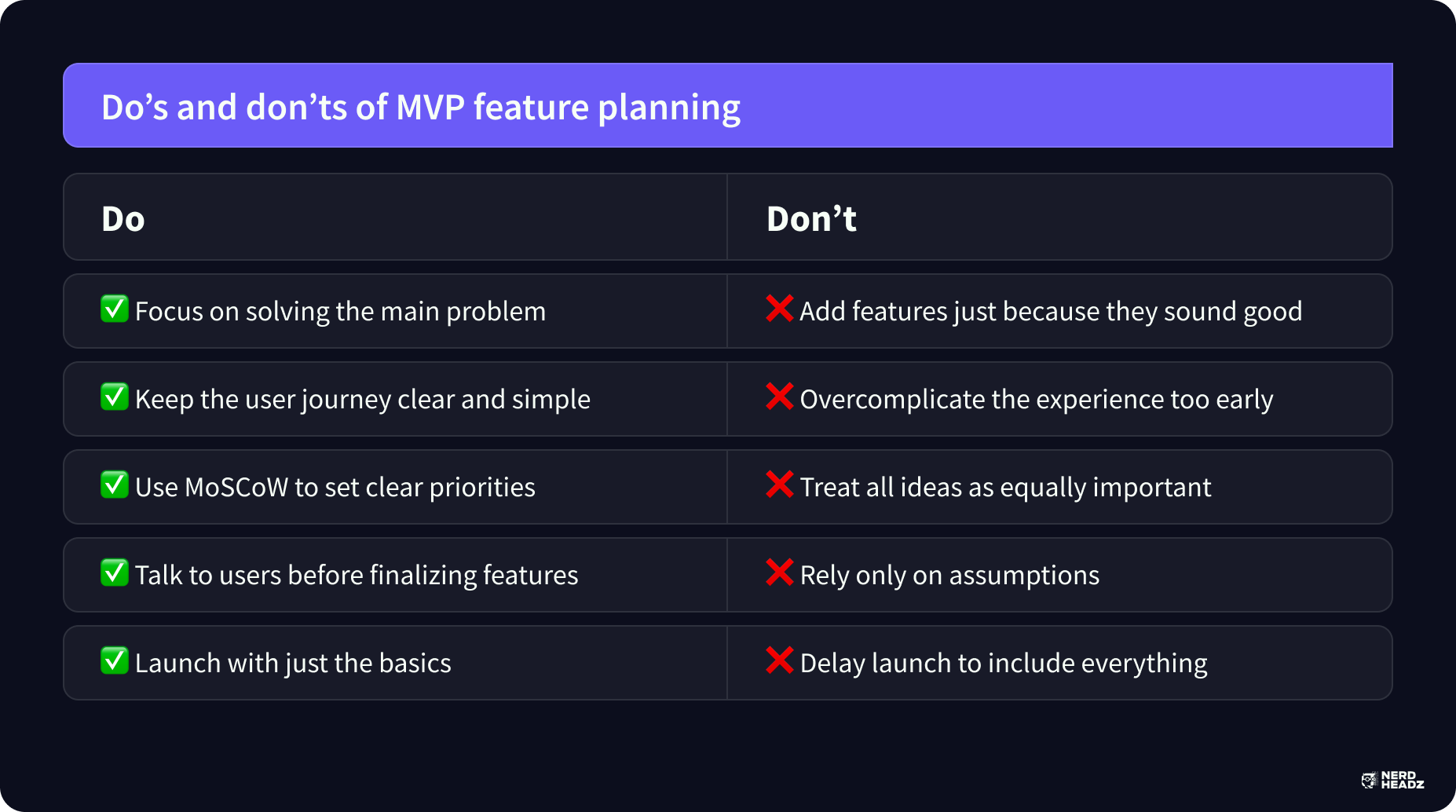
Ask yourself: "What does the product absolutely need to accomplish its basic mission?" Nice-to-have features can be added later, once the MVP has proven its value.
Prioritise your features. Use a method like MoSCoW, which sorts features into Must Have, Should Have, Could Have, and Won't Have. Talking to potential users at this stage shows what they value most, so you can meet their expectations without unnecessary complexity.
Twitter's early version only let users post short messages. That simplicity matched the main idea perfectly, and its success came from sticking to essentials and avoiding distractions.
With the essentials in place, users can clearly see what the product aims to do, which makes their feedback more useful for each next step.
Step 3: Prototype Your MVP
Once you've chosen your essential features, turn your ideas into something tangible. A prototype is a simplified model of your MVP used for early testing, bridging the gap between concept and execution.
Prototypes can take different forms:
- Wireframes: basic layouts showing where things go on each screen.
- Mock-ups: more visual designs of how the product will look.
- Click-through designs: screens you can tap through to simulate using the product.
- Physical models: for hardware, a basic version of the device.
A digital app might start as a static design showing how users would interact with it. The goal is to quickly create a working representation of your idea.
Prototypes let you experiment without large resource commitments. Feedback at this stage helps you spot problems, smooth out interactions, and remove elements that add no value.
Want to build that first prototype yourself? Our guide to building an app with AI using Manus walks through the process step by step, for under $200 and a few hours of your own time.
Prototyping also helps developers, designers, and product managers agree on how the product should look and work, reducing miscommunication.
Step 4: MVP Development
This is where your idea becomes a working version real users can interact with. The emphasis is on practicality over perfection, built around the core features you chose earlier.
- Choose your technology stack. This is the set of tools and technologies used to build your product. Pick one that fits your scope and budget, balancing efficiency, scalability (the ability to grow), and affordability.
- Keep developers and designers working together so the focus stays on user needs.
- Build only what solves the problem. When every feature has a purpose, it's easier to test usability and measure its value to users.
- Test often and in stages. Check individual parts before combining them. Agile methods, which work in quick rounds of improvement based on regular feedback, often make the process smoother.
You don't need a polished product at the end of this phase. Aim for something functional enough to show its purpose and gather insights.
Step 5: Launch Your MVP
Launching an MVP isn't about perfection. It's about presenting a working solution to a specific problem, with good planning behind it.
Start with a small, focused group. These early adopters give valuable feedback without the pressure of a broad launch, helping you refine the product before scaling.
Be clear and honest in your messaging. Explain what the MVP offers, the main problem it solves, and how it benefits users. Avoid overpromising; early users appreciate honesty over inflated claims.
Track results. Use analytics tools to monitor user behaviour and engagement. Spot patterns, find areas to improve, and act on feedback when planning the next version.
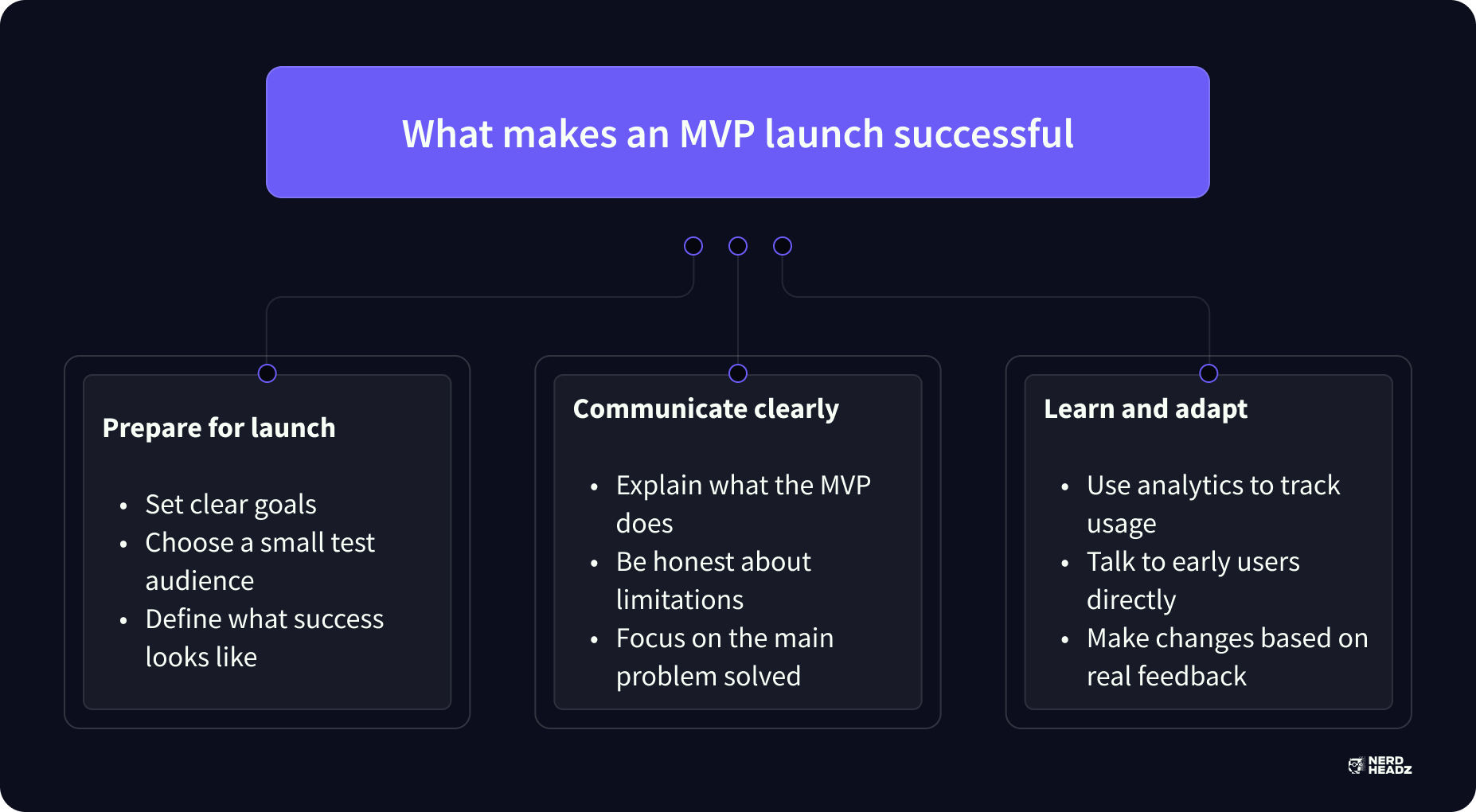
Engage with your users. Answer questions, address concerns, and show that feedback matters. An open dialogue builds trust and a loyal community around your product.
Steps to successfully launch an MVP:
- Set clear goals
- Target early adopters
- Deliver transparent messaging
- Use analytics tools
- Collect and act on feedback
MVP vs. Other Development Approaches

MVP vs. Proof of Concept (PoC)
Both an MVP and a Proof of Concept (PoC) evaluate ideas, but they serve different purposes. Knowing the difference helps you pick the right one for your stage and goals.
A Proof of Concept checks whether an idea is technically possible. It's an early experiment to see if the core function can work. For example, developers might build a PoC to test whether a new algorithm processes data correctly, without worrying about usability. A PoC often stays internal.
An MVP delivers a working version of the product to its intended audience. It goes beyond technical feasibility to solve a real problem for users, with just enough features to meet essential needs and collect meaningful feedback. It's released into the real world so you can measure demand before committing more time or money.
Think of it as the difference between a concept car built to test an engine (PoC) and a simple, working vehicle customers can actually drive (MVP).
Main differences between MVP and PoC:
- User-focused vs. system validation
- Released to users vs. internal testing
- Feedback-driven vs. feasibility testing
- Features included vs. technical core only
MVP vs. Prototype
Product development often involves both MVPs and prototypes, but each plays a different role.
A prototype simulates how a product might work. It focuses on design, interface, or basic usability, helping teams explore ideas and catch user experience issues. A prototype may not fully work but can show how the product looks or flows. Prototypes are often internal and disposable, since they're used to refine ideas before development begins.
An MVP is a working version built to meet essential user needs. It's shared with your target audience to solve problems, collect actionable feedback, and validate demand.
For example, a food delivery app prototype might be static screens showing possible features, while the MVP would include basic ordering and tracking.
Understanding this distinction saves time and resources and keeps your efforts aligned with business goals.
Main differences between Prototype and MVP:
- Simulate functionality vs. core functions
- Used internally vs. shared externally
- Test ideas vs. validate user needs
- Disposable vs. scalable
MVP vs. Final Product
Both aim to deliver value, but their purpose, features, and complexity differ.
An MVP is the first version, with only the essential features needed to address user problems. Its job is to test ideas, gather feedback, and assess demand, so you learn what works before investing heavily.
A final product is the result of rounds of improvement based on that feedback. It has a fully refined feature set, polished design, and broader functionality for long-term use. For example, an MVP mobile app might have sign-in and basic navigation, while the final version adds analytics, integrations, and comprehensive support.
The audience also differs. MVPs target early adopters willing to share insights. Final products are launched to a wider customer base and must run smoothly and meet higher expectations.
Main differences between MVP and Final Product:
- Minimal core features vs. complete functionality
- Early adopters vs. broad audience
- Focus on testing vs. long-term growth
- Lean design vs. polished outcome
Challenges in MVP Development & How to Avoid Them
Over-Engineering the MVP
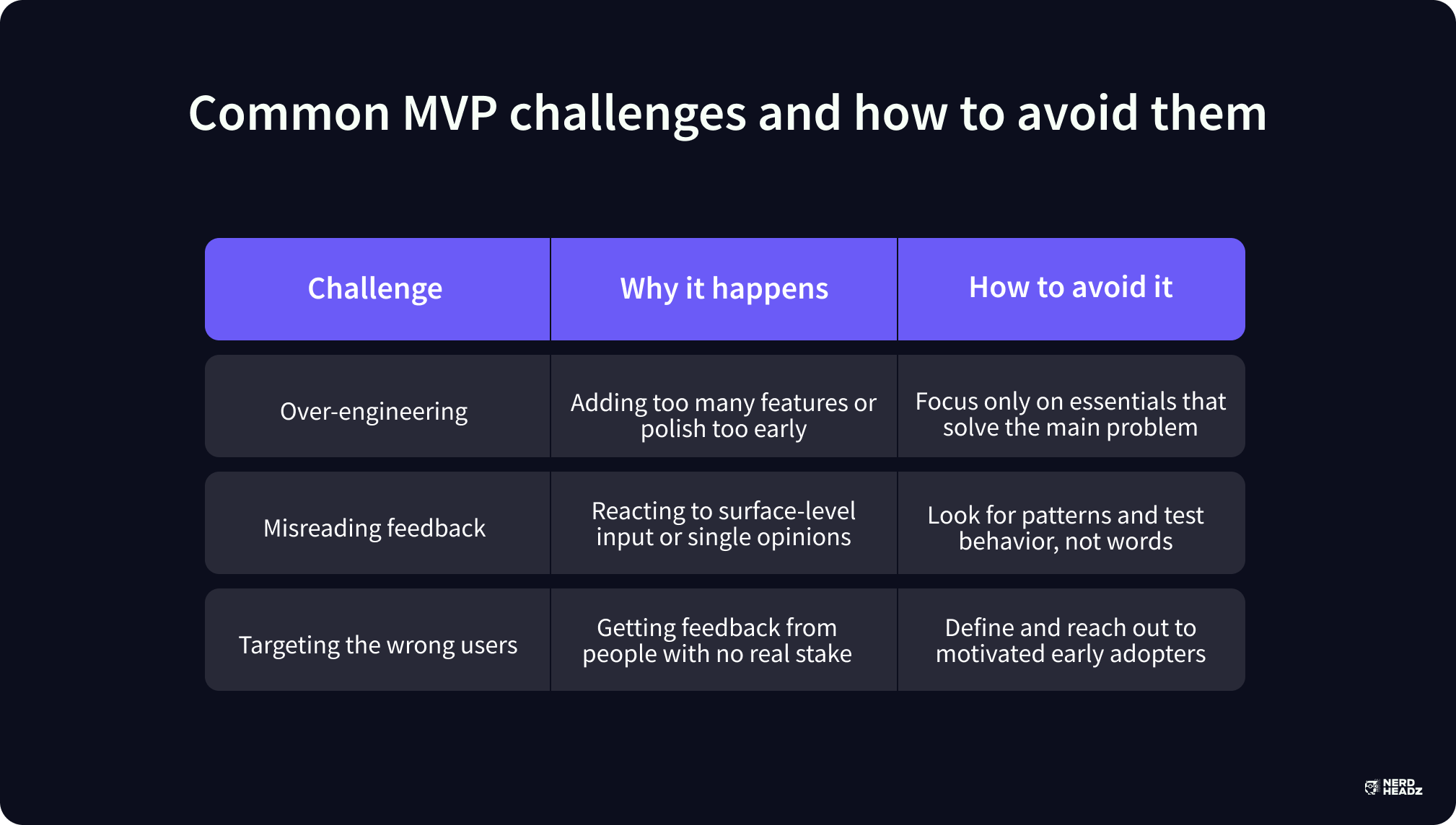
An MVP should test your idea efficiently without excessive resources. Over-engineering, meaning building far more than you need, works against this, causing wasted time, inflated costs, and user confusion.
Why it happens:
- Chasing perfection too early: teams pile on features instead of focusing on what solves the problem, such as advanced design elements or integrations that don't help users.
- Fear of looking incomplete: team members worry a stripped-down version will seem lacking. But an MVP is about delivering value in its simplest form, not perfection.
The result is a product that doesn't reflect users' real problems or answer the key questions about whether the idea is viable.
How to avoid it:
- Define the must-have elements based on user needs and business goals.
- Break the work into small, testable pieces.
- Communicate clear boundaries so the team stays focused on rapid testing and iteration.
Misinterpreting User Feedback
Misreading feedback leads to wrong assumptions, wasted resources, and missed opportunities, usually when teams jump to conclusions without seeing the bigger picture.
Common mistakes:
- Taking every request at face value: users may ask for extra features unrelated to the MVP's core goals. Acting on all of them dilutes focus and slows development.
- Mistaking one voice for a trend: a single passionate user doesn't always represent the majority. Without proper analysis, you may fix minor annoyances instead of fundamental issues.
How to avoid it: Balance what users say with what they do. Track how people actually use the MVP; behaviour often reveals improvements that direct feedback misses.
In practice: Collect feedback from a defined group of users, prioritise findings by impact, and regularly revisit your original goals.
Targeting the Wrong Audience
Too broad an audience gives you conflicting or shallow feedback. People with little stake in the problem may ask for unimportant features, pulling attention away from core functionality.
Too narrow an audience limits the range of useful insights.
The key is finding users who care about solving the problem and are willing to use an unfinished product. Without these early adopters, you may miss essential insights and slow your progress.
In practice: Define your ideal MVP audience through research, pinpoint their specific problems, and confirm your solution can help them. Clear outreach will connect you with people whose feedback adds the most value, and their comments will then guide your next versions.
MVP Development Frameworks
Lean Startup Methodology
The Lean Startup methodology focuses on efficiency and adaptability. You build a product quickly, with just enough features to learn something meaningful from users, instead of spending ages perfecting it.
Starting small and adjusting based on user behaviour reduces the risk of wasted resources. It works as an ongoing cycle of building, testing, and learning. For example: create a simple app, release it, analyse feedback, and adjust.
At its core is a feedback loop: watch how users engage, gather insights, and use them to decide what to do next.
Key points of the lean startup methodology:
- Build, Measure, Learn
- Focus on validation
- Real-time user feedback
- Avoid unnecessary features
Agile Development Framework
Agile is a flexible way of working that adapts to changing requirements. For an MVP, it emphasises collaboration, step-by-step progress, and regular feedback from everyone involved.
Work happens in short, manageable cycles called sprints, each delivering a working piece of the product. This makes it easier to spot and fix problems quickly and to adjust when user input or unexpected challenges come up.
Agile also encourages open communication:
- Daily meetings or check-ins keep everyone aware of goals, tasks, and obstacles.
- Reviews at the end of each sprint are a chance to evaluate work, adjust objectives, and plan next steps.
Key points of the agile development framework:
- Iterative sprint cycles
- Incremental product releases
- Continuous user feedback
Design Thinking Approach
Design Thinking centres on understanding user needs to create meaningful solutions, with an emphasis on empathy, collaboration, and iteration. For an MVP, it keeps every decision tied to real problems users face.
- Understand users: engage deeply with potential users through interviews, surveys, or observation to uncover their challenges and preferences and build trust.
- Generate ideas: brainstorm multiple solutions to address those needs.
- Build and test prototypes: create simple, low-cost versions of the product and test them with users.
- Refine: improve the MVP through rapid rounds of feedback.
Key points of the design thinking approach:
- Empathize with users
- Define the problem
- Brainstorm innovative ideas
- Build and test prototypes
- Iterate based on feedback
Build-Measure-Learn Cycle
The Build-Measure-Learn Cycle is a central part of the Lean Startup methodology. It uses feedback loops to keep your product aligned with what users need.
- Build: create a product with just enough features to test a specific hypothesis (an assumption you want to check), based on a problem found in customer research.
- Measure: observe how users interact with it and track key metrics on performance, usability, and demand.
- Learn: evaluate the data, then improve the product or confirm which features work.
Repeating this loop creates value while avoiding unnecessary development. Collaboration, focus, and responsiveness help you learn more with each round.
Key points of the build-measure-learn cycle:
- Create hypothesis-driven products
- Gather actionable user data
- Analyze metrics for insights
Rapid Prototyping Techniques
Rapid prototyping means quickly creating product models to test ideas with users, so you get feedback before investing heavily in development.
- Start low-fidelity: rough sketches or wireframes let you check basic ideas without spending much. Feedback here highlights gaps early.
- Move to higher fidelity: clickable designs or semi-functional versions give users a more realistic experience.
- Repeat: adapt designs based on real feedback until the MVP is ready for the market or further testing.
Involving users at every stage reduces guesswork and helps you avoid costly mistakes.
Key points of rapid prototyping techniques:
- Create initial sketches
- Design clickable wireframes
- Test semi-functional models
- Iterate based on feedback
Signs Your MVP is Successful

Positive User Feedback Grows
Growing positive feedback often means your MVP is meeting expectations. When engaged users praise key features or offer constructive suggestions, your product is resonating, and the problem you're solving matters.
Look for comments, testimonials, and repeat engagement, often alongside higher usage and returning customers. Paying attention to what users like helps you refine the product and build momentum.
High Engagement & Retention Rates
When people use your product often and keep coming back (retention), it's a clear sign they find value in it.
- Engagement: track active usage, such as daily or monthly use, to see how appealing the product is.
- Retention: track how well your MVP holds interest after people first sign up.
A steady pattern of returning users often points to long-term demand.
Early Adopters Paying Consistently
When people pay for your product repeatedly, it shows you're meeting their key needs. These early customers are often the first to validate both your pricing and your features.
Steady revenue signals your solution resonates with its target audience. Talking with these customers can reveal new improvements or features, and their willingness to keep paying shows your MVP can grow into a full product.
Strong Market Demand Signals
Rising inquiries, pre-orders, or waitlist sign-ups show growing interest. These signals appear when your product addresses a pressing need.
Watch trends like website visits, app downloads, and demo requests. Consistent spikes suggest your MVP is worth further development or scaling.
In practice: Use these indicators early to decide where to focus, so your solution matches what people are actively looking for.
Steady Increase in New Users
A steady rise in new users shows people are discovering your product and choosing to use it, an early sign it appeals to a wider audience.
Track sign-up rates and app downloads to see whether your marketing is reaching potential users. A growing user base also gives you a steady stream of feedback to keep improving.
Let NerdHeadz Develop Your MVP
NerdHeadz builds MVPs using a streamlined no-code development process, which means building apps with visual tools instead of traditional code. Its framework is designed to help startups take ideas to market quickly with minimal risk.
- Faster, cheaper builds: NerdHeadz uses no-code platforms like Bubble, which are proven to save up to 90% on development expenses compared with traditional coding.
- Focus on essentials: the experienced team keeps things simple, building MVPs with the essential features needed to validate your concept.
- A three-step process: products reach early adopters efficiently, with built-in feedback mechanisms for constant improvement.
- Support after launch: tailored updates, maintenance, and a focus on scalability help each project grow into something more robust.
Backed by certifications and awards, NerdHeadz has established itself as a global leader in no-code MVP development, offering startups a clear and trusted path to market.
Get in touch with NerdHeadz to get started.
FAQ
Frequently asked questions
How to determine a minimum viable product?
Identify the core problem your target audience faces and focus on building only the essential features needed to solve that problem effectively. Avoid adding extras that do not directly address the main issue.
What are the three elements of MVP?
1. Core functionality: The minimum set of features needed to solve the primary problem. 2. Target audience: A specific group of users whose feedback will validate the product. 3. Feedback loop: A way to gather user input for improvement and future iterations.
What are MVP requirements?
- A defined problem to solve. - A clear understanding of your target audience. - A basic set of essential features. - A simple, functional design. - A plan for collecting and analyzing user feedback.
How many iterations are needed to build a minimum viable product?
There's no fixed number, as it depends on user feedback and product goals. Typically, building an MVP involves multiple iterations to refine the product, improve features, and deliver better value based on feedback.