In this article05 +
The Old Founder Checklist Is Breaking Down
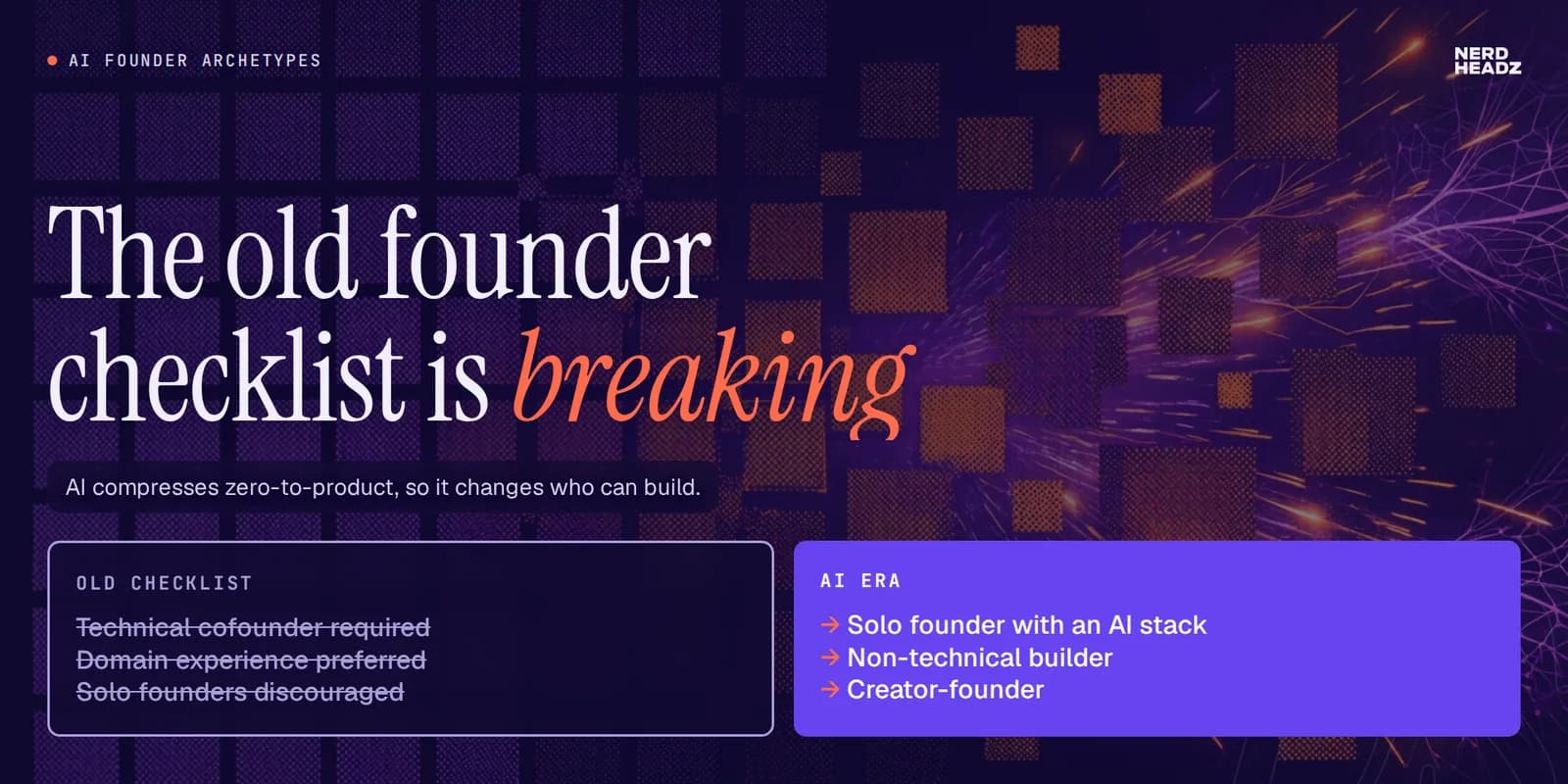
For the better part of two decades, investors and startup ecosystems operated on a fairly predictable checklist: technical cofounder required, domain experience preferred, solo founders discouraged. Each wave of technology produced a new "ideal" founder profile — the Stanford PhD after the search era, the scrappy dropout after social media, the operationally obsessed hustler after on-demand mobile. Each profile made sense given the technology and distribution mechanics of its era.
AI changes the mechanics. And as a16z's Speedrun program observes across hundreds of early-stage founders, that means the checklist itself is now up for revision. At NerdHeadz, we see this shift directly — the clients we build AI-powered products with today look nothing like the clients who commissioned custom software five years ago.
Why AI Disrupts the Founder Formula

The core dynamic is straightforward: AI compresses the cost of going from zero to working product. What once required a technical cofounder and six months of engineering now takes one motivated person and a well-scoped sprint. That compression doesn't just make building cheaper — it fundamentally changes *who* can build.
This is especially visible in the projects coming through our AI development services. Finance professionals building workflow automation tools. Healthcare operators prototyping patient intake systems. Independent creators shipping subscription software to their existing audiences. These are not the founders venture capital expected five years ago. They're arriving anyway.
Working on something similar? Talk to our team about your project.
The Emerging Archetypes — and Their Real Tradeoffs

The Solo Founder With an AI Stack
The solo founder argument is compelling: AI gives one person the output of a small team, making it possible to ship a v1 without splitting equity or managing cofounders. The counterargument is equally real — coding was rarely the only bottleneck. Customer discovery, sales, hiring, and decision-making under uncertainty don't scale with AI the same way engineering tasks do. A solo founder can do more, but a team of three equipped with the same AI stack can do proportionally more still.
The Non-Technical Builder
This archetype is genuinely new territory. People with deep expertise in finance, consulting, creative industries, or operations could not previously build software without a technical partner. That gap is narrowing fast. The risk is that AI lowers the floor for prototyping while raising the ceiling for what a production-ready, scalable product demands. Getting from demo to durable product still requires technical judgment — it's just no longer exclusively the domain of people who grew up writing code.
The Domain Expert
A hospital administrator who knows exactly where care coordination breaks down, or a real estate broker who understands the irrational psychology of buyers in a specific market — these people carry insights that outsiders simply cannot reverse-engineer from research. Domain expertise finds real problems. The tension is that the same intimacy with an industry can create blind spots. Airbnb wasn't built by hoteliers. Disruption historically comes from people who don't accept the existing constraints as permanent.
Our work on AI agent development regularly surfaces this dynamic: domain experts define the problem with precision; they sometimes need a partner to reimagine the solution architecture entirely.
Young Builders and the Compound Skill Effect
Teenagers who grew up building Minecraft mods and Roblox games already understand something powerful: what it feels like to ship something thousands of people actually use. Add AI to a founder who has already internalized the feedback loop of a live product, and you have a genuinely accelerated learning curve. The gap is experience in the adjacent skills — enterprise relationships, fundraising mechanics, organizational design — that matter more as a company scales beyond its first audience.
The Creator-Founder
Content creators carry two assets that traditional founders spend years building: a direct relationship with an audience and a proven ability to generate attention. Distribution is one of the hardest problems in early-stage company building, and creators start with an answer to it. The honest challenge is that an audience generates a spike of awareness, not a sustained growth engine. The DNA required to endlessly iterate a software product over years is different from the DNA required to publish great content consistently. Both are real skills. They don't always live in the same person.
What the Pattern-Matching Actually Gets Wrong

There's a layer beneath founder archetypes that rarely gets discussed openly: investor consensus creates self-fulfilling advantages. When the investment community collectively agrees that a certain profile is desirable, founders matching that profile attract more capital, survive more stumbles, and get more shots at product-market fit. The pattern looks predictive when it's partly just well-funded.
That dynamic cuts both ways in the AI era. Founders from backgrounds that previously faced skepticism — non-technical builders, domain experts, solo operators — are now seeing that skepticism tested against actual product output. The question isn't whether these profiles are theoretically viable. The question is whether the market and infrastructure around them catches up fast enough to let them compound.
For a closer look at how the underlying agent infrastructure is evolving to support these new builders, our coverage of the agent infrastructure arms race lays out what's changing at the platform level.
The Real Question Isn't Which Archetype Wins
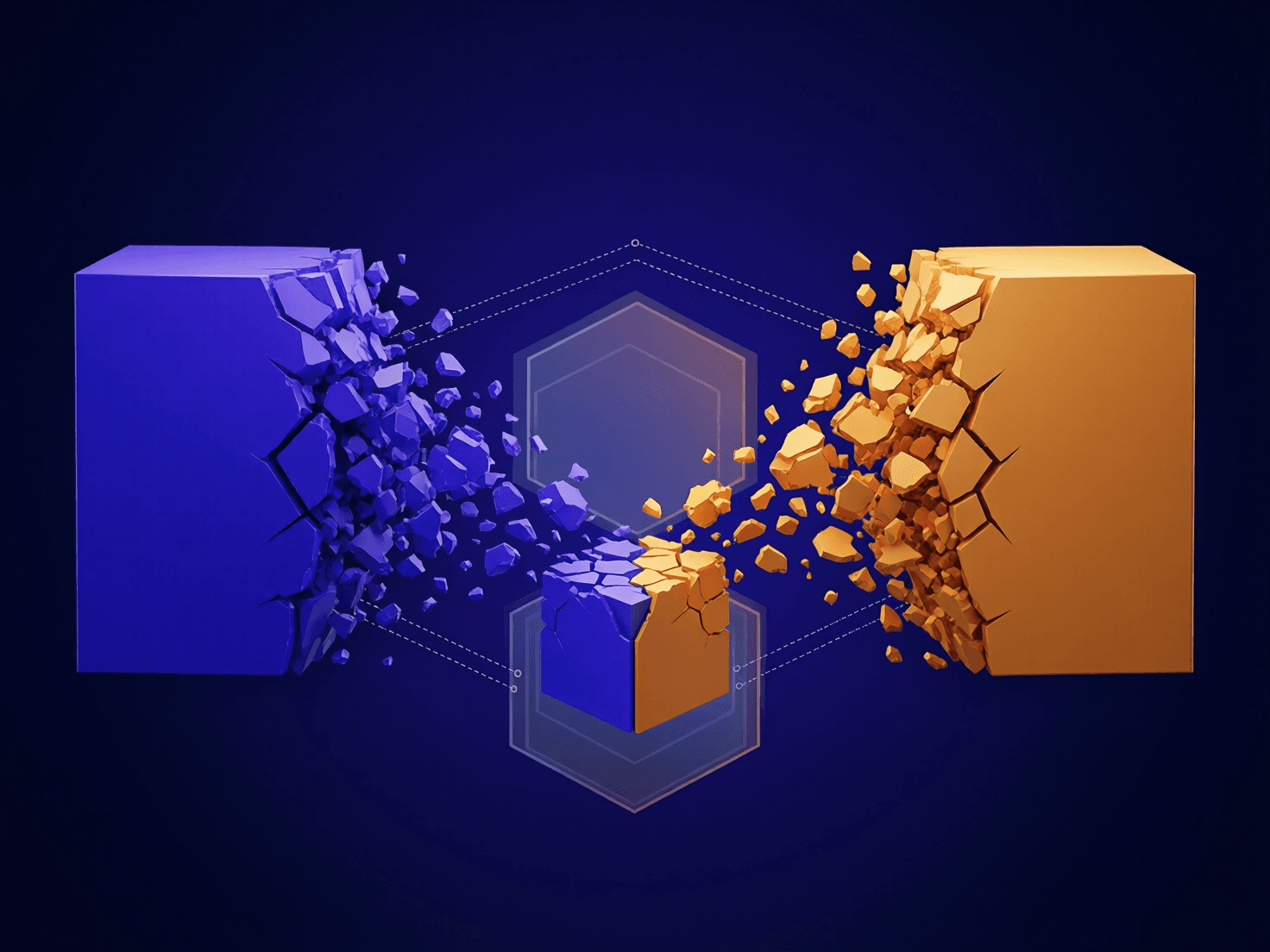
The smarter frame isn't "which new archetype is good now?" That question just replaces one form of pattern-matching with another. The real question is: which of the old assumptions about founders were fundamental truths, and which were just adaptations to the technology and distribution mechanics of a previous era?
Persistence, judgment, the ability to recruit and persuade — those don't compress with AI. The need for a technical cofounder in every founding team, or the assumption that domain expertise disqualifies rather than qualifies — those were adaptations. When the underlying technology shifts this dramatically, the profiles that create great companies must shift too.
Ready to build? NerdHeadz ships production AI in weeks, not months. Get a free estimate.
“When the underlying technology shifts this dramatically, the profiles that create great companies must shift too.”
AI isn't just changing what founders build — it's changing who gets to be a founder at all. The archetypes that succeed in this era will be defined less by their backgrounds and more by their ability to combine domain insight, product judgment, and the willingness to use new tools aggressively. At NerdHeadz, we're already building with this next generation of founders every week.
FAQ
Frequently asked questions
What are the new founder archetypes in the AI age?
The AI era is enabling a broader set of founder profiles including solo founders, non-technical builders, domain experts, young creators, and content creators with existing audiences. AI tools compress the cost of building a v1 product, reducing the traditional requirement for a technical cofounder and opening the path to company-building for people who previously lacked access to software development skills.
Can non-technical founders build successful AI startups?
Yes, but with important caveats. AI significantly lowers the barrier to creating a working prototype without writing code. However, scaling from a demo to a reliable, production-grade product still requires technical judgment — either developed personally or brought in through hiring. Non-technical founders with strong domain expertise and product intuition are well-positioned, particularly in industries where insider knowledge creates a decisive advantage.
Do solo founders have an advantage in the age of AI?
AI gives solo founders substantially more leverage than they had previously, allowing a single person to ship software that once required a multi-person team. The real constraint for solo founders isn't engineering output — it's the parallel demands of sales, customer discovery, hiring, and strategic decision-making, which don't scale with AI the same way. A well-equipped team still compounds faster than a well-equipped individual in most competitive markets.
Spotted via a16z