In this article04 +
When Organization Becomes Execution
File organization used to be a human convenience. You put things in folders so you could find them later — a courtesy to your future self. That assumption is now obsolete.
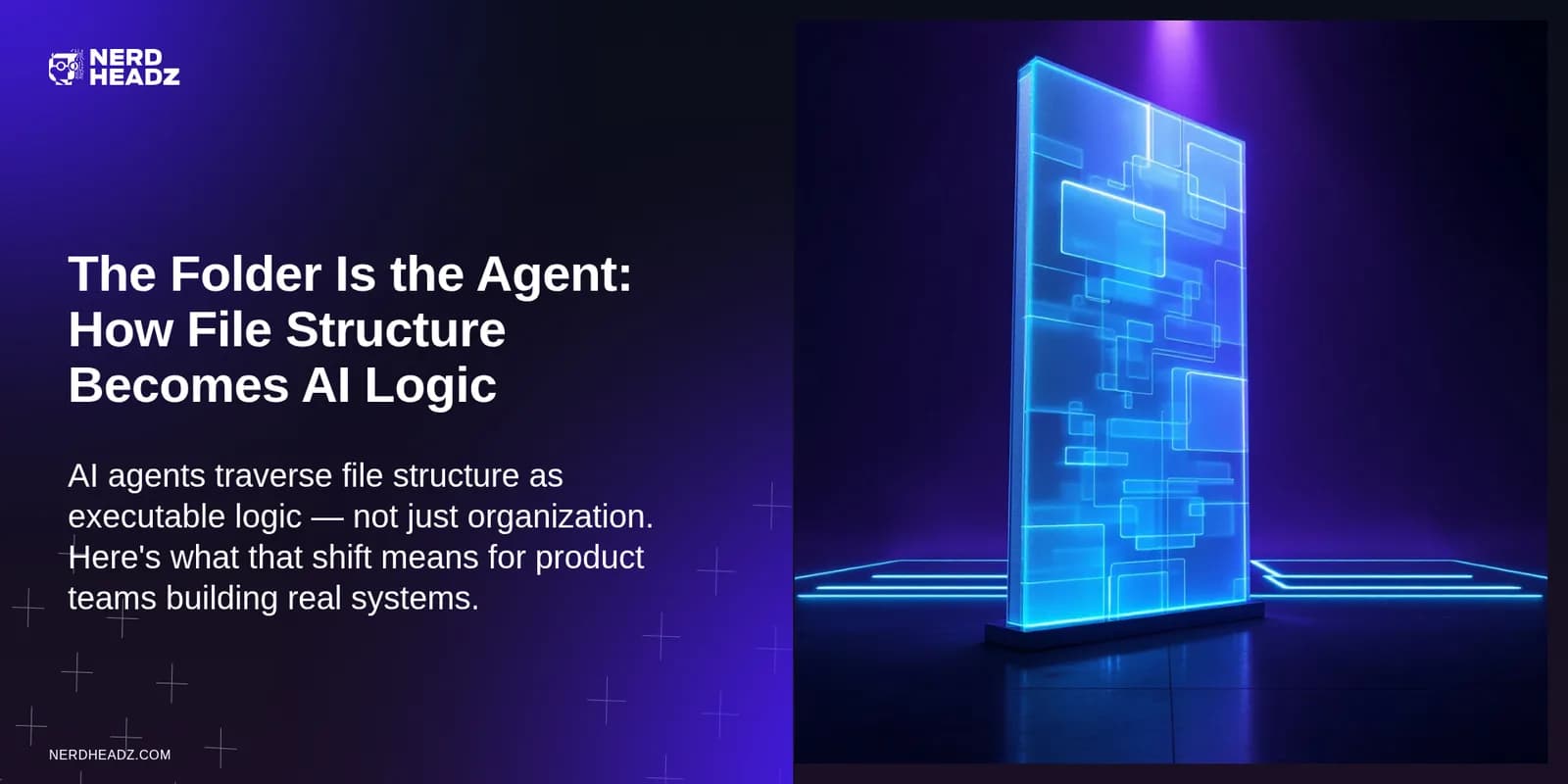
AI agents — the kind we build at NerdHeadz for production environments — don't browse your folder structure the way a person does. They traverse it as logic. The hierarchy of directories, the naming conventions, the proximity of one file to another: these are not aesthetic choices anymore. They are operational instructions that shape how an agent reasons, routes tasks, and takes action.
This is a subtle but significant architectural shift, and Every's exploration of AI-powered file and productivity tooling captures why it matters at the product layer. Our experience building agents for real clients confirms it goes even deeper — into the engineering layer itself.
Working on something similar? Talk to our team about your project.
The Agent Reads Structure, Not Just Content

When a large language model powers an agent with access to a filesystem, the folder hierarchy becomes a form of routing logic. A file sitting in /active/client-a/sprint-3/ communicates more than its filename alone. It tells the agent something about recency, ownership, and phase — context that the agent can use without any additional prompt engineering.
This is why AI agent development at the architecture level requires you to think about your data layout the same way you'd think about your API design. Flat structures with ambiguous naming create ambiguous agent behavior. Hierarchical, semantically consistent structures create predictable, auditable agent behavior.
The folder is no longer a passive container — it is the agent's decision tree made physical.
Why Naming Conventions Are Now Agent APIs
When a human reads a file named final_v3_REAL_USE_THIS.docx, they laugh and open it anyway. An agent doesn't have that social grace. It will either ingest that file as ground truth or skip it based on pattern matching — and either outcome could be wrong.
Teams building AI-assisted workflows need to treat their naming conventions with the same discipline they apply to variable names in code. Consistent prefixes, date stamps in ISO format, status indicators like draft or approved baked into the filename — these become the vocabulary an agent uses to make decisions without human intervention.
This is not a theoretical concern. In the agent systems we ship, poorly structured input directories are one of the top sources of unexpected behavior. The fix is almost never a prompt change — it's a folder restructure.
Automatic Organization as a First-Class Feature

One emerging pattern worth watching is AI that organizes files automatically before other agents consume them. Think of it as a pre-processing agent whose only job is to impose structure — sorting, renaming, archiving — so that downstream agents operate on clean, predictable input.
Tools focused on automatic file organization are pointing at this exact idea: if humans can't be trusted to maintain consistent structure (and they can't, at scale), then an agent should own that responsibility. This creates a two-layer system: one agent that enforces structure, and one or more agents that operate within it.
We've implemented this pattern for clients whose workflows involve high volumes of unstructured document intake. The organizational agent runs first, applies consistent taxonomy, and hands off a normalized directory to the task agent. Error rates drop significantly. Human review time compresses.
This connects directly to a broader principle we've written about — your AI moat is built on systems, not models. The model is interchangeable. The system that feeds it structured, reliable input is your competitive advantage.
Voice, Writing, and the Input Surface Problem
The same structural logic applies to input modalities beyond files. Voice dictation tools that feed transcripts into agent pipelines face an identical challenge: raw transcription is noisy, unstructured, and context-free. Agents that consume it without normalization produce inconsistent results.
The pattern holds whether the input is a spoken note, an uploaded document, or an email. Structure upstream determines quality downstream. This is why the most effective AI workflows we build don't start with model selection — they start with input normalization design.
Building Agents That Respect and Enforce Structure

The practical implication for any team building an AI product is this: your folder and file conventions are part of your agent's specification. They belong in your technical documentation, your onboarding materials, and your QA process.
If you're using our AI development services to build a production agent, one of the first questions we ask is: what does your data actually look like on disk, in your database, or in your document store? The answer shapes everything that follows.
Agents that can enforce their own structural requirements — by auto-organizing inputs, rejecting malformed files, or flagging ambiguous states for human review — are dramatically more robust than agents that assume clean input. Building that enforcement layer is not glamorous work, but it is the work that separates demos from deployable systems.
Ready to build? NerdHeadz ships production AI in weeks, not months. Get a free estimate.
“The folder is no longer a passive container — it is the agent's decision tree made physical.”
The shift from file organization as human convenience to file structure as agent logic is one of the quieter but more consequential changes happening in AI product development right now. Teams that design their data layout with agents in mind will ship more reliable systems with fewer surprises. The folder was always doing work — now that work is explicit.
FAQ
Frequently asked questions
How does folder structure affect AI agent behavior?
AI agents use folder hierarchy and file naming conventions as routing logic, not just storage. Consistent, semantically meaningful directory structures reduce ambiguous agent decisions and improve output reliability without additional prompt engineering.
What is an organizational AI agent?
An organizational AI agent is a pre-processing layer that automatically sorts, renames, and archives files before downstream agents consume them. This two-agent pattern — one that enforces structure, one that operates within it — significantly reduces errors in high-volume document workflows.
Why do naming conventions matter when building AI agent systems?
Agents parse filenames as structured signals. Inconsistent naming — like multiple versions of the same document with informal labels — forces agents to make probabilistic guesses about which file to use, which introduces error. ISO date stamps, status prefixes, and consistent taxonomy give agents unambiguous signals to act on.
Spotted via Every