In this article06 +
DeepSeek Open Source Changes the Build Equation
DeepSeek open source is not a research curiosity. It is a production-grade capability shift that changes what independent teams and enterprise engineering orgs can actually ship without handing every inference call — and every token of context — to a closed API provider.
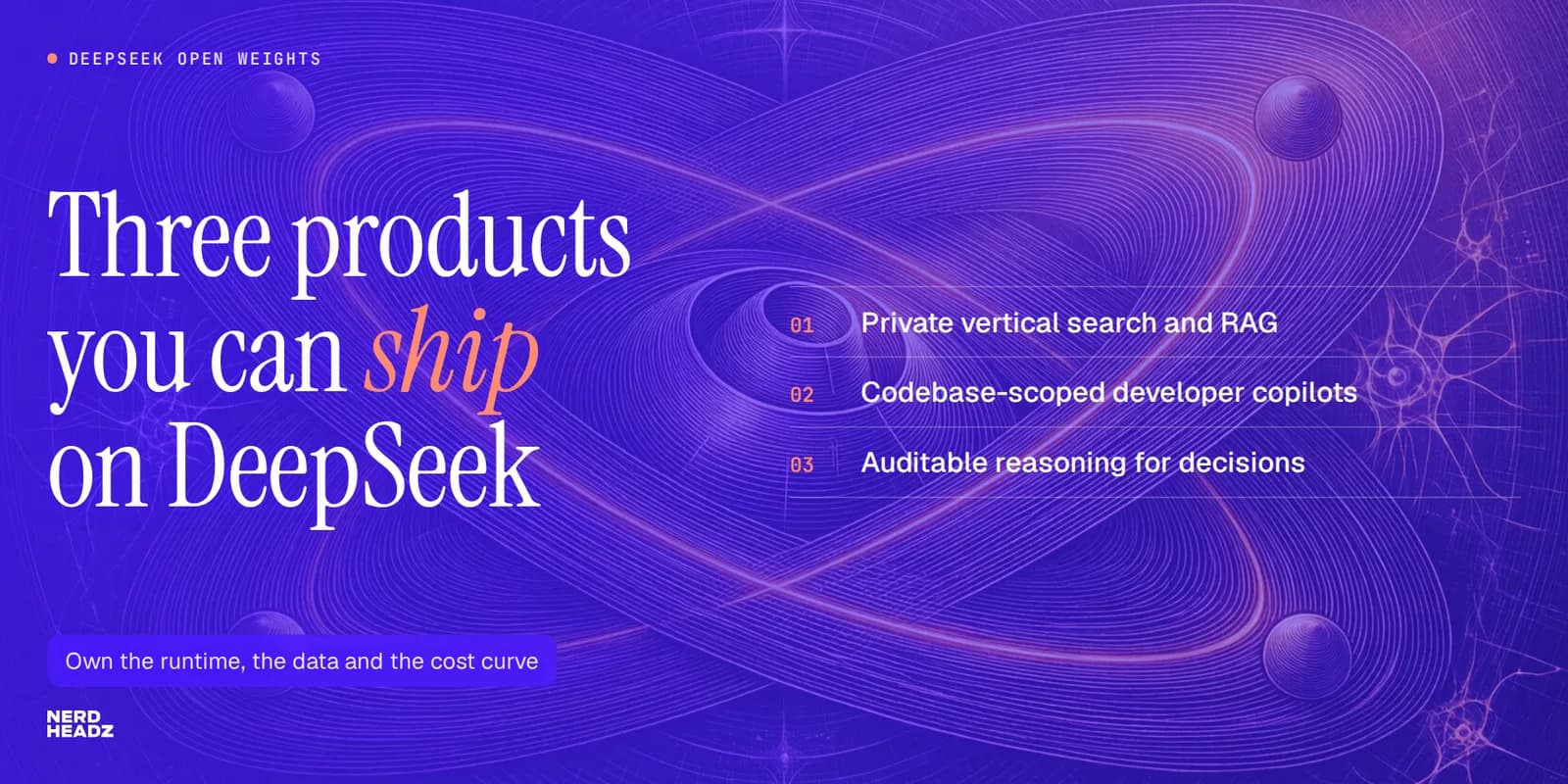
Turing Post has been tracking the model's architectural evolution closely, and the practical upshot is clear: DeepSeek's open weight releases give developers genuine leverage. Open weights mean you control the runtime, the data, and the cost curve — that's a fundamentally different product position than subscribing to a hosted frontier model.
We've been evaluating these models against real client requirements at NerdHeadz, and the deployment patterns that emerge are worth walking through systematically. If you're scoping an AI product right now, this post is the fastest way to calibrate what's actually buildable.
---
What "Open Weights" Actually Unlocks

Open weights are not the same as open source software, but for most product teams the distinction is secondary. What matters is that you can download the model, quantize it, run it on your own infrastructure, and never route a single user query through someone else's server.
For regulated industries — healthcare, finance, legal — that's not a nice-to-have. It's the only path to compliance. A self-hosted DeepSeek-R1 instance can satisfy data residency requirements that make hosted GPT-4o a non-starter.
For consumer products, the economics are equally compelling. Once you're past the threshold where inference costs start compressing margin, owning the runtime is the only way to preserve unit economics at scale. Our AI development services team runs this analysis early in every engagement because the infrastructure decision shapes everything downstream.
Working on something similar? Talk to our team about your project.
---
Three Real Build Patterns We See Working

1. Vertical Search and Retrieval Augmentation
DeepSeek models, particularly the distilled variants, are exceptionally well-suited to retrieval-augmented generation pipelines over proprietary document corpora. Law firms, clinical research teams, and financial analysts all have the same underlying need: a model that reasons carefully over long, structured documents without leaking that content to a third party.
A self-hosted DeepSeek deployment paired with a vector store and a thin API layer is a complete, shippable architecture for this pattern. The reasoning quality on multi-hop document questions is competitive with much larger closed models, and the operational cost is predictable in a way that per-token API pricing never is.
2. Code Generation and Developer Tooling
DeepSeek's coding-specialized variants benchmark extremely well on real-world software tasks. We're not talking about autocomplete — we're talking about agents that can plan, scaffold, and iterate on multi-file implementations given a natural language specification.
The practical build here is an internal developer copilot scoped tightly to a company's own codebase, style guides, and internal libraries. That specificity is only possible when you can fine-tune or prompt-engineer against a model you control. Our work on AI agent development consistently finds that model ownership is the unlock for agents that actually stay on-task in complex codebases.
3. Reasoning Pipelines for Decision Support
DeepSeek-R1 introduced a chain-of-thought reasoning architecture that makes it genuinely useful for decision support tasks — not just question answering. If you want to understand exactly why these reasoning models think the way they do, our breakdown of how o1, DeepSeek-R1, and RLMs actually work is the right starting point.
The build pattern here is a reasoning pipeline that takes a structured input — a loan application, a clinical note, a contract clause — and produces a structured output with an auditable chain of intermediate steps. That auditability is what separates a useful decision support tool from an inscrutable black box, and it's what makes the reasoning model architecture worth the additional inference overhead.
---
Where Teams Get It Wrong

The most common mistake is treating DeepSeek as a drop-in replacement for GPT-4o and expecting identical behavior with lower cost. It is not a drop-in. Prompt formats matter. Quantization choices affect output quality in ways that vary by task type. System prompt sensitivity differs from what teams tuned against OpenAI's models.
The teams that get the most out of DeepSeek open source are the ones that treat the model evaluation phase as a real engineering workstream, not a one-afternoon experiment. That means systematic benchmarking against your actual production tasks, not generic leaderboard scores.
It also means thinking carefully about the serving infrastructure. Running a 70B parameter model well requires either serious on-premise hardware or a cloud GPU setup that's been tuned for your throughput requirements. The cost advantage of open weights erodes fast if your inference layer is inefficient.
---
The Licensing Reality

DeepSeek's weights ship under a license that permits commercial use with restrictions. The key restriction most teams miss: you cannot use DeepSeek outputs to train a competing general-purpose model. For vertical AI products, that restriction is essentially invisible — you're building a specialized tool, not a foundation model competitor.
Read the license before you ship. That's not legal advice, it's engineering hygiene. The broader open-model license landscape is shifting fast enough that any assumption you made six months ago deserves a revisit.
---
The NerdHeadz Take

DeepSeek open source is one of the most significant capability expansions available to product teams right now. The models are strong, the weights are accessible, and the infrastructure to run them in production is mature enough that deployment is an engineering problem, not a research problem.
The opportunity is real. The execution risk is also real, and it lives in the details — serving infrastructure, prompt engineering, evaluation methodology, and license compliance. Those are solvable problems, but they require practitioners who have solved them before.
Ready to build? NerdHeadz ships production AI in weeks, not months. Get a free estimate.
“Open weights mean you control the runtime, the data, and the cost curve — that's a fundamentally different product position.”
DeepSeek open source gives product teams a credible path to self-hosted, production-grade AI without the data privacy trade-offs and unpredictable cost structures of closed APIs. The model quality is competitive, the deployment patterns are proven, and the licensing permits serious commercial use. The teams that win with it are the ones who treat model selection as an engineering decision, not a marketing one.
FAQ
Frequently asked questions
Can DeepSeek open source models be used for commercial products?
Yes. DeepSeek's open weight models permit commercial use under their license terms. The primary restriction is that you cannot use DeepSeek outputs to train a competing general-purpose foundation model, which rarely affects vertical AI product development.
How does DeepSeek compare to GPT-4o for production AI applications?
DeepSeek models are competitive with GPT-4o on reasoning and coding tasks, particularly when self-hosted and fine-tuned for a specific domain. The key difference is infrastructure ownership — DeepSeek runs on your servers, giving you data control, cost predictability, and compliance options that hosted APIs cannot provide.
What hardware do you need to run DeepSeek models in production?
Smaller distilled DeepSeek variants can run on a single high-end GPU. The full 70B parameter models require multi-GPU setups or cloud GPU instances with sufficient VRAM. Quantization reduces hardware requirements significantly with minimal quality trade-offs for most production tasks.
Spotted via 🔳 Turing Post