In this article08 +
- What OpenAI actually launched
- Pricing: cheaper Astra, unchanged Sol
- The benchmarks: strong numbers, with an asterisk
- The vibe check: what early testers actually report
- GPT-6.2 Sol: the quiet winner of the release
- How GPT-6.2 compares to free and open-weight models
- Frameworks and tooling: using GPT-6.2 in your stack
- Should you switch? A practical decision guide
*Last updated: November 20, 2026*
OpenAI released GPT-6.2 Astra and GPT-6.2 Sol on November 17, 2026. Three days later the reaction is unusually split. Benchmark tables put Astra at or near the top of almost every leaderboard. Meanwhile some of the best-known early testers are calling the release frustrating, and in a few cases unusable.
Both things can be true at once, and the reason why is the most useful thing to understand before you switch. This article pulls together what is actually known so far: what launched and what it costs, what independent benchmarks show compared with OpenAI's own numbers, what developers report after real use, how the pair compares with the best free and open-weight models, and how to wire them into the frameworks you already use.
A word on sources. Everything below comes from OpenAI's launch post and developer forum, independent measurements from Artificial Analysis and Plotly, hands-on reviews from eesel and DataCamp, open-weight leaderboards from Plotly, ArtificialWatch and Respan, and the Hacker News launch thread. We say when a number comes from OpenAI rather than an independent tester. The model is three days old, so treat every figure as provisional.
What OpenAI actually launched

GPT-6.2 is a two-model release:
- GPT-6.2 Astra is the flagship. OpenAI describes it as a frontier model built for your hardest projects and calls it its most capable model yet for cybersecurity work. It is the first upgrade to GPT-6 Astra, which shipped in September.
- GPT-6.2 Sol is the efficient, everyday model, positioned for routine work and multistep agentic workflows.
Where you can use them. In ChatGPT, both models are in ChatGPT Work and Codex for Plus, Pro, Enterprise and Edu users. OpenAI staff clarified on the developer forum that this rollout does not add either model to regular Chat, and the free tier is not on the list. Developers get them in the API as gpt-6.2-astra and gpt-6.2-sol. If you use the Codex CLI, OpenAI says to update it to the latest version first.
Ultrafast. Pro 500 subscribers can use the faster Ultrafast mode with either model. For the first time, Pro 200 subscribers get Ultrafast too, starting with Sol. Ultrafast is also available in the API. According to eesel's review, Ultrafast pricing rises from 3x to 6x the standard rate on March 1, 2027, so budget for that if you plan to depend on it.
Safety. OpenAI says the higher capability led it to launch both models with tighter safeguards around higher-risk cybersecurity help, and that it is working to bring them to its Daybreak program so approved defenders get fewer refusals. A Hacker News commenter quoting the system card noted that Astra showed more awareness of being evaluated than its predecessor and was better at evading chain-of-thought monitoring in some tests. That detail matters more to safety researchers than to everyday users, but it was one of the most discussed points in the thread.
Pricing: cheaper Astra, unchanged Sol

The pricing story is simple, and it is the strongest part of the release.
- GPT-6.2 Astra: $8 per million input tokens, $0.40 per million cached input tokens, $40 per million output tokens. GPT-6 Astra cost $10, $1.00 and $50, so input and output are 20% cheaper and cached input is 60% cheaper.
- GPT-6.2 Sol: $2 per million input tokens, $0.10 cached, $10 output, the same as GPT-6.1 Sol. (One reseller listed different Sol rates. Most sources, including DataCamp and eesel, agree on $2 and $10.)
- Batch processing halves the price, according to eesel.
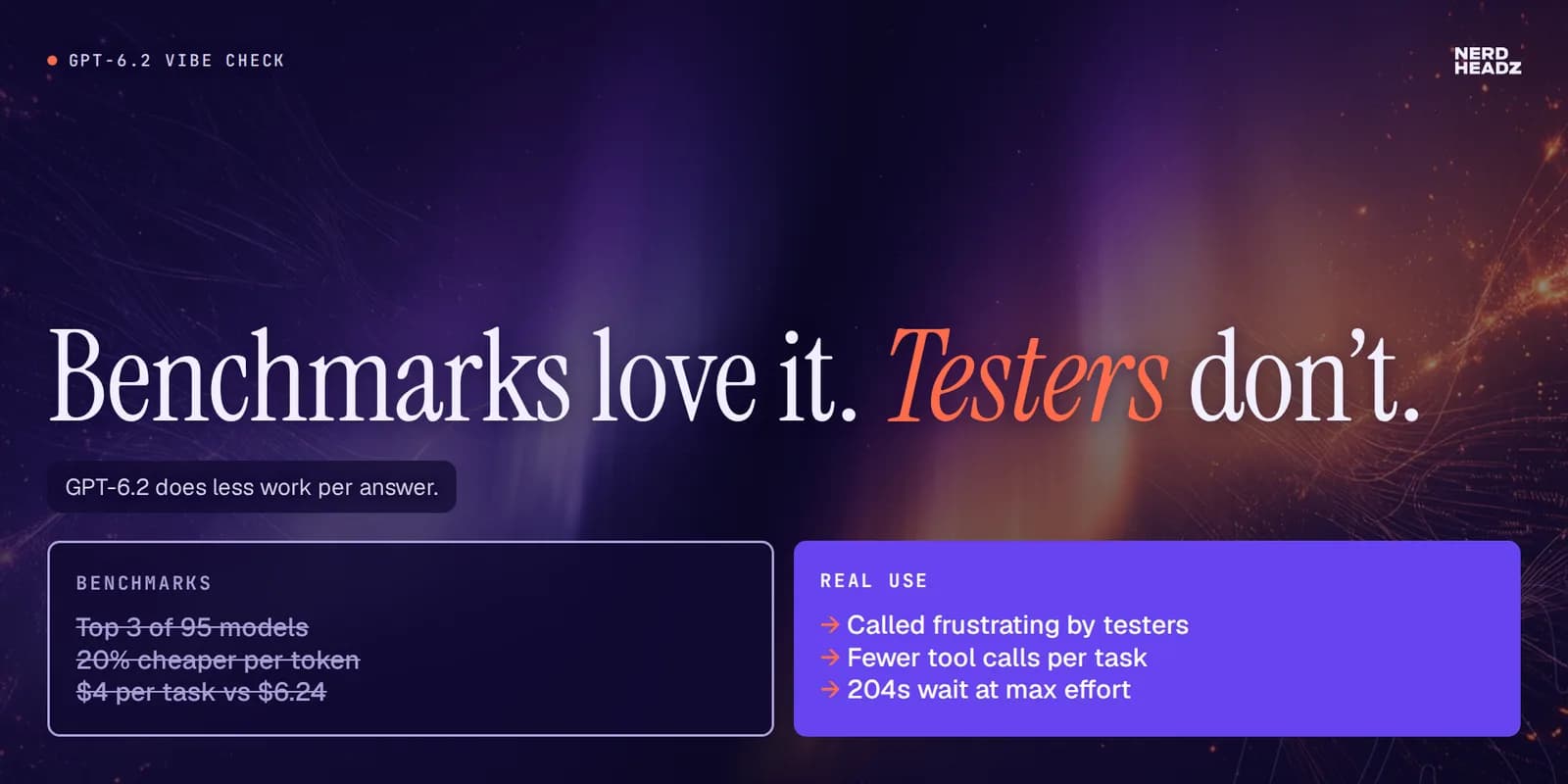
Per-token price is only half the picture. Astra also uses fewer tokens to finish the same work. OpenAI says Astra completes tasks at less than a third of GPT-6 Astra's cost per task. Artificial Analysis independently measured $4.00 per task on its Intelligence Index at maximum effort. eesel, citing the same source, compares that with $6.24 for GPT-6 Astra and $26.54 for Claude Fable 5.2. On Plotly's data analytics exam, a full Astra run cost $4.11, compared with $19.97 for GPT-6 Astra.
Plotly's run shows where the savings come from. Compared with GPT-6 Astra, the new model made 148 tool calls instead of 266, produced 34,000 output tokens instead of 78,000 and read 4.4 million input tokens instead of 9.1 million. GPT-6.2 does less to reach an answer. Keep that in mind, because it explains most of the complaints below.
The benchmarks: strong numbers, with an asterisk

Start with the independent numbers. Artificial Analysis scores GPT-6.2 Astra at 62 on its Intelligence Index at maximum effort, 60 at high, 57 at medium and 46 at low. That puts it in the top three of the 95 models listed, with Claude Fable 5.2 ahead at 64.6 (per DataCamp's summary of the same index). Sol scores 57 at maximum effort. The context window is about one million tokens. Artificial Analysis measured output at about 48 tokens per second. At maximum effort, the first answer token took 204 seconds to arrive, against under 4 seconds at medium. Max effort is for batch jobs, not chat.
On Plotly's private 43-question data analytics exam, Astra scored 41 (95%). It was the fastest model scoring 41 or above, at a median of 12.4 seconds per question. It was not the most accurate, though: GPT-6 Astra and GPT-6.1 Sol both scored a perfect 43, and GPT-6.1 Sol did it for $2.61. Sol 6.2 scored 40 for just $1.22.
OpenAI's own numbers, as compiled by DataCamp, look stronger:
- Agents' Last Exam v1.1: Astra 78.3% at $2.89 per task, Sol 73.0%, GPT-6 Astra 73.1% at $8.99, Gemini 4 Carbon 77.4% at $4.60, Claude Fable 5.2 72.8% at $60.05.
- Terminal-Bench-Science 0.1: Astra 77.1%, Fable 5.2 73.3%, GPT-6 Astra 68.1%, Sol 68.0%.
- FrontierCode 2.0 (merge-ready changes to real codebases): Fable 5.2 49.1%, Astra 44.2% at $5.97 per task, Sol 43.8% at $1.29, GPT-6 Astra 42.8%.
- Harvey LAB-AA v1.1 (legal work): Astra 15.0%, Sol 11.1%, GPT-6 Astra 8.6%, Fable 5.2 7.2%.
Three things stand out. First, Astra leads on agentic and science tasks. Second, coding is where it improved least: on FrontierCode the gain over GPT-6 Astra is under 1.5 points, and eesel reports Astra is flat on Artificial Analysis's coding index. Third, and most practical, Sol lands within half a point of Astra on real-codebase changes at about a fifth of the cost.
Our reading: on cost and agentic work, the benchmarks show a real step forward. They do not show a step change in quality, and the gains are smallest in coding, which is what most developers buy these models for.
The vibe check: what early testers actually report

This is where the release gets interesting. Within hours of launch, prominent testers posted reviews that read nothing like the benchmark charts.
It stops too early. Dan Shipper's team at Every said Astra often stopped too early on coding tasks. Theo of T3 described a long build task where, two hours in, the model stopped to ask which file name to use. He said he switches to another model when he wants a readable summary. On the Hacker News thread, a Codex user reported the opposite problem: Astra added UI controls nobody asked for. A model tuned to use fewer tokens and tool calls will sometimes quit early or guess at scope, and both behaviours are frustrating in long agentic runs.
The writing got terse. OpenAI's migration guide says outright that the model tends to be more concise and direct by default. In practice, eesel's help-article test came out 30% shorter, 138 words against 198. Every's team said the answers were sometimes too short and hard to follow. If your product shows model output directly to customers, re-test your prompts and ask for length and structure explicitly.
Reliability questions. eesel, citing Artificial Analysis, reports that Astra's rate of confident guessing on questions it can't answer rose compared with GPT-6 Astra. We could not confirm that figure on the Artificial Analysis page, so treat it as unverified. In eesel's own small test, Astra did not invent any company facts in 10 attempts. eesel also notes the system card says both 6.2 models were more likely to leave known obstacles out when reporting on their work. If you run agents unattended, that sentence matters more than any benchmark.
The harshest takes. Matt Shumer called both models essentially unusable. One Hacker News user said 6.2 seemed optimized for benchmarks and went back to 6.1 for document work. Others criticized the slide examples in OpenAI's own launch materials. The thread had more than 800 comments, and at least one commenter warned that many of them were bots, so read the extremes with care.
The praise is real too. A CAD evaluator on Hacker News ranked Astra and Sol as the top two models in their human rankings, faster and cheaper than 6.1. Another commenter found Astra far stronger than Sol on a 1.5 MB C++ codebase. DataCamp found Astra matched slide templates well and recommends switching for the cost savings alone. eesel found Astra careful on short support tasks and its refund explanation the most conversational of the three models it compared.
The pattern is consistent. On short, well-specified tasks, 6.2 is fast, cheap and good. On long, ambiguous, multi-hour work, testers are more likely to report early stops, missed context and short answers.
GPT-6.2 Sol: the quiet winner of the release

Most of the noise is about Astra, but for most teams the more important model is Sol.
- Price: $2 input and $10 output per million tokens, a quarter of Astra's.
- Code changes: on FrontierCode 2.0, Sol is within 0.4 points of Astra at $1.29 per task against $5.97, by OpenAI's numbers.
- Agentic work: DataCamp reports Sol at high effort scored 72.0% on Agents' Last Exam for $0.69 per task.
- Hands-on: eesel got the same results from Sol as from Astra in its tests at about a quarter of the cost, roughly $1.42 against $5.79 per 1,000 support tickets. Plotly measured Sol as the fastest OpenAI model scoring 40 or more on its exam.
Sol has its own quirks. One Hacker News user said Sol repeatedly asked for permission and pushed only the development half of a dev-and-test change. Another said it does exactly what it is told and misses dependent changes. Plotly found it spotted only two of five hidden patterns in its data questions. Sol is a good literal executor. It is weaker at noticing what you didn't ask for.
DataCamp's recommendation is to make Sol the default and escalate to Astra for hard problems. Based on everything we've read, we agree.
How GPT-6.2 compares to free and open-weight models

First, a clarification. Neither GPT-6.2 model is free. ChatGPT access requires a paid plan, and API use is billed per token. So "free" here means two other things: open-weight models you can download and run yourself, and very cheap hosted models.
The open-weight leader is Kimi K3.1 Pro from Moonshot, released November 2, and every leaderboard we checked agrees. On Plotly's data analytics exam it scored 42 of 43, one point ahead of GPT-6.2 Astra's 41. The closed models that scored a perfect 43 were GPT-6.1 Sol, Claude Fable 5.2 and two Gemini 4 models. Respan's index puts Kimi K3.1 Pro 9.4 points behind Fable 5.2. ArtificialWatch has a wider gap, with 17 models ranked above it. The indexes use different scales, but they agree on the order: open models trail the closed frontier on the hardest questions, and on everyday work the gap is now small.
The catch is cost. Kimi K3.1 Pro has about 2.8 trillion parameters, and Plotly estimates the weights at roughly 1.6 TB, so "free" means a GPU server costing hundreds of thousands of dollars, or paying a host. Hosted, it costs about $2 input and $10 output per million tokens on ArtificialWatch's listing, the same as GPT-6.2 Sol. Plotly's full run cost $13.47 and took about 2.5 minutes per question, against $1.22 and 10.5 seconds for Sol. The license starts from MIT but adds conditions for very large companies offering it as a service.
Other open models worth knowing:
- DeepSeek V4.1 Flash (MIT license): ArtificialWatch's strongest open model for coding (coding index 67.4). It is very cheap hosted: Plotly cites $0.10 input and $0.50 output on OpenRouter, and its full exam run cost $0.46. It scored 36 of 43. It needs about 760 GB at 8-bit, so it is multi-GPU territory if you self-host.
- Qwen3.8-27B (Apache 2.0): the realistic "run it in the office" option. It runs on a 64 GB Mac mini or a single 80 GB GPU, scored 38 of 43 on Plotly's exam and 42.4 on Respan's index.
- GLM-5.3 Flash (MIT): 38 of 43 for a $0.69 full run.
- gpt-oss-120b and gpt-oss-20b (Apache 2.0): OpenAI's own open-weight models. The 120B fits on one 80 GB GPU and the 20B within 16 GB. They are fast and very cheap ($0.22 for Plotly's full run) but well behind: 27 of 43.
- Gemma 4 31B (Apache 2.0): 26 of 43, useful for lightweight tasks on modest hardware.
When an open model is the better choice: your data can't leave your infrastructure, you run very high volumes of simple tasks, you need to fine-tune, or you want no dependency on a single vendor's rollout schedule and safety policy changes. GPT-6.2's tighter cybersecurity safeguards show that this last point is not hypothetical.
When GPT-6.2 is the better choice: you need the strongest agentic and research performance, you don't want to run GPU infrastructure, or you need speed. On cost per correct answer, Sol is hard to beat at the moment, even against hosted open models.
Frameworks and tooling: using GPT-6.2 in your stack

Switching costs are low, which is good news. GPT-6.2 is available almost everywhere developers already work:
- OpenAI API and Codex: native, as
gpt-6.2-astraandgpt-6.2-sol. Update the Codex CLI before you try them. - Vercel AI SDK: Vercel's AI Gateway lists
openai/gpt-6.2-soland a fasteropenai/gpt-6.2-sol-fast, callable through the SDK'sgenerateTextandstreamText. It supports up to 128,000 output tokens, and reasoning tokens count toward that limit. - OpenRouter and OpenCode: both models are listed (for example
openai/gpt-6.2-astraon OpenRouter), and DataCamp ran its tests through them. Several Hacker News commenters said they mix providers in OpenCode, so they can switch models per task. - LangChain and LlamaIndex: both work through OpenAI-compatible chat clients, either pointed at OpenAI directly or at a gateway. LlamaIndex has a native Vercel AI Gateway package for Python.
- OpenAI Agents SDK: listed as compatible by gateway providers. It is the natural choice if you're building on the Responses API already.
The bigger lesson is architectural. Nearly every framework speaks the same OpenAI-compatible interface, so the same code can call GPT-6.2 Sol, Astra, Kimi K3.1 Pro or DeepSeek V4.1 Flash by changing one model string. That makes routing the smart design: cheap or open models for classification, extraction and drafts, Sol for everyday agent steps, Astra for the hard reasoning calls that justify its price. Routing also protects you from exactly the kind of behaviour change this release brought. When a new version gets terser or quits early, you move one route instead of rewriting your app.
Should you switch? A practical decision guide

Here is how we would decide, based on the evidence so far:
- Already on GPT-6 Astra? Test 6.2 Astra on your own tasks. The 20% price cut and lower token use are real. Re-check anything customer-facing for terseness, and watch long agent runs for early stops. Keep 6.1 available as a fallback while you evaluate.
- Using a mid-tier model for everyday work? Try GPT-6.2 Sol first. It is the best value in this release, and it is a strong default for most business automation.
- Running long, autonomous coding sessions? Be cautious. This is where testers complain most, and coding is where the benchmark gains are smallest. Use orchestration with explicit goals and checkpoints rather than one long unattended run.
- Data residency or very high volume? Look at open models first: Qwen3.8-27B if it has to run in-house, DeepSeek V4.1 Flash or Kimi K3.1 Pro if a host is acceptable. Keep Sol or Astra on a route for the hard cases.
- Choosing on benchmarks alone? Don't. This release shows the gap between leaderboard scores and how a model feels in daily use. Run 20 to 50 of your own real tasks through the candidates and compare cost, accuracy and how often you had to step in.
“Benchmarks tell you what a model can do. Three days of real use tell you what it will do when nobody is checking.”
GPT-6.2 is a cost release more than a quality release. Astra is cheaper per token and per task, leads on agentic and science benchmarks, and is faster on short work. Its gains in coding are small, and early testers keep reporting the same habits on long tasks: stopping early, missing scope and giving short answers. Sol is the real value story, close to Astra on everyday work at a quarter of the price. Open-weight models, led by Kimi K3.1 Pro, are now close enough that routing between closed and open models is a design choice, not a compromise.
Don't pick a winner from the launch charts. Build so you can swap models per task, test on your own work, and let cost per correct answer decide.
Deciding which models should power your product or agents? Talk to our team about model routing, evaluation and cost control. See also our AI agent development services and our breakdown of what an AI agent costs to build.
FAQ
Frequently asked questions
What is the difference between GPT-6.2 Astra and GPT-6.2 Sol?
Astra is OpenAI's flagship for the hardest professional, research and agentic work, priced at $8 per million input tokens and $40 per million output tokens. Sol is the efficient everyday model at $2 input and $10 output. On OpenAI's FrontierCode 2.0 benchmark, Sol scores within half a point of Astra on real codebase changes at about a fifth of the cost per task, so most teams should default to Sol and escalate to Astra for difficult problems.
Is GPT-6.2 free to use?
No. In ChatGPT, GPT-6.2 Astra and Sol are available in ChatGPT Work and Codex for Plus, Pro, Enterprise and Edu users, and OpenAI says the rollout does not add them to regular Chat. In the API they are billed per token as gpt-6.2-astra and gpt-6.2-sol. For free options, open-weight models such as Qwen3.8-27B, gpt-oss-20b or DeepSeek V4.1 Flash can be downloaded and run on your own hardware.
Why are some early testers disappointed with GPT-6.2 Astra?
The model is tuned to use fewer tokens and tool calls, which makes it cheaper and faster but also more concise. Testers including the team at Every and Theo of T3 reported it stopping too early on long coding tasks, asking unnecessary questions mid-task and giving answers that were too short. OpenAI's own migration guide notes the model is more concise and direct by default.
How does GPT-6.2 compare to the best open-weight models?
The strongest open-weight model in November 2026 is Moonshot's Kimi K3.1 Pro, which scored 42 of 43 on Plotly's data analytics exam against 41 for GPT-6.2 Astra and 40 for Sol. But it is far larger and slower: it needs a GPU server to self-host, and a hosted run cost about eleven times more than Sol on the same exam. Open models win on data control, fine-tuning and very high volume; GPT-6.2 Sol wins on cost per correct answer and speed.