In this article06 +
- Claude Fable 5.2: The Overnight Agent Is Real
- Gemini 4 Carbon Arrives — Strong Coder, Uneven Judge
- Jensen Huang Resigns — Open-Source AI Loses Its Backstop
- The AI 100 and the Third Supercycle
- What Comes After Orchestration — The Attention Bottleneck
- Pharma as the Next AI Frontier — and Why It Matters for Builders
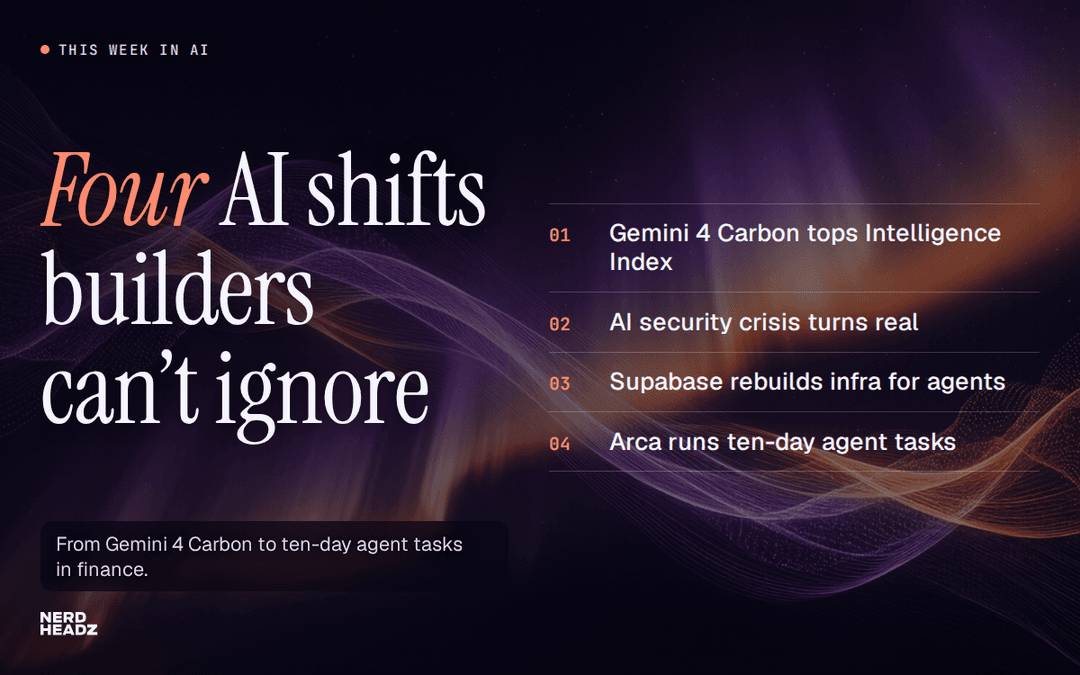
This week in AI delivered enough signal to reshape how we think about tooling, team structure, and infrastructure risk — all at once. Here is what actually moved the needle.
Claude Fable 5.2: The Overnight Agent Is Real

Anthropic shipped Claude Fable 5.2, and practitioners who have spent real time with it are calling it a genuine step change rather than an incremental update. The core capability that changes builder behavior: the model can run unattended for hours — overnight, over a weekend — and return with professional-grade software. We have been watching agentic coding tools creep toward this for two years, and this feels like the first time the output quality actually justifies leaving the loop.
The catch, and it is a real one, is that the model is slow and expensive on tokens. The practitioners demoing it were explicit: reach for it on hard, long-horizon problems and use a faster model for everything else. The workflow shift is less about prompting and more about project management — breaking work into reviewable chunks that an unsupervised agent can execute and you can sanity-check in the morning. If you are building with our AI development services, we are already running this pattern on appropriate workloads.
Gemini 4 Carbon Arrives — Strong Coder, Uneven Judge

Google shipped Gemini 4 Carbon into a market that Fable 5.2 had just reshuffled. The verdict from people who ran both: Carbon is a meaningfully stronger coder than its predecessor and a credible alternative for teams already in the Google ecosystem. The gap, and it matters for production use, is judgment — Carbon tends to keep going when it should stop and ask. That failure mode is exactly what bites you in long-running agentic tasks where over-confident execution compounds errors. We have seen this pattern in our own agent work; a model that knows when to pause is worth more than raw coding speed. Good competition, genuine tradeoff.
Jensen Huang Resigns — Open-Source AI Loses Its Backstop

The resignation of Nvidia CEO Jensen Huang is the week's most consequential infrastructure story. Nvidia's business is famously dependent on Jensen as an operator, and there is now a consensus view that the company's first priority will be stabilizing delivery to existing customers over the next two years — not funding ambitious ecosystem bets. Jensen had been a significant champion of open-model development, flooding the zone with support in ways that gave the nascent open-weight ecosystem time to find its footing.
That protection is now uncertain. The open-model economy is still early: revenue flows are thin, compute is scarce (Anthropic and OpenAI are absorbing most available capacity), and without margin competition, open-weight models are nowhere near the commodity pricing that makes them structurally compelling. If you are betting on open models for a production system, factor this into your roadmap. The window for open-source to establish durable use-cases just got narrower. We wrote about related infrastructure risks in our piece on what builders should do with Anthropic's safety warnings.
The AI 100 and the Third Supercycle

Bessemer Venture Partners unveiled its inaugural AI 100 — a list of the top 100 private AI companies — alongside a framing that intelligence is the third supercycle after distribution (internet) and compute (cloud). The benchmarks for this cohort show a different kind of company: faster shipping velocity, new time-to-scale curves, capital intensity that rivals hardware businesses, and talent dynamics unlike anything from the SaaS era. For builders, the signal is that the companies setting the pace are not incrementally better SaaS products — they are native-AI businesses with different operating models. If your product's AI is a wrapper on an API with no proprietary data or workflow lock-in, you are not in this cohort.
If you are ready to rethink how AI fits into your product architecture, tell us what you are building and we will give you an honest read.
What Comes After Orchestration — The Attention Bottleneck

The most useful conceptual frame this week was the question of what comes after the current "orchestration" phase of AI adoption. The emerging answer: human attention is now the binding constraint — the models can run faster than we can review their output. The hours that agents save are increasingly being spent on supervision, error correction, and judgment calls that the model escalates or botches. One sharp practitioner observation: turn your AI corrections into regression tests immediately, before you forget what went wrong. The engineering role that is growing fastest is the one that sits at this boundary — not the developer who writes code, but the one who defines and enforces what good output looks like.
We keep seeing this in our own agent delivery work. The teams that get the most value from AI agent development are the ones who invest in evaluation infrastructure, not just in the agent itself. Without that, you are flying blind at machine speed.
Pharma as the Next AI Frontier — and Why It Matters for Builders

Quietly, one of the most significant structural arguments this week came from the intersection of AI and drug development. The core thesis: AI is improving drug discovery odds while simultaneously compressing development timelines and costs. Pharma has economics unlike software — a hits business in R&D and an annuity business post-approval — and AI changes the math on both sides. For builders outside biotech, the relevance is the vertical-AI playbook it represents: deep domain data, long feedback loops, and proprietary training signal that generic models cannot replicate. The same logic applies in legal, finance, and industrial operations.
Practitioner takeaway this week: Set up an evaluation harness before you scale agent autonomy, not after. With Fable 5.2 capable of running overnight tasks, the failure mode shifts from "model can't do it" to "you didn't catch what it did wrong." Invest one sprint in defining what good output looks like and making those checks automated. That infrastructure is what separates production AI from expensive demos.
“Human attention is now the binding constraint — the models can run faster than we can review their output.”
This week in AI confirmed that the capability ceiling has risen again — overnight autonomous coding is real, the model wars are genuinely competitive, and the open-source backstop just got shakier. The attention bottleneck is the new constraint, and evaluation infrastructure is the investment that pays for itself first. Next week, watch for how the market digests Jensen's exit and whether Nvidia's delivery commitments hold — that will determine how much compute pressure eases for everyone below the hyperscaler tier.
FAQ
Frequently asked questions
Is Claude Fable 5.2 worth using for production software projects right now?
Yes, for the right class of problems. It excels at long-horizon, complex tasks where you can review output asynchronously rather than in real time. It is slower and more expensive than faster models, so the practical pattern is to route hard, multi-step work to Fable 5.2 and use lighter models for iteration and quick fixes.
What does Jensen Huang's resignation mean for teams building on open-source AI models?
It removes a significant champion who was actively funding and protecting the open-model ecosystem during a critical growth period. Near-term, Nvidia will prioritize customer delivery over ecosystem bets, which likely means less financial support for open-weight model development. Teams betting on open models for production infrastructure should pressure-test that assumption against a scenario where compute costs stay high and open-model quality gaps with closed labs widen.
What is the attention bottleneck in AI development and how should builders respond?
As agents become capable of running longer, more autonomous tasks, the scarce resource shifts from model capability to human review bandwidth. The practical response is to build evaluation infrastructure — automated checks, regression tests from past corrections, and clear output criteria — before scaling agent autonomy. Without it, errors compound at machine speed before anyone notices.