The Ocean Floor Is No Longer Safe Enough for the Internet
The global internet runs on glass buried under thousands of miles of seawater. That has been true for thirty years, and until recently, it was a reasonable arrangement. But the threat environment has changed, and the engineering alternatives have finally matured enough to matter.
Space-based optical networks — systems that relay data between continents via laser beams and satellites in medium Earth orbit — are crossing from research curiosity to viable commercial infrastructure. A16z recently profiled Endeavor Optical Networks (EON), a startup making exactly this bet, and the underlying argument is hard to dismiss.
Why Subsea Cables Are a Single Point of Failure

Approximately 95% of intercontinental internet traffic moves over roughly 500 active subsea cable systems. Each one takes close to a decade to plan, permit, and lay — touching the exclusive economic zones of multiple sovereign nations, requiring a shrinking fleet of specialized ships, and depending on a handful of manufacturers capable of building optical repeaters at depth.
That supply chain is running at capacity. It cannot be meaningfully accelerated with capital alone. Environmental permits and landing rights don't compress because a hyperscaler writes a larger check.
The fragility is structural, and adversaries have noticed. In early 2024, cables in the Red Sea were severed during active conflict, rerouting roughly a quarter of traffic between Europe, Asia, and East Africa overnight. Similar incidents have occurred near Taiwan repeatedly, with no confident public attribution each time. Russian naval operations have spent years surveying Atlantic and Baltic cable routes. In early 2025, Chinese researchers published a design for a device capable of cutting the most heavily armored cables in existence.
The infrastructure the world runs on is fragile — and that fragility is no longer theoretical.
When a cable is cut — whether by accident, fishing trawlers, or deliberate action — repair takes weeks to months. There are no hot spares. Entire regions can go dark with no alternative path, and this is quietly accepted as the cost of doing business in global connectivity.
Working on something similar? Talk to our team about your project.
What Space-Based Optical Networks Actually Do

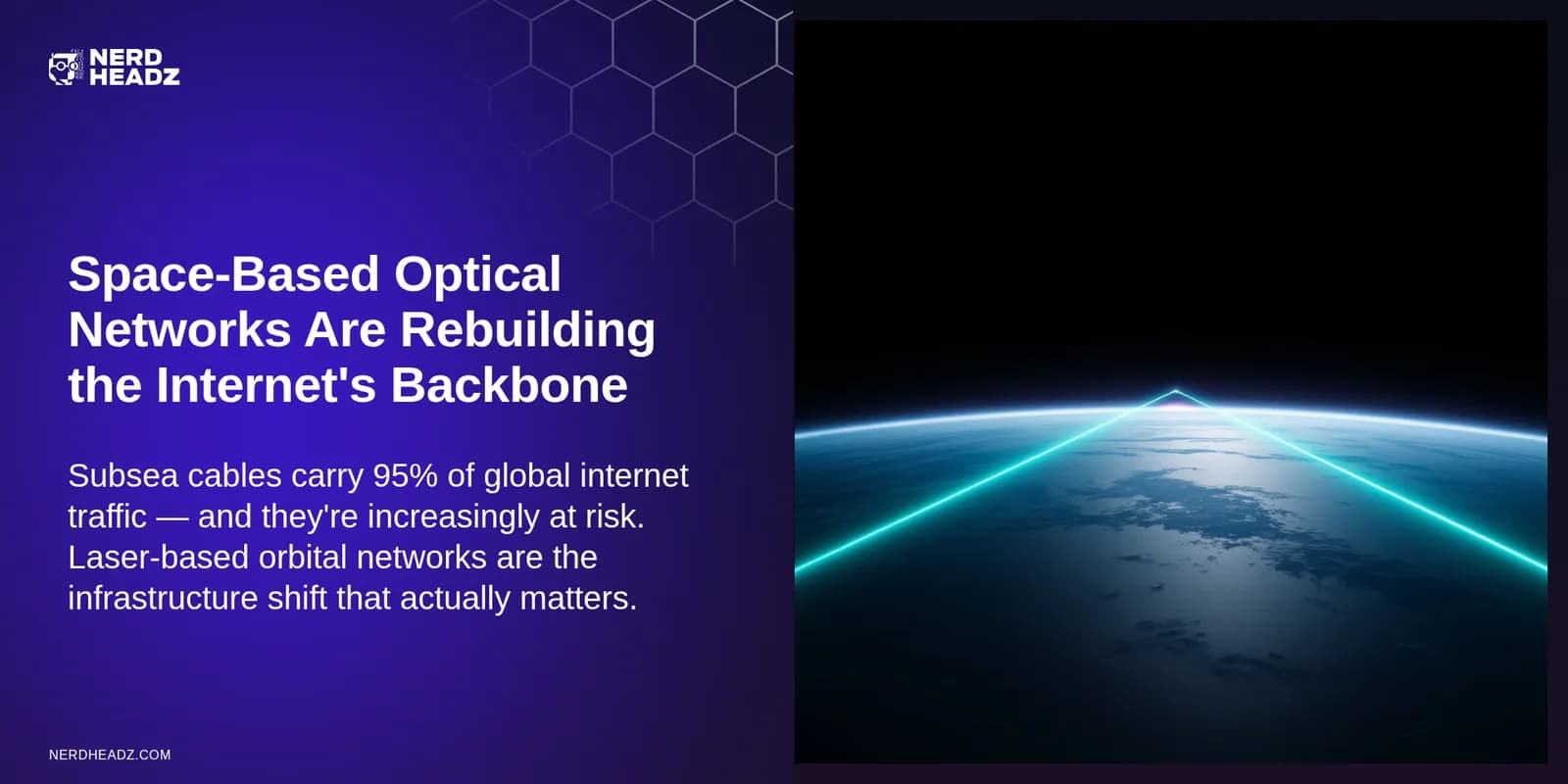
The core idea behind systems like EON is straightforward: replace the ocean-floor path with an orbital one. A ground station points a high-powered laser at a satellite in medium Earth orbit. The satellite catches the signal and fires it back down to a receiver on the other side of the ocean. Two endpoints, one hop, nothing on the seabed.
This architecture delivers several properties that subsea simply cannot match. Capacity can come online in months rather than years. Ground stations connect to existing terrestrial fiber — no specialized ships required. Routes are not fixed by physical cable paths, which means a provider can serve anywhere with a clear view of the sky and adapt routing dynamically.
The "bent-pipe" relay model EON describes is capable of delivering multiple terabits per second across ocean-scale distances. That's fiber-class throughput without fiber-class infrastructure constraints.
For developers and product teams building latency-sensitive applications across continents — including the kind of RAG and LLM infrastructure that requires fast, reliable data movement between distributed compute regions — this shift matters directly. The underlying transport layer shapes what's possible at every layer above it.
Why This Wasn't Viable Before

Space hardware costs have dropped by roughly an order of magnitude over the past decade. More importantly, the space industry has developed real standards, reusable supply chains, and commercially proven components. A decade ago, a satellite system for this application would have required bespoke engineering at every level. Today, off-the-shelf components close the economics in ways that simply weren't possible before.
This mirrors a pattern we've seen repeatedly in technology: the moment commodity infrastructure catches up to a previously exotic use case, the business model becomes viable and the incumbents' moat shrinks fast. The shift from custom servers to cloud compute, from proprietary ML frameworks to open-source model ecosystems — each was enabled by hardware and tooling reaching a cost floor that unlocked competition.
Subsea cable dominance isn't maintained by technological superiority. It's maintained by the absence of a credible alternative. That's the kind of moat that collapses quickly once a real option appears.
This dynamic is worth understanding for anyone building AI infrastructure. We explored a similar pattern in how continual learning in LLMs requires rethinking the offline training pipeline — the underlying infrastructure assumptions shape what's architecturally possible at every layer.
The Demand Side Isn't Waiting

AI training runs move petabytes between continents. A single hyperscaler now moves more data across its own network in a day than the entire internet carried in 2010. Every new model deployment, every new cloud region, every new enterprise workload that crosses an ocean adds pressure to a system that cannot expand proportionally.
The largest companies can fund their own cable builds and still can't commission them fast enough. Every other company competes for whatever capacity remains on routes that someone else decided to build years ago.
Space-based optical networks don't just offer resilience — they offer a path to capacity that doesn't depend on a 60-ship global fleet and decade-long permitting cycles. That's a fundamentally different scaling curve, and it arrives at the right moment.
For teams building the kind of distributed AI infrastructure that increasingly spans regions and continents, understanding what the Claude Fable 5 safety architecture means for builders is one layer of the stack — but the transport layer underneath is where physical constraints become application constraints.
Ready to build? NerdHeadz ships production AI in weeks, not months. Get a free estimate.
The global internet's dependence on ocean-floor infrastructure is a risk that capital alone cannot fix — the supply chain is capped and the attack surface is documented. Space-based optical networks represent the first credible alternative architecture, arriving precisely as AI-driven data demand outpaces everything the seabed can carry. For builders and enterprises thinking about resilient, globally distributed systems, the infrastructure layer is about to change in ways that ripple upward through every application.
“The infrastructure the world runs on is fragile — and that fragility is no longer theoretical.”