The Database Decision That Shapes Every AI Feature You Ship
The fastest way to slow down an AI product isn't a bad model — it's a data architecture that fights you at every turn. We've seen this pattern repeatedly when building AI-powered applications for clients: teams spend more engineering hours wrestling with synchronization logic than building the features that actually matter.
The core tension lives in a single question: should your AI application store vector embeddings and operational data in one database, or split them across specialized systems? MongoDB's engineering team has written about the strategic considerations at length, and it tracks closely with what we encounter in production. The architectural choice you make today has direct consequences on consistency, developer velocity, and total cost of ownership.
What Makes Database Architecture for AI Different

AI applications don't just run CRUD queries. They generate and search high-dimensional vector representations of unstructured content — text, images, audio — to find semantically similar items. At the same time, they still need fast transactional operations: user profile lookups, metadata filtering, access control checks.
This dual workload is what makes database architecture for AI a genuinely different problem from traditional application design. You're not choosing a database once and forgetting about it. You're choosing the operational model your entire retrieval pipeline depends on.
If you've explored hybrid search RAG combining vector and relational databases, you already know how quickly query complexity compounds when two systems need to cooperate on a single response.
Working on something similar? Talk to our team about your project.
Split Architecture: The Hidden Cost of Specialization

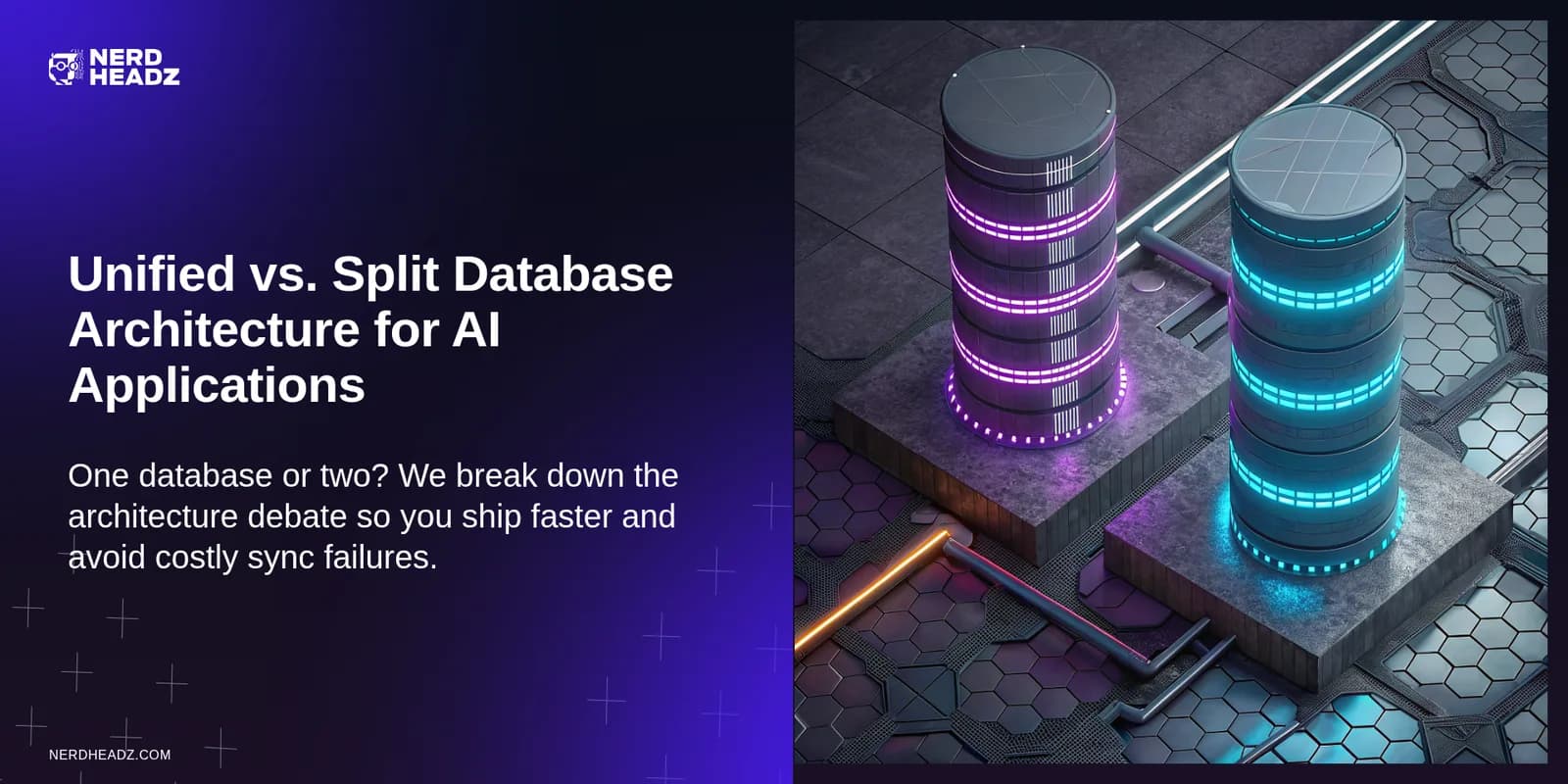
The split approach pairs a general-purpose operational database with a dedicated vector store — for example, MongoDB or PostgreSQL alongside Pinecone or Elasticsearch. In theory, each system does what it's best at. In practice, you've just hired two employees to do a job that requires constant communication between them, with no shared memory.
Every write operation now has two destinations. Every query requires two round trips. And every failure — network timeout, partial write, process crash — opens a gap between what your operational database knows and what your vector index believes.
The Ghost Document Problem
The most insidious failure mode in split architectures is the ghost document. A document gets deleted from your primary database, but the corresponding vector deletion in your search index fails silently. The next time a user runs a semantic search, the vector index confidently returns that document's ID as highly relevant. Your application tries to fetch it — and finds nothing.
From the user's perspective, they get a broken result. From a security perspective, if the document was made private rather than deleted, its metadata or preview content may still surface through the vector store. This isn't a bug you fix once — it's a symptom of a structural decision you made at the start.
Resolving ghost documents at scale requires background reconciliation jobs, outbox patterns, custom monitoring systems, and manual intervention workflows. That's engineering capacity that should be building features.
Unified Architecture: One Source of Truth for AI Workloads

A unified architecture stores vector embeddings directly alongside their source documents in the same database. Operations that modify a document and its embedding happen atomically — either both succeed or neither does. There is no synchronization gap because there is no synchronization step.
This isn't a theoretical advantage. It changes the daily experience of every engineer on the team. Creating a document is one write. Updating content is one atomic transaction. Deleting a record automatically removes its associated vector. The entire category of sync-related bugs simply doesn't exist.
Modern platforms like MongoDB Atlas implement this with integrated vector search built on HNSW indexing, support for hybrid search combining semantic and keyword queries, and automatic vector quantization — all within a single query interface. Dedicated search nodes handle vector workloads without competing with transactional operations, addressing the performance argument that historically pushed teams toward split approaches.
Developer Velocity Is the Real Differentiator
When we build RAG and LLM-powered applications for clients, one of the most consistent productivity drains we eliminate is the integration layer. Split architectures require teams to write and maintain glue code: dual-write logic, retry handlers, consistency monitors, and rollback procedures. None of that code ships a feature.
Unified architectures let developers work in a single query language, reason about a single data model, and trust that search results reflect the actual current state of the database. For teams shipping AI features on aggressive timelines, that trust is worth more than marginal search throughput gains from a specialized engine.
When Each Approach Makes Sense

Unified architecture is the right default for most teams building new AI products. If you're starting from scratch, modernizing an existing application, or prioritizing consistency and time-to-market, consolidate your stack.
Split architecture earns its complexity in narrow circumstances: you're operating at extreme vector scale (billions of entries), you have deeply tuned infrastructure already built around a specialized engine that's genuinely meeting your needs, or regulatory requirements mandate physical data separation. Even then, you should design your synchronization processes with care — change streams, event buses, and reconciliation jobs are table stakes, not optional extras.
The performance gap between unified and split has narrowed substantially. Dedicated search nodes, quantization, and optimized HNSW implementations inside unified platforms now match or exceed what many teams achieved by running separate engines. The infrastructure cost and operational complexity of split systems rarely pays off at the scales most applications operate at.
For AI products built on top of structured data — think conversational interfaces over business data, as we explored in our Datasette Agent walkthrough — unified architecture removes an entire class of failure modes before you write your first query.
The Infrastructure Decision Is Also a Team Decision

Consolidating onto a unified database platform isn't just an architectural choice — it's an organizational one. Teams that already operate a primary database gain vector capabilities as an incremental extension of existing knowledge. There's no new security model to learn, no separate provisioning workflow, no second system to monitor when an alert fires at 2 a.m.
For technical leaders managing both innovation speed and operational risk, that reduction in cognitive overhead compounds over time. Every new AI capability your platform adds lives in the same system, accessible without redesigning your integration layer.
Ready to build? NerdHeadz ships production AI in weeks, not months. Get a free estimate.
The unified vs. split database architecture debate for AI ultimately comes down to how much complexity you're willing to carry in exchange for specialization you may not need. For the vast majority of AI applications, a unified architecture delivers better consistency, faster development cycles, and lower operational overhead — without sacrificing the performance that modern vector search requires. Make the architectural call early, because the synchronization debt from a split system compounds exactly as fast as your data does.
“Ghost documents aren't a bug you fix once — they're a symptom of a structural decision you made at the start.”